🎧 Listen to this story
Narrated by Kore · 7,628 characters
There is a chair in Dr. Miriam Alvarez’s office that nobody sits in during the first fifty minutes of a session. It is a worn, slightly faded armchair angled toward the west-facing window, and it has become, in her words, “the most important piece of furniture in the room.”
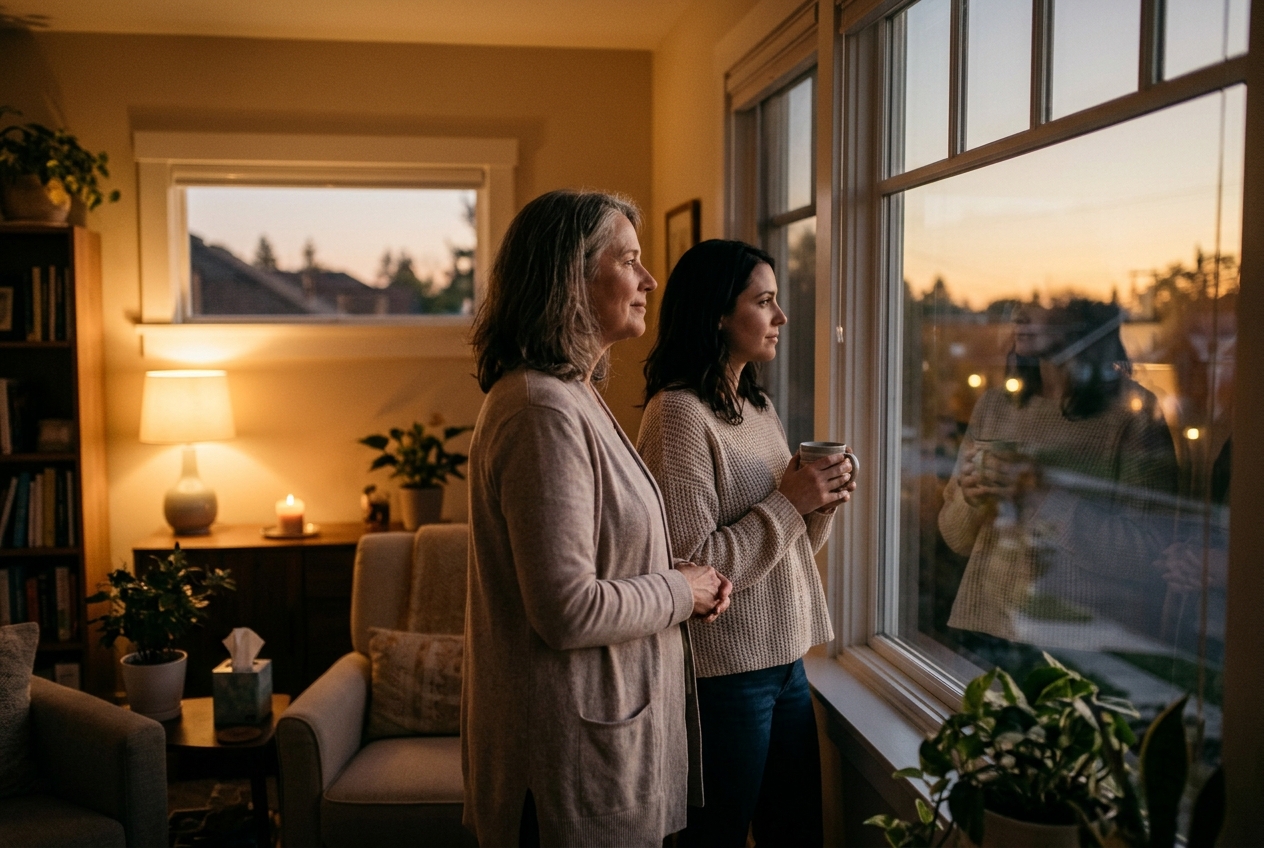
Dr. Alvarez is a licensed clinical psychologist who has practiced for nineteen years. For the last six, she has ended her late-afternoon and early-evening appointments the same way: she stops talking, stands up, opens the blinds, and invites her patient to watch the sun go down with her. No agenda. No homework. Just the light changing on the glass.
I spoke with her on a quiet Tuesday evening, naturally, as the sky was beginning to soften. What follows is part conversation, part reflection, and part invitation to try something similar in your own life.
How It Started by Accident
Miriam did not design this ritual. It happened by mistake, during a session with a man she describes only as “a retired machinist who had not cried in thirty years.”
“He had just told me something he had never told anyone,” she explained. “The session was technically over. I had that sinking feeling therapists get, where you know the hour is up but the person in front of you is wide open and raw. Sending someone out the door in that state felt wrong.”
So she did something unplanned. She said, “Let’s just sit a minute.” The sun happened to be sliding low behind the rooftops across the street, throwing amber across the carpet. Neither of them spoke. After about ten minutes, he exhaled, thanked her, and walked out looking, as she put it, “like a man who had set down a suitcase.”
The following week he asked if they could do that part again.
The Science Behind the Stillness
Dr. Alvarez is careful to say that she does not think of the sunset as magic. She thinks of it as a gentle, reliable container for something therapy often struggles to provide: a soft landing.
Here is what she and many of her colleagues understand about why transitions matter:
- Emotional work is physiological work. When we discuss painful memories, our bodies react. Heart rate rises, muscles tighten, breathing shallows. A quiet wind-down gives the nervous system time to settle before re-entering traffic, text messages, and obligations.
- Natural light cues rest. The dimming of daylight signals the body to begin shifting toward calm. Watching it happen, rather than just living through it indoors under bright bulbs, can reinforce that shift.
- Shared silence builds trust. Sitting beside someone without needing to perform or explain can feel profoundly safe, especially for people who have spent years bracing for judgment.
- Gazing outward relieves the inward spiral. Looking at something vast and slow-moving gives an anxious mind somewhere else to rest.
“I am not claiming a sunset heals trauma,” she said, smiling. “Hard, patient work does that. But the sunset helps people carry what they have unpacked back out into the world without feeling shattered.”
What the Ritual Looks Like
If you imagine something elaborate, picture instead something almost embarrassingly simple.
The Structure of the Final Ten Minutes
- The pause. Around the fifty-minute mark, Miriam gently stops the conversation. “We have done enough talking for today,” she says.
- The window. She lifts the blinds. Her patients are welcome to stay seated or move to the armchair.
- The quiet. They watch. Sometimes she offers a single prompt, like “Notice what color the sky is right now,” but often she says nothing.
- The release. When the light fades, so does the session. No summary. No wrap-up. Just a nod, and often a long breath.
During winter months, when the sun sets as early as 4:30, the ritual comes mid-afternoon. In summer, some patients schedule later appointments specifically to catch it. One woman, Miriam told me, once booked her sessions for the final slot of the day for an entire year “just for the last ten minutes.”
Stories From the Armchair
With permission, and with identifying details changed, Miriam shared a few moments that have stayed with her.
The Young Mother
A new mother struggling with postpartum anxiety told Miriam she had not looked at the sky in months. “Everything in my life is a screen or a nursery wall,” she said. During one sunset, she began quietly crying, not from sadness but from relief at remembering that the world was bigger than her fear. She later said it was the first time in weeks she felt like a person and not just a function.
The Teenager Who Would Not Speak
A sixteen-year-old boy sat through three entire sessions in near silence. Miriam never pushed. During a sunset at the end of the third, he said, almost to himself, “My dad used to take me fishing at this time of day.” It was the first thing he had volunteered. That sentence opened a door that stayed open for the next two years.
The Widower
An elderly man who had lost his wife of fifty-one years told Miriam that evenings were the hardest part of his life. The empty chair across from his at dinner. The quiet that arrived with dusk. “Watching the sunset here,” he said, “is the first time dusk hasn’t felt like a punishment.” He began taking walks at that hour afterward, reclaiming a time of day that had once felt like an enemy.
Why Evenings Hold So Much Weight
There is something about the hour when day turns to night that makes people honest. The performing is over. The inbox has stopped demanding. The mind, finally unoccupied, begins to surface whatever it has been holding back.
Many of us have felt it: the lump in the throat while washing dishes after dark, the sudden memory that arrives as we lie in bed, the sense that the quiet is asking us a question. Dusk is a threshold. It invites reflection whether we want it or not.
Miriam believes this is exactly why the sunset works so well in therapy. “Evening is when people are most likely to feel what they have been avoiding,” she told me. “So I figured, why not meet that feeling in a safe room, with a witness, and with something beautiful happening outside?”
Bringing a Little of This Into Your Own Evenings
You do not need a therapist’s office to borrow this idea. Here are a few gentle ways to create your own soft landing at the end of a heavy day:
- Choose a window. Pick one spot in your home with a view of the sky, even a small one.
- Silence the screens. Put your phone in another room for ten minutes.
- Let your breath slow. You do not have to meditate formally. Just notice the in and out.
- Name one thing. Quietly acknowledge something the day asked of you, or something you are carrying.
- Stay until the color fades. The urge to get up and do something is strong. Resist it for a little while.
If you share your home with others, consider inviting them to join you. Some of the sweetest family traditions begin with nothing more than people sitting together while the sky changes.
What Stays With Her
When I asked Miriam what the ritual has taught her after six years, she was quiet for a moment, watching the light slide down her own wall.
“I used to believe my job was to help people say the right words,” she said. “Now I think part of my job is to help them be still enough to hear themselves. The sunset does half the work. All I have to do is open the blinds.”
As our conversation ended, the room had gone golden and then rose and then a deep, gentle blue. We did not talk about it. We just sat there, two people watching a day let go.
Tonight, wherever you are, perhaps you can find your own window. The sky will do what it always does. And you, however tired, however tangled, are allowed to simply sit and watch it go.