🎧 Listen to this story
Narrated by Kore · 6,381 characters
Marguerite Okafor-Lindqvist does not remember much about her first week in the burn unit. She remembers the smell of antiseptic, the soft beeping that never quite stopped, and the particular sound of a nurse’s shoes in the hallway at three in the morning. But she remembers, with perfect clarity, the first evening the sky came back to her.
She was thirty-four years old. A kitchen fire, the kind that happens in the space of a single breath, had left her with burns across her arms, shoulders, and the left side of her neck. The days that followed were a blur of surgeries, dressing changes, and pain that arrived in waves she could not predict. Then, on the eleventh day, something small shifted.
The Window She Almost Didn’t Notice
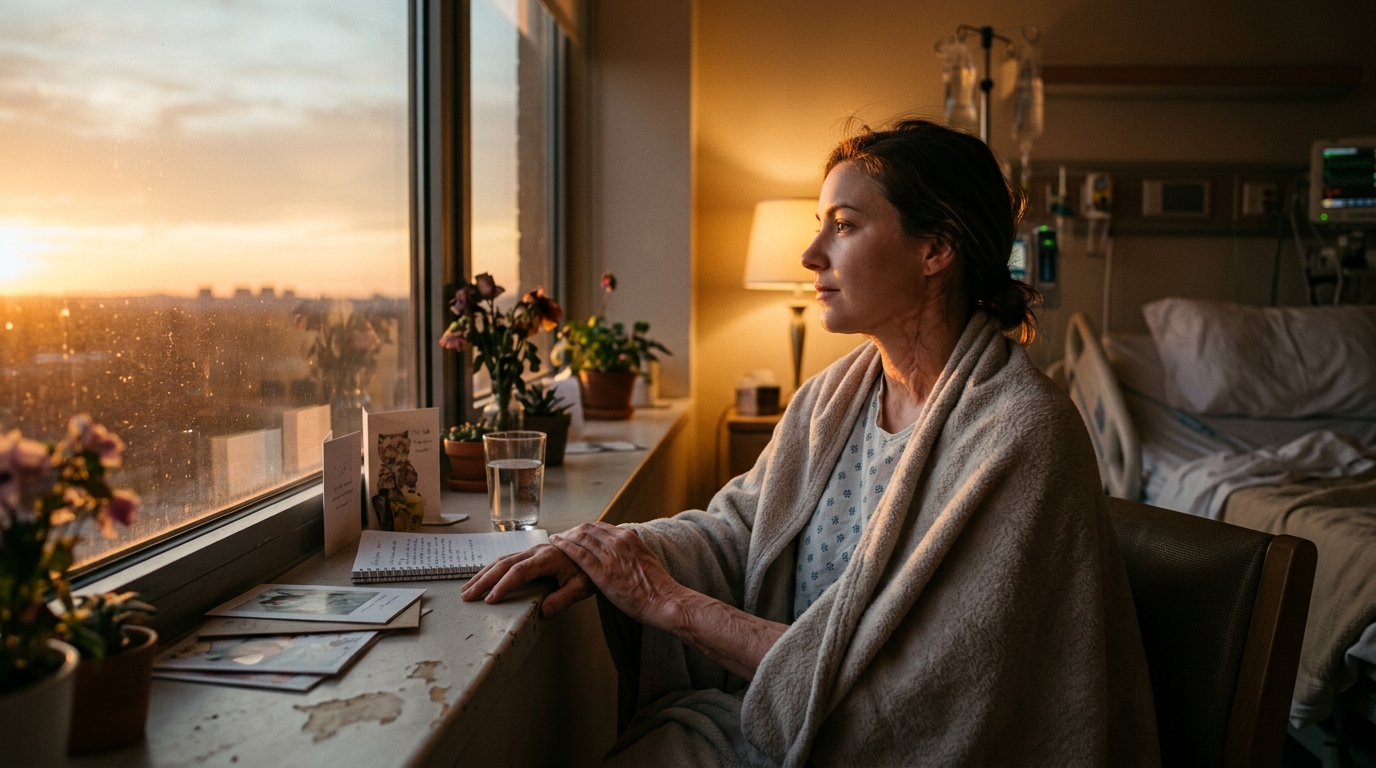
Her bed had been moved. It was a routine reshuffling of the ward, nothing anyone thought twice about. But when Marguerite opened her eyes that evening, the corner of her room had changed. A tall window now sat to her right, and through it she could see a strip of open sky above a row of rooftops and one stubborn maple tree.
It was nearly six o’clock. The light in the room had gone amber, then rose, then something closer to the inside of a seashell. She lay very still, afraid that moving would break it.
“I had been so focused on my body,” she told me when we spoke by phone, her voice warm and unhurried. “Every hour was about what hurt, what was healing, what came next. And then there was this color I had no word for. It had nothing to do with me. It didn’t need anything from me. I just got to watch.”
A Ritual Is Born
The next evening, she asked the nurse on shift to raise her bed a little before dusk. The evening after that, she asked again without being embarrassed about it. By the end of the first week, the nurses had started to anticipate her. Someone would quietly adjust the blinds, dim the overhead light, and leave her to the window.
Marguerite began to think of it as an appointment. The whole day was something to get through, but the sunset was something to look forward to. For the first time since the fire, she had a reason to want the day to move forward.
Over the weeks, she noticed things she would have missed in her old life:
- How the sky was never the same color twice, even on days that looked identical.
- How the maple tree turned from green to a flaming orange as autumn crept in, a fire she could finally look at without fear.
- How the birds gathered on the rooftops in the last half hour of light, as though they, too, were winding down together.
- How the pain seemed to soften at the edges when she gave her whole attention to something else.
What the Quiet Taught Her
There is a hush that settles over a hospital ward in the early evening. Visitors drift home. The clatter of carts fades. The day’s urgency loosens its grip, and a different kind of time begins. Marguerite came to treasure it.
“The mornings were loud,” she said. “Doctors, tests, decisions. But the evenings were mine. That’s when the fear would usually come, so I decided to meet it with something else. I’d watch the light go, and somehow the fear would go with it, at least for a while.”
She began to understand something she had never grasped in the rush of her working life: that rest is not the absence of progress. Healing happens in the pauses. The body mends while the mind is quiet, and the mind quiets when it has something gentle to hold.
The Nurse Who Noticed
One of the night nurses, a soft-spoken man named Desmond, started lingering a moment longer by her bedside each evening. He never said much. Sometimes he would simply stand beside her and watch the sky with her for a minute before returning to his rounds.
“He told me once that he’d worked on that ward for nineteen years and had never really looked out that window,” Marguerite remembered. “He said I’d given him back something he’d forgotten to notice.”
It was a small exchange, but it spoke to something larger. Healing, she realized, is rarely a solitary act. Her quiet ritual had rippled outward, touching the people who cared for her.
Forty-One Sunsets
Marguerite spent forty-one days in the hospital. She counted them afterward, not by the surgeries or the dressing changes, but by the evenings. Forty-one sunsets, forty-one small reasons to keep going.
On her last night, she asked for her bed to be raised one more time. The sky was a deep, bruised violet that faded into a thin line of gold at the horizon. She cried, but not from sadness. “It felt like saying goodbye to a friend,” she said. “A friend who had sat with me through the worst of it and never asked me to be anything other than exactly where I was.”
Carrying the Evening Forward
Today, Marguerite’s scars are a part of her story rather than the whole of it. She still lives with the physical reminders, and some days are harder than others. But she has kept the ritual. Every evening, no matter the weather, she finds a window, a porch step, or a patch of open sky and gives herself ten minutes to simply watch the light change.
She has also started volunteering with a support group for burn survivors, and she shares her practice with anyone who wants to try it. She does not promise it will fix anything. She only offers it as an invitation.
A Gentle Practice You Can Try Tonight
If you are carrying something heavy, whether it is pain, worry, or just the weight of an exhausting day, here is the practice Marguerite suggests:
- Choose a spot with a view of the sky, even a small one.
- Set aside ten minutes just before sunset, with no phone and no agenda.
- Watch the colors shift without trying to name or fix anything.
- Let your breathing slow to match the fading light.
- When the last glow is gone, thank the day for what it gave you, even if it was very little.
The Lesson of the Dimming Light
As the conversation wound down, I asked Marguerite what she would say to someone in the middle of their own hard season. She was quiet for a moment, and I could almost hear the evening settling around her.
“The sun sets every single day, and it doesn’t ask whether you deserve it,” she said. “It’s just there. Beauty keeps showing up, even in the places we least expect it. You just have to be still enough to receive it.”
Tonight, as the light fades where you are, perhaps take a moment to look up. There may be a color waiting for you that has no name yet, offered freely, asking nothing in return.