🎧 Listen to this story
Narrated by Kore · 7,966 characters
There is a particular hour at Willow Bend House when the whole building seems to exhale. The medication rounds are finished. The visitors’ parking lot has thinned to a handful of cars. The kitchen smells faintly of toast and chamomile. And down the long hallway, someone is quietly rolling a hospital bed toward a wall of windows.
This is the hour the staff calls the Turning Light. It is the heart of a practice that began almost by accident, and it has since become the thing families remember most.
How It Started: A Single Request
Nine years ago, a retired schoolteacher named Marguerite, who was in her final week of life, asked a simple question of her night nurse. She did not ask for more pain relief or for a different room. She asked, “Could someone sit with me while the sun goes down? I have watched it every day for eighty-one years, and I would like to see it once more.”
The nurse, a soft-spoken woman named Daniela, pulled a chair to the window and stayed. Marguerite did not say much. She held Daniela’s hand and watched the sky turn from gold to rose to a deep, settling blue. When it was dark, she smiled and said, “Well. That was lovely.” She died peacefully two nights later.
Daniela told the other staff about it the next morning, a little embarrassed, as if she had broken a rule. Instead, her colleagues said the same thing: why don’t we do that for everyone?
What the Turning Light Looks Like Now
Today, every patient at Willow Bend is offered an evening at the window. It is never forced, and it is never rushed. It simply waits, like an open door, for whenever a patient feels ready.
The house was designed with this in mind. A long west-facing room, called the Sky Room by everyone, has floor-to-ceiling glass, a bank of soft chairs, and wheels built into every bed so that no one is ever moved against their will or without a blanket. Outside, a sloping meadow runs down to a line of maples, and beyond them the horizon is wide open.
As the light begins to change, the evening ritual unfolds:
- The lamps go low. Overhead lights are switched off, and only a few warm lamps stay lit, so the glow from the sky does the work.
- Someone is invited to sit close. A family member, a friend, or when no one is available, a trained volunteer who has been told only to listen and to stay.
- A warm drink appears. Tea, cocoa, broth, or a small glass of whatever the patient has always loved.
- The talking is optional. Some people tell stories. Others say nothing at all. Both are treated as complete.
The Evening That Stays With Them
A volunteer named Teodor, a former bus driver who joined after losing his wife, remembers one evening in particular. A man in his seventies, a lifelong fisherman, had been quiet all week. His daughter had flown in from across the country, and the two of them had struggled to find words that felt big enough for the moment.
They sat at the window as the sky turned the color of ripe peaches. For a long time, nothing was said. Then the old man pointed a trembling finger at a thin band of cloud and said, “Red sky at night.” His daughter laughed, then cried, then laughed again. “Sailor’s delight,” she answered, the way he had taught her as a child.
That was the whole conversation. But Teodor says the room felt full of everything they had never managed to say. “Sometimes love does not need new sentences,” he told me. “It just needs a window and a little time.”
Why the Sky Matters at the End of a Life
It may seem like a small thing, to watch the sky. But the people who work at Willow Bend have come to believe that evening carries a special kind of mercy.
The day’s demands fall away. There are no appointments left, no tasks undone, no one waiting for an answer. The sky does its slow, ancient work without asking anything of anyone. For a person who has spent weeks surrounded by monitors and schedules, that stillness can feel like being handed back to themselves.
The medical director, a gentle physician who asked that her name not be used, explained it this way: “We spend so much energy at the end of life trying to fix, to treat, to manage. The sky asks nothing. It simply reminds a person that they are still part of a larger, beautiful world. That reminder is not a small medicine.”
What Families Say Afterward
The staff keeps a small notebook by the Sky Room door where families are invited to write a line or two. Over the years it has filled several volumes. A few entries, shared with permission:
- “We spent the best hour of that whole terrible month right here. Thank you for the sky.”
- “Mom did not say goodbye in words. She said it by squeezing my hand when the first star came out.”
- “I will never watch a sunset again without feeling her next to me.”
For Those Who Have No One
Not every patient arrives with a family at the bedside. Some have outlived their friends. Some are estranged. Some simply have no one left who can make the trip.
For them, Willow Bend keeps a quiet roster of volunteers who have trained in what the staff calls “companion presence.” These are not counselors or clergy. They are ordinary people, retirees, nurses on their days off, a college student, a mail carrier, who have chosen to give an hour of their evening to someone who might otherwise sit alone.
The training is brief and surprisingly simple. Volunteers learn to sit without fixing, to ask gentle questions only if invited, to hold a hand without squeezing too tight, and to be comfortable with silence. Above all, they learn that they are not there to say the right thing. They are there to be a living, breathing sign that this person matters.
One volunteer, a woman in her sixties, described sitting with a patient who had no visitors in his final days. “He told me he used to be a baker,” she said. “He described the smell of bread at four in the morning. By the time the sky went dark, I swear I could smell it too. When he passed, I wasn’t there, but I had been there for the evening that mattered. That is enough for me.”
What We Can Carry Into Our Own Evenings
You do not need to be in a hospice to learn from Willow Bend. The lesson is gentler and more universal than that. Most of us rush through the end of the day, eyes on screens, minds on tomorrow’s list. We miss the quiet hour when the light changes and the world softens.
Here are a few small ways to borrow the Turning Light for your own life:
- Step outside, even for five minutes. Let the day’s last light fall on your face before you reach for your phone.
- Invite someone to sit with you. A partner, a child, a friend, a neighbor. You do not have to talk.
- Call someone you love at dusk. There is something tender about reaching out when the world is going quiet.
- Let silence be enough. Not every moment needs filling. Sometimes presence is the whole gift.
- Remember that every evening is a small ending. Treat it with a little reverence, and the mornings will feel brighter for it.
The Light Left On
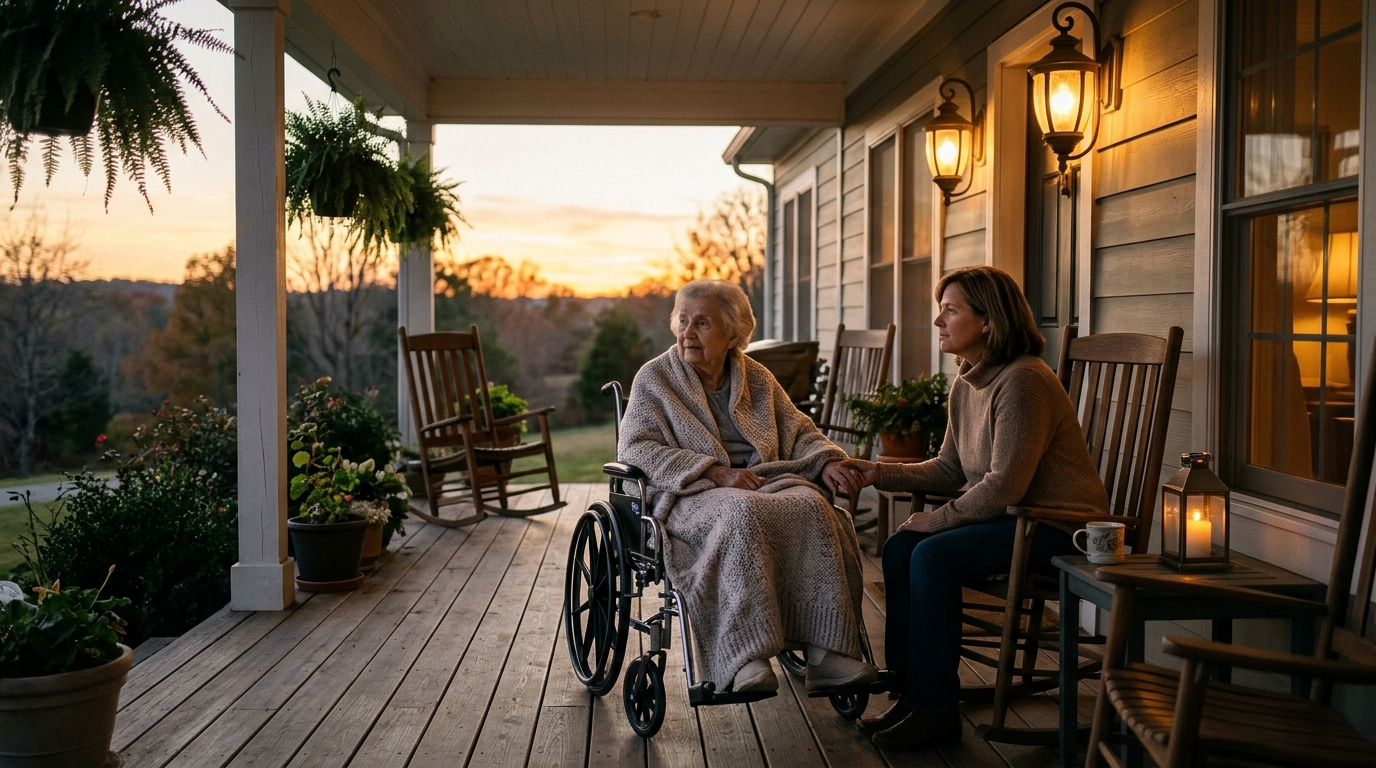
When night finally settles over Willow Bend, the Sky Room empties, the beds roll gently back to their quiet corners, and the staff makes a last, soft round. On the front porch, a single lamp stays lit until morning. Nobody remembers who decided that. It is simply how the house says, to anyone walking in the dark, that someone is here and someone is welcome.
Daniela, the nurse who sat with Marguerite all those years ago, still works the evening shift. She says she has watched hundreds of skies turn from gold to blue beside people at the end of their lives. “I used to think I was giving them something,” she told me. “Now I know it is the other way around. Every one of them taught me how to be still and how to love without hurry. I carry those evenings with me everywhere.”
Tonight, when the light begins to change where you are, consider pausing. Find a window. Find a person, or simply find yourself. And let the sky remind you of what the people at Willow Bend know so well: that we were never meant to watch the light go down alone.