🎧 Listen to this story
Narrated by Kore · 7,605 characters
There is a particular hour in late autumn when the light turns the color of weak tea, the air cools just enough to feel clean, and the neighborhood begins to exhale. Cars pull into driveways. Kitchen windows glow. Somewhere a screen door slaps shut. It is, for most people, the hour of going inside.
For Marguerite Alvarado, it became the hour of going out.
This is the story of how a woman who had stopped trusting her own feet learned to trust them again, one quiet evening at a time, with a short length of fabric looped between her hand and a stranger’s.
The Year the World Got Smaller
Marguerite lost most of her sight in her late thirties, the result of a degenerative condition that arrived slowly and then, as she puts it, all at once. She had been a casual runner for years, the kind who ran for headspace rather than medals. When her vision faded, the running was among the first things to go.
It was not a dramatic decision. She simply stopped. A curb became a threat. An unfamiliar sidewalk became a gamble. She told herself she would return to it when things settled down, and things did not settle down.
“People assume the hardest part is the darkness,” she said when we spoke. “It was not. The hardest part was how my world kept shrinking. First the park, then the block, then the walk to the mailbox. I was not losing my sight so much as I was losing my nerve.”
The Quiet Cost of Staying Inside
She describes a long stretch of evenings spent in the same chair, listening to the neighborhood go by outside her window. She could hear footsteps pass, the rhythm of joggers, the soft slap of sneakers on pavement. Each one felt like a small door closing.
It was her sister who first mentioned a local program that paired visually impaired athletes with volunteer running guides. Marguerite said no. Then she said maybe. Then, three weeks later, she said yes, mostly to make the conversation stop.
Meeting Dennis
Her guide was a retired postal worker named Dennis Okafor, sixty-one years old, who had spent thirty-four years walking routes and decided retirement should involve more movement, not less. He volunteered because, in his words, “I figured I already knew every street in this town. Might as well share the map.”
Their first meeting was awkward in the way first meetings are. Dennis handed her a tether, a simple loop of cord about eighteen inches long, so that each of them could hold one end. He explained that he would call out turns, curbs, and changes in the ground. She explained that she was fairly certain she would fall.
She did not fall. They walked that first evening, only walked, for about twenty minutes. When they got back to her porch, Marguerite realized she had been smiling for most of it, and she had not noticed when it started.
Why Evenings
The schedule was practical at first. Dennis volunteered after dinner, and Marguerite worked during the day. But both of them came to understand something that neither had planned.
Evenings were gentler. The streets emptied. The roar of the day’s traffic dropped to a murmur. For someone navigating by sound, the quieter hour was a gift. She could hear his voice clearly, hear the difference between pavement and gravel, hear a distant dog or a closing garage door and place herself in the world.
“The evening gave me back my ears,” she said. “During the day, everything was noise. At dusk, I could finally hear where I was.”
What the Tether Teaches
A running tether is a humble object. It carries no weight and offers no real support. If Marguerite stumbled, the cord would not catch her. Its entire purpose is communication: a tug that says slow down, a gentle pull that says bend left, a steady tension that says I am here.
Over the weeks, the walks became a shuffle, the shuffle became a jog, and the jog slowly found a rhythm. Dennis learned to read her breathing the way he once read the weather. Marguerite learned to read the small changes in the cord, a language made of tension and slack.
She says the first time they ran a full mile without stopping, she cried, and Dennis pretended he had something in his eye.
Small Lessons Learned at Dusk
- Trust is built in increments. No one leaps into confidence. It arrives in ten extra steps, then twenty, then a whole block.
- Asking for help is a form of strength. Marguerite spent months believing that accepting a guide meant surrendering independence. She now describes it as the opposite.
- Consistency matters more than intensity. The two of them ran at roughly the same hour every evening, rain or clear. The routine itself became a kind of anchor.
- The other person is changed too. Dennis admits he was not sure who was guiding whom by the end of the first year.
The Evening Ritual
Over time, their runs developed a gentle ceremony. They met at the same corner. Dennis described the sky, because she liked to know what color it was, even though she could only sense the dimming light. “Orange tonight,” he would say, or “gray and heavy,” or “the kind of pink that looks fake.”
They ran their usual loop through the quiet residential streets, past the school, along the edge of a small park where the trees dropped their leaves in slow spirals. Marguerite learned the loop by feel: the slight rise near the bakery, the smooth stretch by the library, the place where the sidewalk buckled under an old oak.
When they finished, they walked the last block slowly to cool down, and Dennis would describe what the neighborhood looked like as the lights came on. Porch by porch, window by window, the street lit itself.
“That was my favorite part,” Marguerite said. “He gave me the sunset in words. I never felt like I was missing it.”
Rebuilding, Mile by Mile
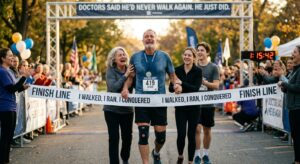
By the second spring, Marguerite was running three evenings a week. By the third, she signed up for a local ten kilometer race, with Dennis at the other end of the tether. They finished in the back half of the field. She says it was the proudest she has ever been of anything.
But she is quick to point out that the race was never really the point. The point was the thousand ordinary evenings that came before it, the unglamorous ones, the days when she was tired and almost stayed home.
“Confidence is not a feeling you wake up with,” she told me. “It is something you assemble. A little at a time, in the dusk, with someone beside you.”
What Changed Beyond the Running
The shift did not stay on the pavement. Marguerite began taking longer walks on her own with her cane. She started attending a weekly community class she had avoided for years. She said yes to invitations she once declined by reflex.
Her world, which had shrunk to a chair and a window, began to widen again. First the block, then the park, then the town.
A Thought for the End of Your Day
As the evening settles around you, it is worth asking a quiet question: where in your own life has your world grown smaller than it needs to be? Not because of any single dramatic loss, but because of a thousand small hesitations that added up.
And then a second question, perhaps the more important one: who might be willing to hold the other end of the tether?
Marguerite and Dennis still run most evenings. The cord between them is a little frayed now, softened by years of use. She keeps it on a hook by her front door, and when she reaches for it, she says, it feels less like equipment and more like an old friend.
Somewhere tonight, the streetlights are flickering on. Two people are crossing a quiet intersection in step, one calling out the curb, one trusting the voice. The day is ending, and for them, it is exactly the right time to begin.