🎧 Listen to this story
Narrated by Kore · 6,826 characters
Daniel Reyes was not a man who talked about the war. Eleven years after he returned from his second deployment, his wife could still count on one hand the number of times he had said anything about it. He kept busy. He fixed fences, coached youth baseball, and worked long shifts at a regional distribution center. By every outward measure, he was fine.
But evenings were a different matter. When the house went quiet and the dishes were put away, something in him began to rise, the way a tide comes in so slowly you only notice when your feet are wet. This is the story of how a secondhand lamp, a drugstore notebook, and about twenty minutes a night began to change that.
The Hour He Dreaded Most
For Daniel, daylight was manageable. Daylight had tasks. It was dusk that undid him, that blue-gray stretch when the sky dims and the world turns inward. It was the hour of day he associated with convoys, with waiting, with the particular dread of the light going out of a road.
He would sit on the back porch with a glass of water he never finished and feel his chest tighten. His thoughts would loop. Some nights he walked the perimeter of his yard three or four times, checking things that did not need checking.
His counselor at the veterans’ clinic, a soft-spoken woman named Marguerite, had suggested journaling months earlier. Daniel had nodded politely and done nothing. Writing it down felt like inviting it in.
What Changed
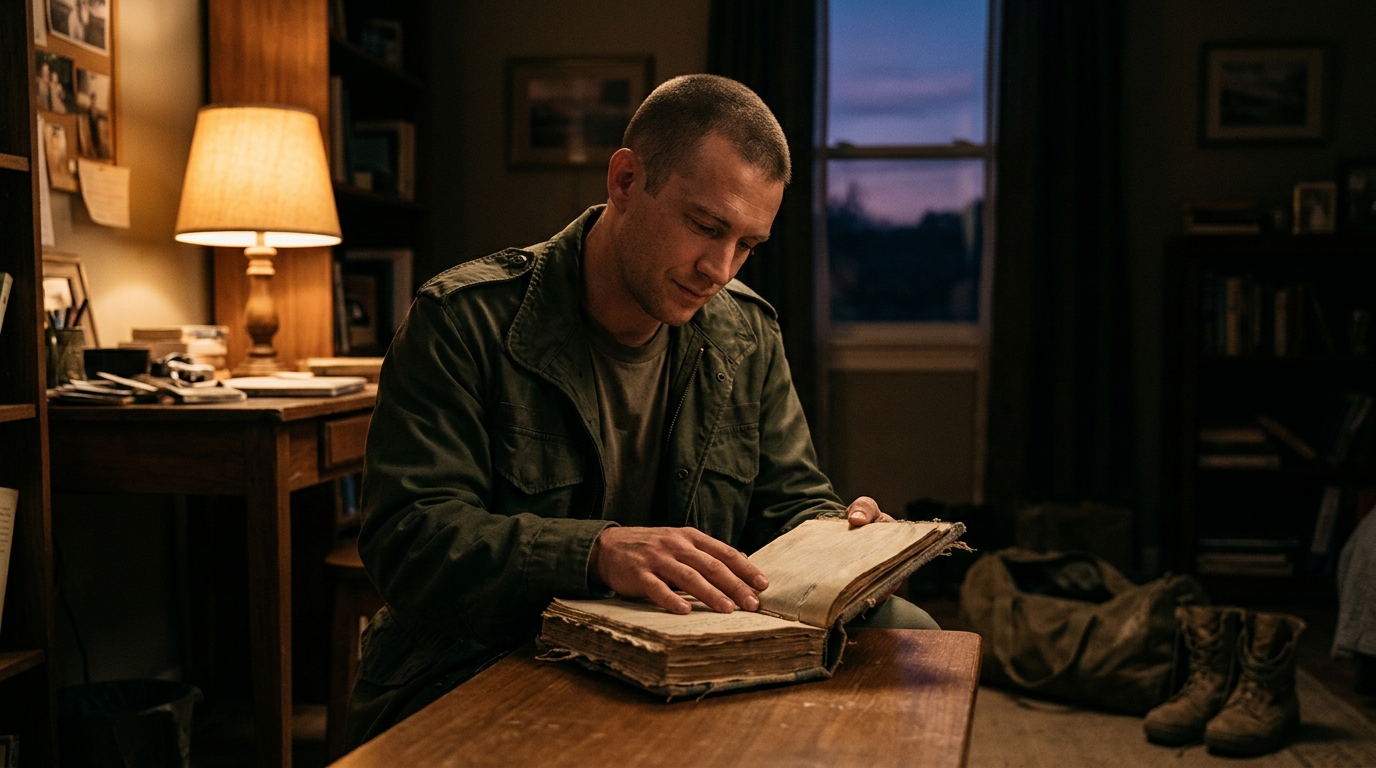
It was his daughter, Lucia, who accidentally gave him the nudge. She was fourteen and had started keeping a diary of her own. One night she left a small brass desk lamp on the kitchen table, the kind with a warm, amber shade, and said she did not need it anymore. “Dad, it’s too dim for homework,” she shrugged. “But it’s good for thinking.”
He carried it to the spare room that night, mostly to get it out of the way. Then he sat there, looking at it. He plugged it in. The room glowed the color of weak tea and honey.
For the first time in a long while, the dark did not feel like something closing in. The lamp made a small, bounded circle of light, and inside that circle, he realized, he could choose what came in.
The First Page
He did not write about the war that first night. He wrote three sentences: what he had eaten for dinner, that the lamp was warm, and that his hands felt strange holding a pen.
Marguerite later told him that this was exactly right. She had encouraged a gentle approach: do not force the heavy things. Let the ritual come first. Let the body learn that this hour, this light, this notebook meant safety rather than threat.
Over the next few weeks, Daniel built a small routine:
- Lamp on, overhead lights off. The warm, contained glow told his nervous system the day was ending, not that danger was approaching.
- Ten minutes minimum, no maximum. He gave himself permission to stop at any time, which made it easier to start.
- No rereading that night. He wrote, closed the notebook, and put it in a drawer. Reading it back could wait for daylight, or for never.
- One kind thing at the end. He always finished by writing one thing he was grateful for, however small.
The Night It Broke Open
About five weeks in, a rainy Tuesday brought it up. A smell from the neighbor’s burning leaves, maybe, or the sound of a truck backing up. Daniel sat down at the lamp and, without planning to, began to write about a young private named Okafor who had been in his unit.
He wrote for almost an hour. He wrote about the joke Okafor used to tell badly, about the day everything changed, about the thing he had said afterward that he had never forgiven himself for. The handwriting got ragged. At one point he stopped, put the pen down, and sat with his hands over his face.
But here is the part he told Marguerite at their next session: he did not feel destroyed. He felt, strangely, lighter. The memory had been living inside him as a sealed room. On paper, under the lamp, it was something with edges. Something he could look at and set down.
Why Evening Writing Works
Marguerite explained that there is real reasoning behind the ritual Daniel stumbled into. While no single method works for everyone, many clinicians who work with trauma note a few helpful principles that his lamplit habit happened to hit:
- Containment. A small, defined circle of light and a closed notebook create a boundary. The memories get a place to live that is not his whole mind.
- Putting experience into words. Turning fragmented images and feelings into sentences can help the brain organize what feels chaotic.
- A predictable wind-down. Doing the same thing at the same hour each evening signals safety and can ease the restlessness that dusk used to bring.
- Gentle pacing. Choosing when to go deeper, and when to stop, returns a sense of control that trauma often takes away.
Marguerite was careful to add that journaling is not a replacement for professional care. For Daniel, it worked alongside therapy, not instead of it. Anyone carrying heavy memories deserves real support, and reaching out to a counselor or a veterans’ crisis line is a sign of strength, not weakness.
What Evenings Look Like Now
It has been nearly two years. Daniel has filled four notebooks. He still does not reread most of it. Some pages he has torn out and burned in the backyard fire pit, watching the paper curl in the dark. Others he keeps.
The back porch is different now too. He still goes out at dusk, but he brings the notebook sometimes, and Lucia occasionally sits with him, doing her own homework, the two of them in comfortable quiet. He has started, haltingly, to tell his wife a little more. Not everything. Enough.
Last spring, he drove four hours to meet Okafor’s mother. He had written her a letter first, drafted a dozen times at the lamp. They sat at her kitchen table until the evening light turned gold across the floor, and she held his hands and thanked him for coming. He cried the whole drive home, and slept better that night than he had in years.
A Few Gentle Things to Take With You
If you are carrying something heavy, or love someone who is, here is what Daniel would tell you:
- Start small. Three sentences count.
- Create a space that feels safe, even if it is just one lamp.
- You do not have to write the hard thing tonight. The ritual itself is the beginning.
- Get support from people trained to help. You were never meant to hold it alone.
The Light You Leave On
When the day is finally over and the house settles, there is a particular kind of courage in sitting down with whatever the day has left behind. It does not have to be dramatic. It can be a small lamp, a plain notebook, and the decision to stay a little while.
Tonight, as the light fades where you are, maybe leave one lamp on. Let it be enough. Some things only become bearable when we finally give them a quiet place to land.