🎧 Listen to this story
Narrated by Kore · 8,529 characters
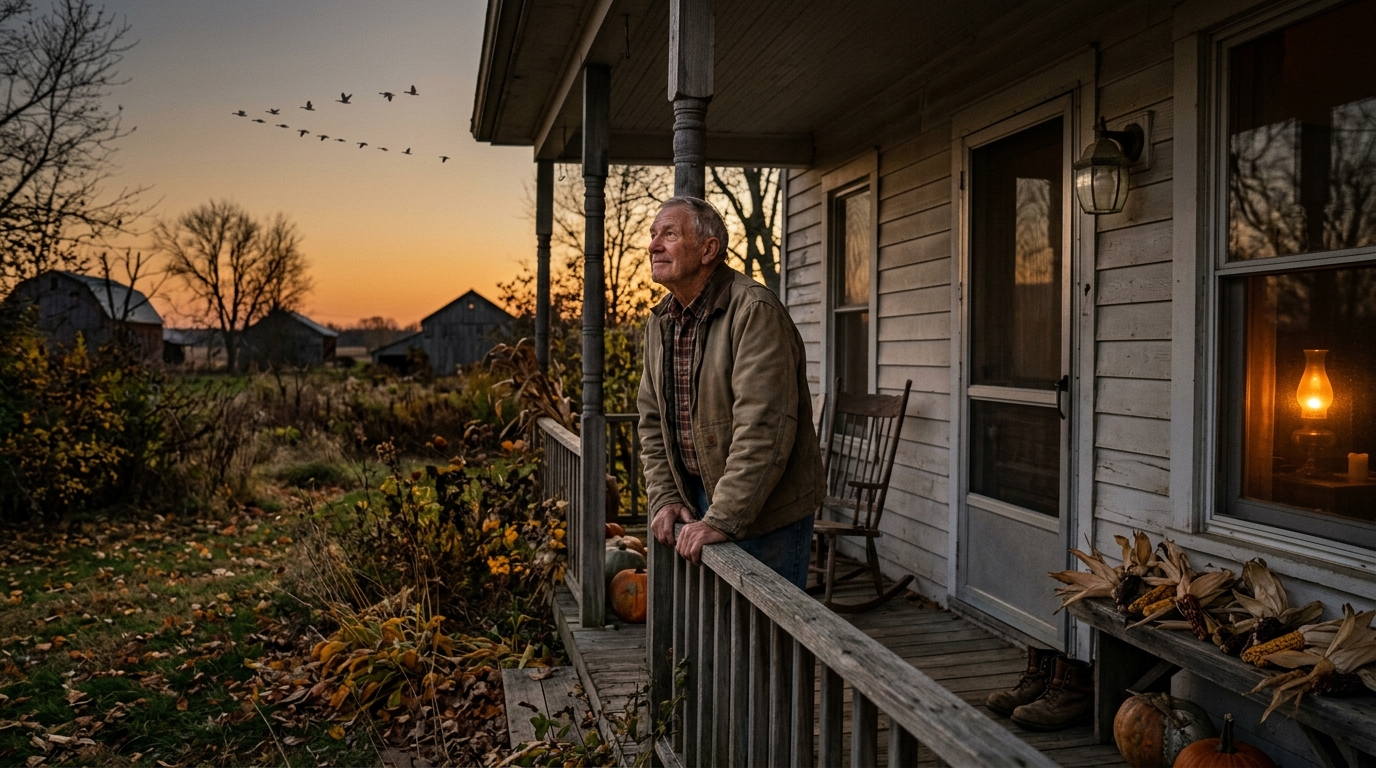
There is a particular hour in late October when the sky over Harold Weatherby’s pasture turns the color of weak tea and the wind drops to almost nothing. It is the hour he calls the settling. The cattle are fed, the barn is latched, the supper dishes are rinsed, and an eighty-three-year-old man pulls a wool blanket over his knees and sits on a weathered bench at the edge of his back field to wait for the geese.
He has done this for forty-one autumns. Some evenings the geese come. Some evenings they do not. He sits either way.
The Pond Behind the Pasture
The pond is not much to look at. It is about two acres of shallow, reed-fringed water that Harold’s father dug out in 1958 to give the cattle somewhere to drink. For most of the year it is the quiet, forgettable kind of pond that every farm seems to have. But in the second half of October, something changes.
The first autumn Harold noticed it, he was forty-two and in a hurry. He was hauling the last of the feed to the barn when a sound from above stopped him cold: the low, rolling, conversational honking of a big flock coming in over the tree line. Dozens of Canada geese, wings cupped, feet dangling, sliding down out of the amber sky onto the black water of his pond like a slow, perfect exhale.
He stood there with a bucket in each hand until his arms ached. When he finally went inside, his wife Margaret asked why he was late. He told her he had been watching something he could not explain.
They came back the next year, and the next. By the third autumn, Harold had built the bench.
How You Come to Know a Flock
Harold will tell you, a little sheepishly, that he cannot prove it is the same flock. Geese are geese. But he has his reasons for believing it, and they are not nothing.
There is the lead bird, for one. Years ago he noticed a gander with a bent primary feather on the left wing, a kink that made its silhouette slightly lopsided against the sky. That bird led the arrival for what Harold figures was about a dozen seasons. He named it Crooked. Geese can live well into their twenties in the wild, and when Crooked finally stopped appearing, a younger bird with the same stubborn, slightly angled approach seemed to take over the front of the formation. Harold does not think that is a coincidence. He thinks the flock teaches its young where to go.
There is also the timing. The geese arrive within the same three-day window every year, usually when the first hard frost has silvered the grass but before the pond skims over with ice. They stay a week or two, resting and feeding, then lift off one gray morning and are gone.
Wildlife biologists will tell you this is entirely plausible. Migratory geese show strong site fidelity, returning to the same stopover wetlands year after year, often following routes learned from their parents. What Harold has is a front-row seat to something science describes in careful, measured language and a farmer describes as a visit from old friends.
The Rituals of the Evening
Over the decades, Harold has built a small, private liturgy around the arrival. He does not call it that. He just says it is how things are done.
- The porch light stays off. Margaret used to leave it on out of habit. After she asked once whether the glare might bother the birds, Harold started switching it off every night from mid-October on, and he has never turned it back on before November.
- The dog stays in. Biscuit, his current border collie, is a good girl but an enthusiastic one. She spends the geese weeks watching through the screen door with an expression of deep personal suffering.
- No one mows the shoreline. The tall grass along the water’s edge is left alone from September on, so the birds have cover.
- He brings a thermos. Black coffee, a little too strong, poured into the lid and sipped slowly while the light goes.
- He says nothing. This one matters most. Harold believes the whole point of the evening is to be quiet enough to hear them before you see them.
What Margaret Understood
Margaret died six winters ago, in February, when the pond was frozen solid and the sky was the flat white of an unwritten page. Harold says the hardest part of that first year was not the funeral or the empty chair. It was the October that followed.
He almost did not go out to the bench. The house was too quiet, and the idea of sitting alone in the cold waiting for birds felt, he said, like an insult to the whole concept of company. But the light began to go, and something in his bones pulled him toward the door, and he went.
The geese came in just as the last orange bled out of the sky. Wings, voices, that long sliding descent onto the water. And Harold, who is not a man given to tears, put his face in his hands on that bench and wept like a boy.
He told me later it was not only grief. It was the plain, enormous relief of discovering that some things go on. The world had lost Margaret and the geese had come anyway, on schedule, indifferent and faithful, and there was a strange comfort in that indifference. Whatever he had lost, the great slow machinery of the seasons was still turning, and he was still allowed to sit at the edge of it and watch.
The Lesson That Arrives After Dark
I have thought a lot about why Harold’s story stays with me, and I think it is because it describes a kind of attention we have almost forgotten how to pay.
We live in a world that rewards the quick glance. We check, we scroll, we refresh, and we call it staying informed. Harold’s whole practice is the opposite: an hour of doing nothing, repeated for decades, in service of a few minutes of wonder that he cannot schedule, cannot control, and cannot guarantee.
Some years the geese were late. One autumn, a bad storm kept them away entirely, and Harold sat on the bench for nine evenings straight with nothing to show for it but a cold nose and a thermos. He says those were not wasted evenings. He says that waiting for something you love is its own kind of love, and that the waiting teaches you things the arrival never could.
What the Waiting Taught Him
When I asked Harold what he had learned from forty-one autumns on that bench, he thought about it for a long while, long enough that the dusk deepened around us and I began to wonder if I had asked something unanswerable. Then he said three things, slowly, like a man setting stones in a wall.
First, that showing up counts for more than outcomes. You do not sit on the bench because the geese owe you a performance. You sit because you have decided that this is the kind of man you want to be: one who shows up at the edge of the day and pays attention.
Second, that faithfulness is mostly just repetition. Nothing about his routine is dramatic. It is the same bench, the same blanket, the same thermos, year after year. And yet he said that if you stack enough ordinary evenings together, they begin to look a lot like a life.
Third, and this was the one he said quietest, that you are never as alone as you feel. The geese do not know his name. But they have chosen his pond, forty-one years running, out of all the water in the world. He says there are worse things than being chosen, even by a bird.
The Quiet Hour Is Still Yours
The evening I visited, the geese came in at 6:12. I know because Harold glanced at his old wristwatch the moment the first distant honk drifted over the trees, and he gave the smallest nod, the way you would greet someone you have been expecting at the door.
They descended in long, loose lines, dark shapes against a sky gone the soft pink of the inside of a shell. The water received them without a ripple of complaint. For a few minutes the whole field was full of low, murmuring, contented sound, the sound of a family arriving home after a very long road.
Harold did not say a word. He just sat with his thermos lid steaming in his hands, watching, and I realized I was watching him as much as the birds. His face in that fading light looked like a man receiving a letter he had been waiting a year to read.
As the dark came down and the geese tucked their heads and the first stars pricked through, he finally spoke, so softly I almost missed it.
“Same time next year,” he said. Not to me. Not quite to the geese. Just to the evening itself.
If you have a quiet corner at the end of your own day, a porch step, a window seat, a patch of back garden, consider claiming an hour there this week. You do not need a flock of geese. You only need to be still enough, and patient enough, to notice what has been arriving all along.