🎧 Listen to this story
Narrated by Kore · 6,069 characters
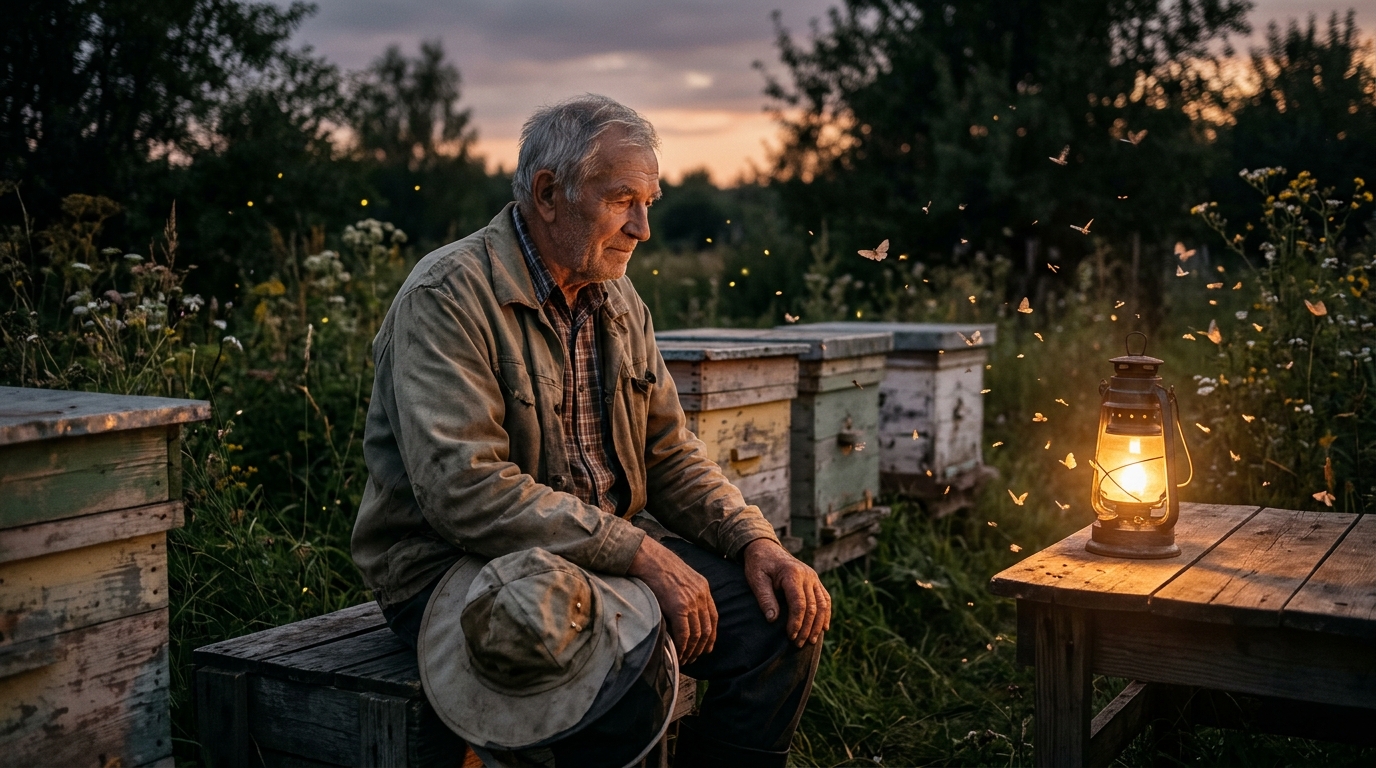
Walter Hennessey has kept bees for fifty-one years, and for most of that time he believed he understood pollination. Then, at seventy-eight, with a bad hip and a porch swing he could no longer easily leave, he started noticing the second shift.
It began with an ordinary evening, the kind where the day’s work is done and the light goes soft and amber across the clover. His bees had returned to the hives, the buzzing had thinned to a low murmur, and the garden he had tended since his wife passed seemed to be settling into sleep. Except it was not. Something was just beginning.
The Moment the Garden Changed Shifts
He remembers the first one clearly. A pale, feathery shape drifted past the porch light and hovered at the evening primrose by the steps, its wings a blur, its long tongue unrolling like a tiny silver ribbon into the yellow bloom. He thought it was a hummingbird at first. Then he saw the antennae.
“I’d spent half a century watching the day crew,” Walter says, resting his hands on his knees. “Never once did I think to stay out for the night crew.”
Over the following weeks, a quiet ritual formed. After supper, he would carry a cup of chamomile out to the porch, switch off the kitchen light, and wait. As the sky shifted from gold to rose to a deep, bruised blue, the moths arrived, one by one, then dozens.
Why the Night Shift Matters More Than We Think
Moths do not get the credit bees do. They do not have a charming reputation or a children’s book series. But researchers have increasingly shown that nocturnal pollinators carry a surprising share of the load. Studies in Europe and North America have found that moths visit a wide variety of flowers after dark, and that many plants depend on them, especially those that open their blooms only in the evening.
Here is what Walter learned from watching, and later from reading everything he could get his hands on:
- Many flowers wait for dark. Evening primrose, moonflower, night-blooming jasmine, and nicotiana release their sweetest scent and open fully as light fades, a signal built for moths.
- Pale colors glow at night. White and cream flowers reflect moonlight, making them easy for moths to find when color vision fades.
- Long tongues reach deep. Hawk moths, sometimes called hummingbird moths, can have tongues longer than their own bodies, reaching nectar that few other insects can.
- They travel far. Moths often cover great distances in a night, carrying pollen between plants that would otherwise never meet.
A Lesson That Settled In With the Dark
What struck Walter most was not the science, though he came to love it. It was something quieter. For decades he had measured his usefulness by the daylight hours: the honey harvested, the hives inspected, the neighbors who stopped by for a jar. When his body slowed down, he quietly feared that his usefulness had slowed with it.
“Then I sat out here and watched these little gray creatures do their work in the dark, where nobody was clapping,” he says. “No one thanks a moth. It just shows up, does its part, and the garden is richer for it by morning.”
He pauses, and the porch swing creaks.
“That’s a good thing to learn at my age. The work that matters doesn’t always happen where people can see it.”
The Rituals of the Evening Watch
Walter has turned his porch into a small observatory of stillness. He keeps a worn notebook beside the swing and writes down what he sees, not with scientific rigor, just with the attention of a man who has finally slowed down enough to notice.
What He Sees in a Single Evening
- Golden hour: The last honeybees tumble home, heavy with pollen, while the first swallows skim the lawn.
- Dusk: The evening primrose unfurls, almost audibly, its petals opening in a few quiet minutes.
- Blue hour: The hawk moths arrive, hovering in the half-dark like small prayers.
- Full night: Smaller moths flicker through the lavender and phlox, barely visible except where the porch light catches their wings.
Sometimes a neighbor’s grandchild comes to sit with him. A seven-year-old named Poppy now knows the names of three kinds of moths and insists the hawk moths are fairies in disguise. Walter has not corrected her.
How You Can Build Your Own Night Garden
The beauty of Walter’s story is that anyone can make room for the night shift. You do not need acres or fifty years of experience. A balcony pot or a corner of a yard is enough. If you would like to welcome moths to your own evenings, here are a few gentle starting points:
- Plant evening bloomers. Try evening primrose, night-scented stock, moonflower, or honeysuckle near a spot where you like to sit.
- Choose pale and fragrant. White and cream flowers with a sweet scent after sunset are moth magnets.
- Dim the lights. Bright outdoor lighting confuses and exhausts nocturnal insects. Warm, low, or motion-activated lights are kinder.
- Skip the pesticides. Even products meant for daytime pests can harm the creatures that work at night.
- Leave a little wildness. Fallen leaves, native grasses, and an unmowed corner give caterpillars somewhere to grow.
The Stillness That Stays With You
There is a particular kind of peace that comes from watching something small and faithful do its work without an audience. It reminds us that not every contribution announces itself, and that rest and usefulness are not opposites.
On the evening I visited, the sky had gone the color of watered ink, and Walter had gone quiet, the way people do when something wonderful is about to happen. Then a single pale moth lifted out of the dark, found the primrose, and began to feed.
“There she is,” he whispered, as though greeting an old friend. “Right on time.”
We sat together without speaking, two people and a thousand unseen wings, while the garden did what it has always done in the hours when no one is looking. If you have a porch, a window, or even a small patch of dusk to call your own, consider stepping out tonight. Turn off the light. Let your eyes adjust. The night shift is already at work, and it would be a shame to let all that quiet kindness go unwatched.