🎧 Listen to this story
Narrated by Kore · 6,746 characters
For almost three years, Marguerite Okafor dreaded the same moment every evening: the click of the bedroom light switch. Not because of the dark itself, but because of what the dark had come to mean. After surviving a violent home invasion at the age of thirty-four, she found that night became the hour when her body refused to believe she was safe.
This is the story of how she rebuilt her evenings, one small ritual at a time, and how those quiet, unglamorous steps eventually gave her back something she thought was gone for good: a night of unbroken sleep. Marguerite, who is now thirty-nine, agreed to share her experience in hopes that someone else lying awake tonight might feel a little less alone.
When the Night Became the Enemy
The incident itself lasted only minutes. The aftermath lasted years. Marguerite physically recovered quickly, but her nervous system did not get the memo. She would lie in bed with her heart pounding, listening to every creak of the house, her body braced for something that was never coming.
“I was exhausted all day and wired all night,” she says. “People kept telling me to just relax. As if I hadn’t tried. As if relaxing was a switch I was refusing to flip.”
She slept in two-hour fragments. She checked the locks four, five, six times. She began avoiding bedtime altogether, scrolling on her phone until her eyes closed on their own, which only made her sleep shallower and her mornings heavier.
The Turning Point
Her turning point was not dramatic. It came during an appointment with a trauma-informed therapist, who asked her a question nobody else had: “What does your body need to hear at night?”
Marguerite had no answer. She had spent so long fighting her sleeplessness that she had never stopped to ask what it was trying to tell her. Her therapist explained that for many trauma survivors, the nervous system stays in a state of vigilance, and that the evening hours, when the world quiets and distractions fall away, can feel like an invitation for that alarm to ring louder.
The goal, she was told, was not to force sleep. It was to build a trail of small signals, night after night, that said: you are safe now, and the day is done.
Building the Routine, Piece by Piece
Marguerite did not overhaul her life in a weekend. She started with a single change and added others only when the previous one felt steady. Over several months, her evening took shape.
The Elements That Made the Difference
- A fixed “closing time” for the day. At 8:30 each evening she wrote down tomorrow’s three most important tasks, then closed her laptop. This gave her mind a clear boundary: the work was finished, held safely on paper.
- The same lock check, once. Instead of repeating it compulsively, she walked through a deliberate, slow routine, one time only, touching each lock and saying quietly, “Secure.” Then she walked away.
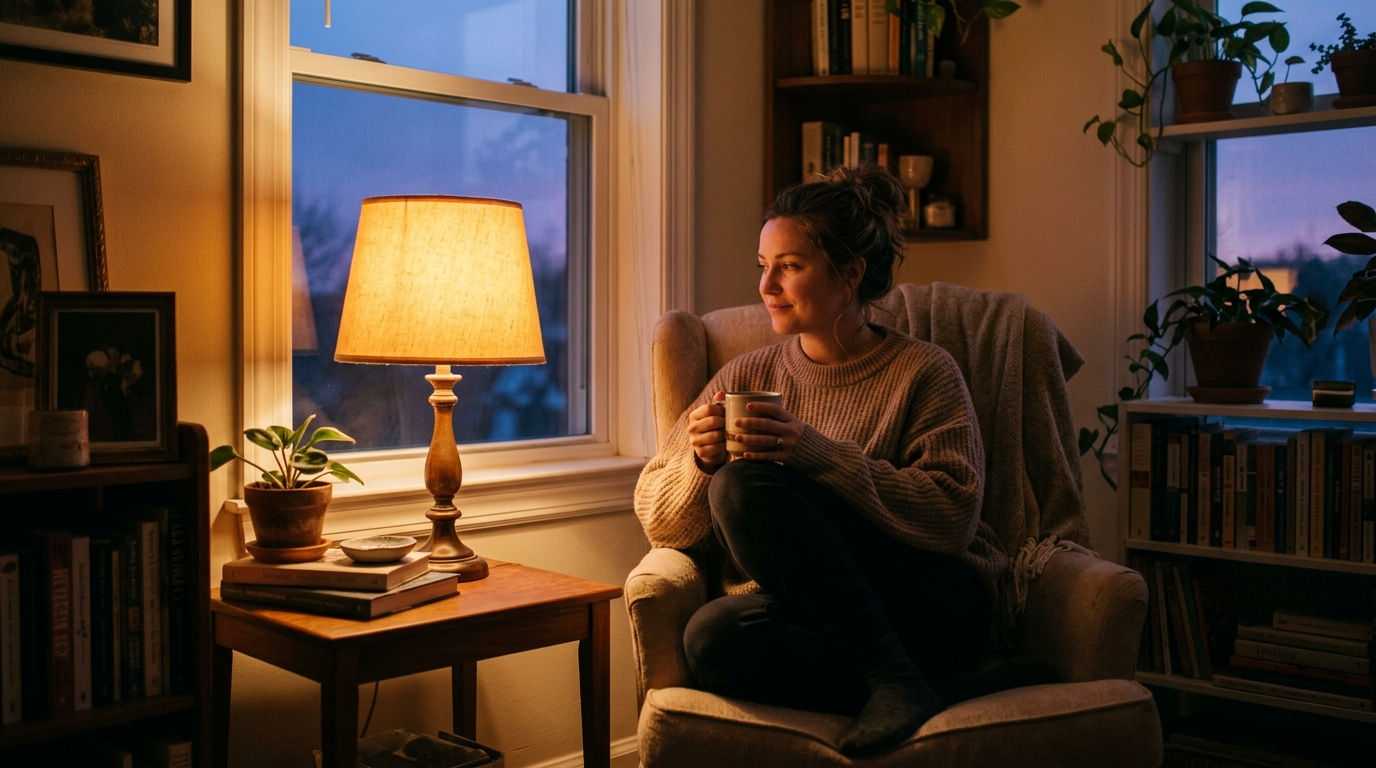
- The lamp. She stopped trying to sleep in total darkness. A warm, dim lamp stayed on in the corner, and she gave herself full permission to keep it there as long as she needed.
- A cup of something warm. Chamomile at first, then simply hot water with lemon on the nights she did not feel like tea. The act of holding something warm became a cue for her body to soften.
- Phone out of the bedroom. It charged in the kitchen. A small paper alarm clock took its place.
- Slow breathing with a long exhale. Five minutes, lying down, breathing in for four counts and out for six, a rhythm her therapist said could help signal calm to the body.
The Evening That Surprised Her
The first weeks showed little change. Marguerite admits she nearly quit. But around the third month, something shifted on an ordinary Tuesday.
She finished her tea, did her single lock check, and settled under the blanket with the lamp glowing softly. She started her breathing, expecting the usual hum of dread to rise. Instead, she noticed her shoulders had already dropped. She noticed the quiet of the house, and for the first time in years, it did not feel like a threat. It just felt quiet.
She woke at 6:40 the next morning, sunlight at the edges of the curtains, and lay there confused. Her first thought was that something must be wrong. Then she realized she had slept for more than seven hours straight.
“I cried a little,” she says, smiling. “Not from sadness. It felt like my body was finally saying, okay, we can try this.”
What Evening Taught Her
Marguerite says the most surprising lesson was not about sleep at all. It was about patience with herself. For years she had treated her sleeplessness as a personal failure, something she was doing wrong. The routine reframed it entirely. Her body had not been broken. It had been protecting her, and it simply needed to be shown, gently and repeatedly, that the danger had passed.
There is a particular tenderness in that idea. The evening hours, which had felt like a battleground, became a kind of daily conversation with herself. Each ritual was a small sentence in a longer reassurance: I am here. I am safe. The day is over.
On the Nights That Still Go Wrong
Healing, she is quick to point out, is not a straight line. There are still nights when a sound or a memory sends her heart racing. The difference is that she now has a path to follow back. On those evenings she does not panic about panicking. She turns the lamp up a little, makes her warm cup, and begins again.
“The routine is not a cure,” she says. “It is a place to come home to.”
If You Are Lying Awake Tonight
Marguerite is not a doctor, and she is careful to say so. Her therapist guided much of her progress, and she encourages anyone struggling with trauma-related sleep trouble to seek professional support. But she offers a few gentle thoughts for anyone beginning their own journey:
- Start with just one small ritual. Add another only when the first feels comfortable.
- Let the lamp stay on if you need it. There is no prize for sleeping in darkness.
- Give your routine at least a few weeks before judging it. Nervous systems learn slowly, and that is allowed.
- Be kind about the setbacks. A hard night does not erase the progress you have made.
A Quiet Kind of Courage
We tend to celebrate loud forms of bravery. But there is a deep, unseen courage in someone who keeps turning toward the evening, night after night, and chooses to make it gentler. Marguerite did not conquer her fear in a single dramatic moment. She dismantled it slowly, with tea and lamplight and long, patient exhales.
Tonight, as the sky darkens outside her window, her routine begins the way it always does. The laptop closes. The tea steeps. The lamp glows in the corner, soft and steady. And somewhere in the quiet, a woman who once dreaded the dark now lies back, breathes out slowly, and lets the day go.