🎧 Listen to this story
Narrated by Kore · 6,896 characters
There is a hush that falls over a garden just after the sun slips behind the hills. The heat lifts from the soil. The bees drift home. And in a small backyard at the edge of a quiet town, Margaret Ellison steps out the back door, a cup of chamomile in one hand, her other hand trailing along a rope handrail she strung herself decades ago.
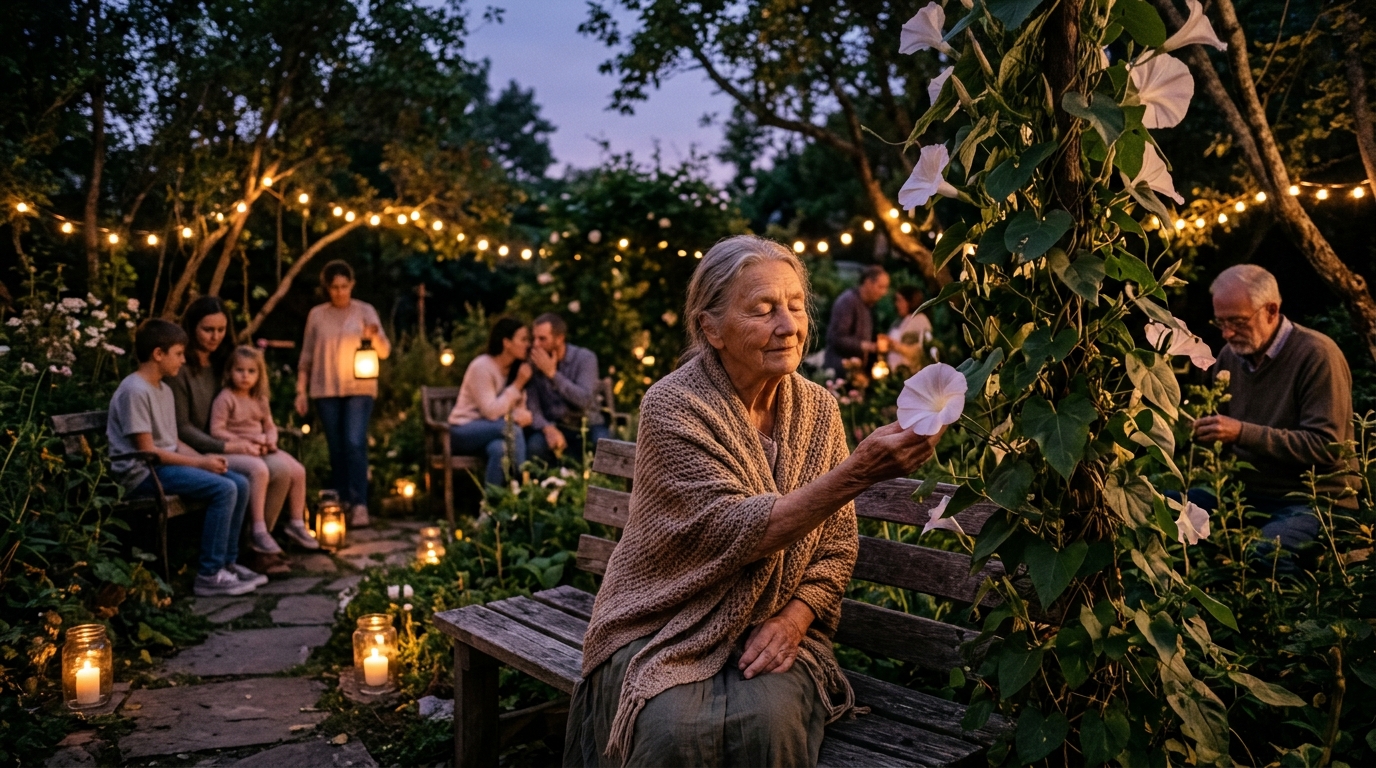
Margaret has been blind since she was nineteen. She is seventy-one now. And the garden she tends is one that people drive across the county just to stand inside, usually at dusk, usually in silence, usually with their eyes closed.
This is her story, as she told it to me over two long evenings on her porch, and as the neighbors who love her helped me understand it.
The Garden That Was Built for the Hours After Dark
Most gardens are designed for the eye. They shout in color at noon. Margaret’s was designed for everything else.
When she lost her sight to a degenerative condition in her early twenties, she lost the thing she thought she loved most: watching her mother’s roses open each June. For nearly two decades afterward, she avoided gardens entirely. They felt like a room whose lights had been switched off permanently.
Then, in her late thirties, something shifted on an ordinary summer evening.
“I was sitting on the back step,” she told me, “and the smell of the neighbor’s jasmine hit me all at once. It was stronger than it ever was in daylight. And I realized the evening was handing me something the day never had. The garden wasn’t gone. I had just been visiting it at the wrong hour.”
That was the beginning. She began to learn that many flowers save their best gift for nightfall. As the light fades and the air cools, they release their fragrance into the dark, calling to moths and night-flying insects. For someone who navigates the world by scent and touch, dusk is not the end of the garden. It is the doorway.
How She Built It, Piece by Piece
Margaret never drew a plan on paper. She built the garden the way she does everything: by hand, by memory, and by patient repetition. Here is how it came together.
Starting With Fragrance
She began with the plants that perfume the evening air. Night-blooming jasmine anchors the back fence. Evening primrose opens at twilight with a soft, lemony scent. Nicotiana, sometimes called flowering tobacco, releases a sweet, heady fragrance after sundown. Moonflower vines climb the trellis near her chair.
Layering Texture Underfoot and Underhand
Each section of the garden has its own feel, so Margaret always knows where she stands without a single visual cue.
- Lamb’s ear along the main path, soft as flannel against her palm
- Creeping thyme between the stepping stones, springy and fragrant when crushed underfoot
- Ornamental grasses that whisper and rustle when the evening breeze moves through
- Smooth river stones marking the edge of the herb bed, cool to the touch
- Rough cedar posts at each turn in the path, a landmark she can feel from a few feet away
Sound as a Second Map
She hung a series of wind chimes, each tuned to a different tone, at different corners. A low bamboo chime marks the east side. A bright, high one marks the pond. A small water fountain trickles near the center, so she can always find her way home by the sound of it.
“People think a blind gardener is working in blackness,” she said. “But my garden is full of landmarks. They just aren’t visual ones.”
The Evening Walk She Never Skips
Every night, Margaret takes what she calls her closing walk. She starts at the back step and moves slowly along the path, pausing at each plant like an old friend.
She greets the lavender with her fingertips. She presses a mint leaf between her thumb and finger and breathes it in. She kneels to feel whether the soil has stayed damp, whether the day’s heat has baked it dry.
I asked her once why she does this every single night, even in the cold, even when her knees ache.
She was quiet for a moment. “Because the day is loud,” she said. “There are errands and phone calls and people who need things. But the garden at night asks nothing of me. It just lets me notice. And noticing, I have found, is a kind of prayer.”
That line has stayed with me for weeks.
The Neighbors Who Started Showing Up
It began quietly. A neighbor named Daniel, a tired nurse coming off the late shift, wandered past the fence one evening and caught the scent of the night jasmine drifting over. He stopped. He stood there longer than he meant to.
Margaret, sensing someone by the gate, called out a hello. By the end of that week, he had joined her on the porch with a mug of tea.
Word spread without anyone trying to spread it. Now, on warm evenings, a handful of people gather in the garden as the light fades. There is no program. Margaret simply invites them to close their eyes, and she walks them through what she knows: the first scent that rises, the cool damp that settles over the herbs, the soft dry rustle of the grasses.
“I’ve lived next to this woman for nine years,” Daniel told me. “I thought I knew what a garden was. She showed me I’d only ever looked at one.”
What the Dark Teaches
Over our two evenings together, Margaret returned again and again to a handful of ideas. I have kept them close.
- Slowness reveals what speed hides. She moves through the garden at a pace that lets every plant introduce itself.
- Loss can redirect rather than end. The garden did not replace her sight. It opened a different way of belonging to the world.
- Attention is a gift you can give anywhere. You do not need a garden. You need a willingness to stop and notice.
- The best things often bloom after the crowd goes home. Some beauty only reveals itself in quiet hours.
A Few Ways to Borrow Her Evening
You do not need a yard or a green thumb to try what Margaret does. If this story stirs something in you, here are a few gentle places to begin tonight:
- Step outside for five minutes after dinner, before you reach for any screen.
- Close your eyes and name three scents in the air.
- Rest your hand on something living: a tree trunk, a leaf, a patch of grass.
- Listen for the sounds that only appear when the day quiets down.
- If you can, plant one night-scented flower in a pot by your door.
The Last Light
On my final evening there, the sky had gone the soft violet of a bruise healing. The chimes were moving. Somewhere near the fence, the first moths had begun to circle the nicotiana.
Margaret stood at the center of her garden, face tilted slightly upward, one hand resting on the lamb’s ear. She was smiling at nothing I could see, and everything she could feel.
“It’s a good one tonight,” she said softly.
I closed my eyes. The jasmine rose around us like a slow, sweet tide. And for the first time in a very long while, I understood what it meant to simply be present at the end of a day.
She never saw a single bloom of the garden she built. And yet she may know it better than anyone alive.