🎧 Listen to this story
Narrated by Kore · 7,739 characters
The fire at Marguerite’s Kitchen started a little after two in the morning on a Tuesday in late February. By the time the sun came up over the small mill town of Alder Creek, there was nothing left of the restaurant but blackened beams, a collapsed roof, and the smell of wet ash drifting down Main Street.
Marguerite Delacroix had run that kitchen for twenty-six years. She stood on the sidewalk in a borrowed coat, watching the last of the smoke thin out against the gray sky, and she said something her daughter would later repeat to the local newspaper: “I didn’t cry because of the building. I cried because I thought about all the people who would come on Friday and find a locked door.”
What happened next is a story about what a town can do when it decides, collectively and without much fuss, that something is worth saving. It is also a story about evenings.
The First Evening
The day after the fire, a retired electrician named Walt Brannigan walked over to the ruins at about five-thirty in the afternoon, after finishing his own errands. He did not bring a plan. He brought a wheelbarrow and a pair of work gloves, and he started hauling debris from the dining room floor.
Nobody asked him to. Nobody organized it. He simply showed up at the end of his day, as the light was turning amber and the street was going quiet, and began to work.
The next evening, he came back. This time, two other people were already there.
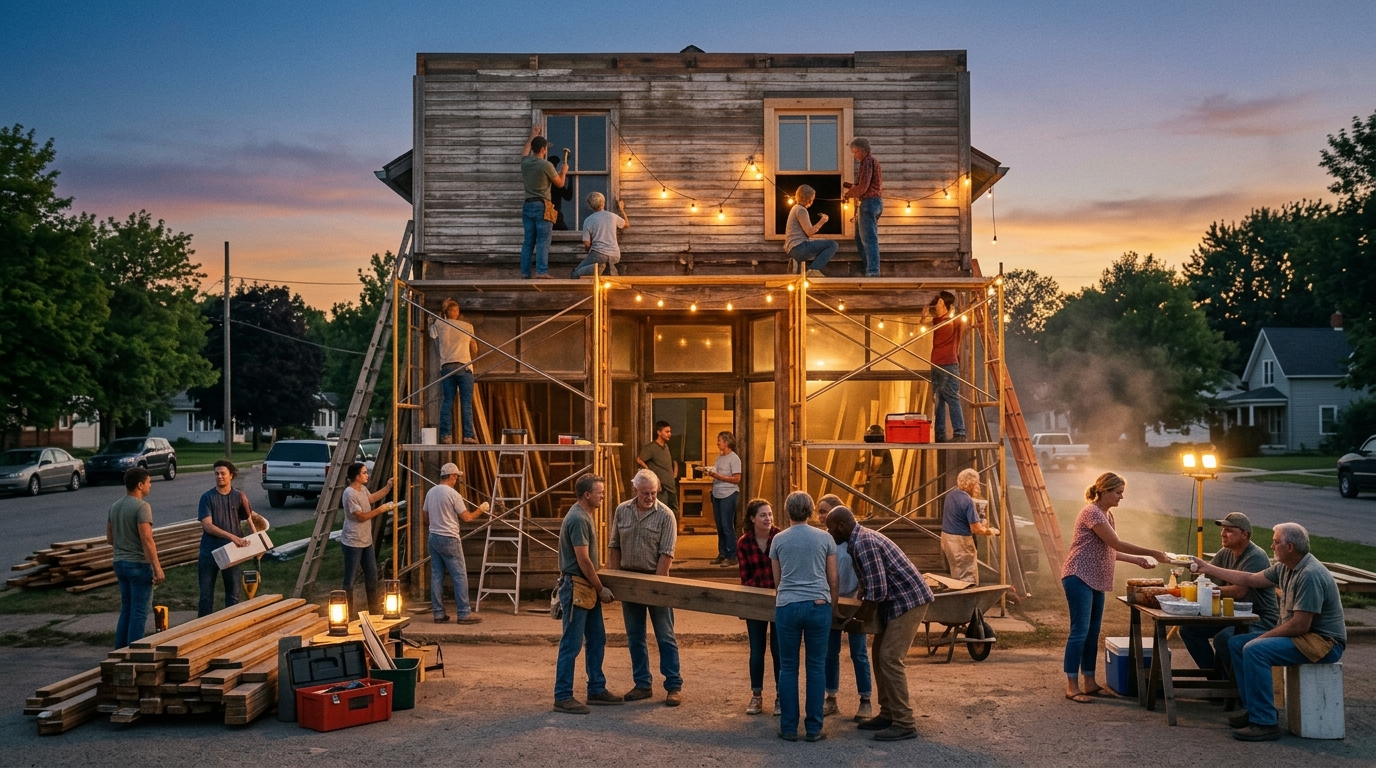
By the end of that first week, a pattern had formed without anyone declaring it. Around six o’clock each evening, after jobs ended and kids were fed and the worst of the daily rush had passed, people drifted toward the old restaurant on Main Street. They worked until the light failed, usually around eight, and then they went home.
Someone started calling it “the six o’clock crew.” The name stuck.
Why Evenings Mattered
There is something particular about doing hard, physical, useful work as a day winds down. Several of the volunteers said the same thing when asked later: the evenings felt different from their regular days.
During the day, everyone in Alder Creek was busy being what they were supposed to be. Teachers taught. Mechanics fixed engines. Nurses worked shifts. But at six o’clock, those roles dissolved. The accountant swung a sledgehammer next to the high school principal. A teenager who had never held a drill learned from a woman who had been framing houses since the nineties.
“You stop being your job,” said Dessa Okonkwo, a pharmacist who joined the crew in the second week. “You’re just a person carrying lumber. And somehow that feels like the truest version of yourself at the end of a long day.”
The light helped too. Marguerite’s Kitchen faced west, and every evening the setting sun poured straight through the skeleton of the burned-out windows, turning the dust in the air to gold. Volunteers began to pause for a few minutes at the end of each shift just to watch it. Nobody talked much during those moments. They leaned on their tools and let the quiet settle.
What the Crew Actually Did
The rebuilding was not magic. It was thousands of small, practical acts, stacked one on top of another. Here is a rough picture of what the six o’clock crew accomplished over roughly four months:
- Cleared and hauled away more than forty truckloads of burned debris and damaged materials
- Pulled out and replaced the entire roof structure, mostly in the long light of summer evenings
- Donated and installed wiring, plumbing, and a brand new ventilation system
- Sanded and refinished the original maple bar top, which had survived the fire with only surface scorching
- Painted the dining room walls the same soft yellow Marguerite had chosen decades ago
Local businesses chipped in without being asked. The hardware store quietly marked down materials. A lumber supplier two towns over delivered a pallet of beams and refused payment. A woman who ran a bakery began leaving trays of bread and cookies on a folding table near the entrance every evening at five-thirty, so the crew would have something to eat when they arrived.
The Night Marguerite Came Back
For the first several weeks, Marguerite stayed away. She told her daughter she could not bear to watch. She was afraid, she admitted later, of being pitied, and of feeling like a burden to people she had fed for a quarter century.
Then one evening in April, she walked down Main Street on her own, just as the street lamps were flickering on. She stopped across from the restaurant and watched.
She saw Walt Brannigan teaching a fourteen-year-old how to read a level. She saw Dessa carrying a bucket of paint. She saw people she had known for decades, people she had served birthday dinners and wedding receptions and quiet Tuesday lunches, working in the fading light for her.
She did not cross the street right away. She stood there for a long time, letting it sink in. When she finally walked over, Walt looked up, wiped his hands on his jeans, and said, “About time. We need someone who knows where the walk-in freezer is supposed to go.”
That was all it took. She picked up a pencil and started drawing on the wall.
The Reopening
Marguerite’s Kitchen reopened on a Friday evening in early July, almost exactly five months after the fire. The doors opened at five, and the line stretched down the block by five-fifteen.
Every member of the six o’clock crew was given a seat of honor. There was no menu that night. Marguerite simply cooked, and the kitchen sent out plate after plate of the same dishes people had been eating there for twenty-six years: slow-braised short ribs, buttered noodles, a peach cobbler that had its own unofficial fan club.
As the evening wore on and the windows glowed warm against the darkening street, someone raised a glass and proposed a toast. Marguerite waved it off. She said she was not the one who deserved thanks. Then she looked around the packed room and could not finish the sentence.
Lessons That Settle In at the End of the Day
When people talk about this story now, a few ideas come up again and again. They feel worth keeping close, especially in the quiet hour before sleep when we tend to sort through what mattered.
1. Showing up beats announcing up
Walt did not call a meeting or start a fundraiser. He brought a wheelbarrow. The simplest, least dramatic act of help often becomes the seed that others gather around.
2. Consistency is its own kind of love
Not everyone could come every night. But the rhythm of it, the steady return at the same hour, told Marguerite something words could not: you are not alone in this, and we are not leaving.
3. Community is built in ordinary hours
The restaurant was rebuilt not on weekends or holidays but in the tired, slanting light at the end of ordinary workdays. Real generosity often happens in the margins of busy lives.
4. Letting yourself be helped is a gift too
Marguerite’s hardest moment was not the fire. It was crossing the street to accept help. Receiving kindness with grace gives other people the chance to give it.
A Quiet Thought Before Bed
Tonight, as the day settles and the noise falls away, it might be worth asking a gentle question: who in your life is standing in the ashes of something, waiting to be seen? And what small thing, a wheelbarrow, a tray of bread, an hour at six o’clock, could you bring?
You do not have to rebuild an entire restaurant. You only have to show up once, and then again tomorrow evening.
On quiet nights in Alder Creek, if you walk down Main Street around dusk, you can still see the warm light spilling from the windows of Marguerite’s Kitchen. Inside, the maple bar glows. And somewhere near the back wall, a small brass plaque reads: Built one evening at a time, by everyone who came.