🎧 Listen to this story
Narrated by Kore · 7,111 characters
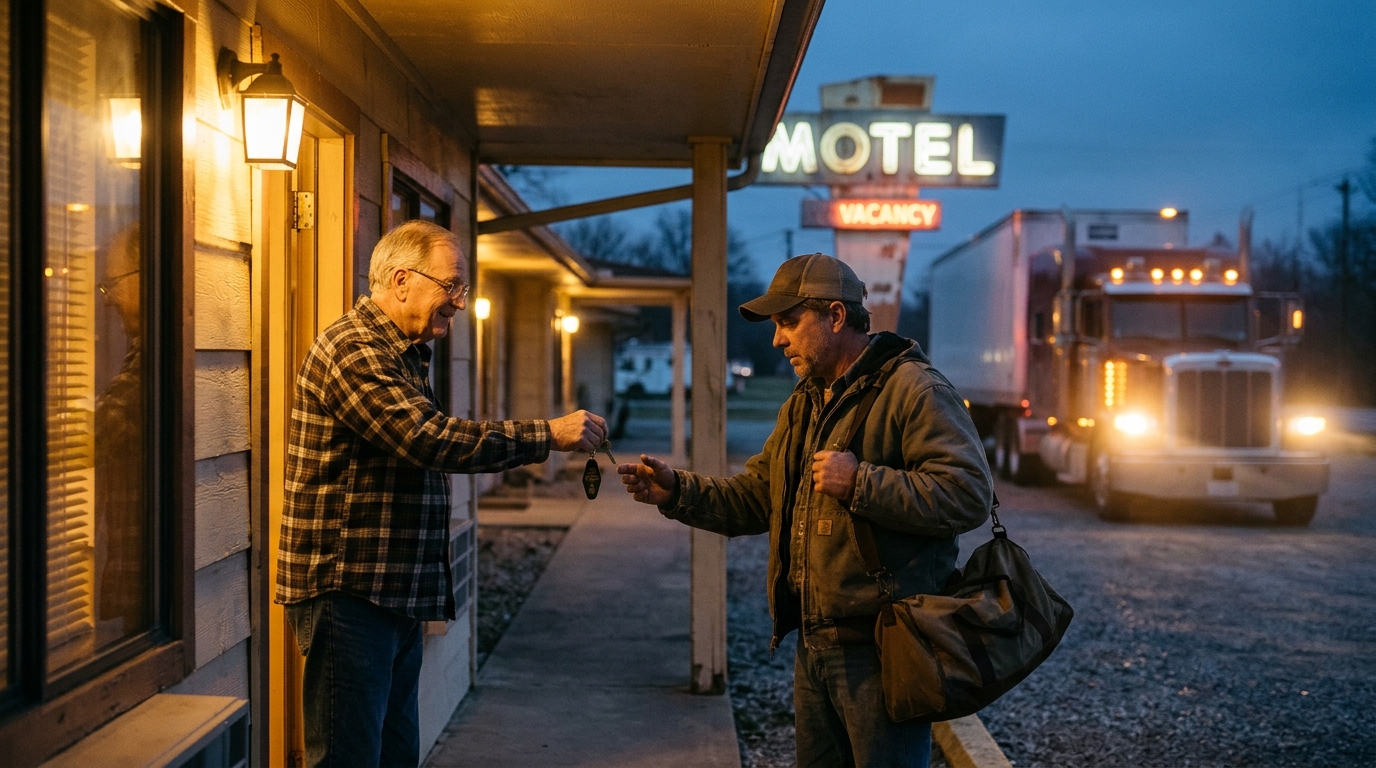
There is a particular kind of quiet that settles over a highway motel after the last of the evening traffic fades. The vending machine hums. The neon sign buzzes a little louder than it did at noon. Somewhere out on the two-lane road, a pair of headlights slows, hesitates, and turns into the gravel lot.
For the owner of a small roadside motel, this is the hour that matters most. Not the busy check-in rush of late afternoon, but the stillness after midnight, when the people who arrive are the ones who have run out of road, out of hours, and sometimes out of money.
This is the story of a motel owner who keeps a simple rule: if a trucker pulls in after midnight with empty pockets, the room is free. No questions, no paperwork shame, no lecture.
The Rule That Started With a Knock
The owner, a soft-spoken man in his sixties who asked that his name be left out of the story, did not set out to become a quiet legend among long-haul drivers. The rule began years ago, on a winter night when snow was drifting across the lot and a driver knocked on the office window.
The man’s fuel card had been declined at the last stop. His logbook said he was out of legal driving hours. He had forty dollars in cash and a rig that could not safely go another mile. The room cost sixty.
“I looked at him, and I looked at the snow, and I just handed him the key,” the owner recalls. “What was I going to do, let a tired man sleep in a cab in that weather? I couldn’t have slept myself.”
He did not think of it as a policy then. But the next time it happened, he did the same thing. By the third time, it was simply how the motel worked.
What Happens After Midnight
Truckers live by a strict clock. Federal rules limit how many hours a driver can legally stay behind the wheel, and when the clock runs out, they must stop, whether or not they have a safe place to do it. Fuel prices swing. Payments get delayed. A delivery falls through, and a driver ends up stranded, hundreds of miles from home, with a bank balance that does not match the day’s costs.
That is the gap this motel fills. Here is how a typical late night unfolds:
- A driver arrives after midnight, often apologetic before they even reach the counter.
- The owner asks only one thing: “Do you need a room tonight?”
- There is no demand for proof of hardship. If the driver says the pockets are empty, that is enough.
- A key is handed over, along with a cup of coffee and a note on where the quiet side of the building is.
- In the morning, the driver leaves, often with a handshake and a promise to make it right someday.
The Evening Ritual Behind the Kindness
Ask the owner when he thinks about all of this, and he does not point to the late-night encounters themselves. He points to the hour afterward, when the lot is dark and the last light in the office is still on.
“That’s when I sit down and think it over,” he says. “The day’s noise is gone. You can hear the highway, but it’s far away. And I ask myself the same question every night: did anyone come through here who needed something I could give?”
It has become a small ritual. He turns off the television, pours the last of the coffee, and watches the road for a few minutes before locking up. If a rig is parked along the fence with its cab dark and its driver finally asleep in a real bed, he counts it as a good day.
“People think kindness has to be a big thing,” he says. “But mostly it’s a key, a warm room, and a person who doesn’t make you feel small for needing it.”
Stories the Walls Have Kept
Over the years, the motel has collected a quiet archive of moments. The owner shares them without names, protective of the privacy of the people involved.
The Driver Who Paid It Back Tenfold
One driver stayed a single night years ago, left without a word beyond a thank you, and returned eighteen months later. He walked into the office, set an envelope on the counter, and said, “For the next guy.” Inside was enough money to cover a dozen free rooms. The owner keeps that envelope in a drawer, still unopened in spirit, a reserve of other people’s gratitude.
The Man Who Was Heading Home
Another driver arrived near two in the morning, eyes red, hands shaking. He had just learned that his father was in the hospital. He had enough fuel to reach the next town but nothing for a bed. The owner gave him a room, a hot meal from the microwave, and an alarm call at five. “He made it in time,” the owner says quietly. “That’s all I’ll say.”
The Rookie Who Was Scared
A young driver on his first solo haul pulled in shaken after a long, wrong turn. He had been too embarrassed to say he could not afford a room. The owner simply said the room was “on the house for new drivers.” The young man, he learned later, is now running his own small fleet.
Why It Matters More Than It Seems
It is easy to see a free room as a small gesture. But to someone exhausted, far from home, and counting every dollar, it can be the difference between a safe rest and a dangerous night.
Tired driving is one of the quiet hazards of the road. A driver who feels they cannot afford to stop may push on past the point of safety. By removing the cost, this motel owner removes the pressure, and in doing so, he may be protecting not just the driver but everyone sharing the highway at three in the morning.
There is a ripple here that the owner never planned. Truckers talk. On long hauls and in late-night radio chatter, the story of the motel with the light that stays on has traveled far beyond its small stretch of road. Drivers plan their routes around it. Some stop even when they can pay, simply to leave a tip or a thank-you note on the counter.
What We Can Take From a Night Like This
You do not need a motel to practice this kind of generosity. The lesson is simpler, and it settles in best at the end of the day when things go quiet.
- Notice who arrives late. The people who show up at the edges of the day, tired and out of options, are often the ones who need kindness most.
- Skip the interrogation. Help that comes with a demand for proof can feel like a second burden. Sometimes trust is the kindest gift.
- Make it a habit, not an event. The owner did not plan a grand gesture. He made a small rule and kept it, night after night.
- Give people their dignity. A free room handed over with warmth feels very different from charity handed over with judgment.
- Pause before bed and reflect. Ask yourself what small thing you could have offered today, and carry the answer into tomorrow.
The Last Light of the Night
As the evening deepens and the highway thins to a few distant headlights, the motel office glows like a small lantern at the edge of the dark. Inside, an older man folds a newspaper, checks the lock on the door, and takes one last look at the lot.
A rig is parked near the fence. Its cab is dark. Somewhere inside the building, a tired driver is finally asleep.
The owner switches off the desk lamp but leaves the sign burning, just in case. “You never know who’s still out there,” he says. “Somebody always is.”
And somewhere out on the road, there is always a driver watching for a light that stays on.