🎧 Listen to this story
Narrated by Kore · 6,631 characters
There is a particular hour on Sunday when the light turns soft and gold, the church parking lot empties out, and the day seems to exhale. For most people, it is the hour of leftovers and laundry, of dreading Monday. For a retired postal worker named Walter, it has been the hour of the walk.
Every Sunday evening for ten years, Walter has made the same slow journey: eleven blocks from the church steps to a small yellow house with a crooked porch rail. At his side, matching his pace exactly, is Dolores, a widow who lost her husband the same spring she lost her ability to drive after a fall. This is the story of how a small offer on a damp April evening became a decade of quiet faithfulness.
How It Started
Dolores remembers the first walk clearly, though she says Walter does not. It was raining lightly, and the church van that used to carry her home had been discontinued after budget cuts. She had stood under the awning with her umbrella and her cane, trying to decide whether to call a taxi she could not afford.
Walter, who barely knew her then, simply said, “I’m headed that direction anyway.”
He was not, in fact, headed that direction. His own home sat four blocks the opposite way. He has admitted this only once, years later, with a sheepish grin. “It seemed like the kind of lie the Lord wouldn’t mind,” he said.
What an Eleven-Block Walk Holds
Eleven blocks does not sound like much. But at the pace of a woman with a cane and a man who refuses to rush her, it takes nearly forty minutes. Over a decade, that adds up to something remarkable.
- Roughly 500 Sunday evenings of conversation, give or take a few missed weeks for illness and snow.
- More than 300 hours of walking side by side.
- Countless small moments: a neighbor’s blooming lilac, a stray cat they named Biscuit, a shared bag of butterscotch candies Walter keeps in his coat pocket.
They have talked about grief, about grandchildren, about the best way to grow tomatoes, about whether the new pastor is any good. They have also walked in long, comfortable silences, which Dolores says are the best part. “When you’re lonely, you forget that silence can be good company,” she told me. “Walking with Walter reminded me.”
The Hour That Used to Hurt
Here is what Walter did not know when he first offered his arm. For Dolores, Sunday evening had become the loneliest hour of the week.
Her husband, Harold, had always made Sunday supper. After church, they would come home, he would hum over the stove, and the house would fill with the smell of roast and onions. When he died, the evenings became a kind of echo. The sun would slant through the kitchen window at the same angle, and the chair across from hers would sit empty.
“The daytime I could manage,” she said. “I had errands, phone calls, the garden. But when the light went gold and the day started winding down, that’s when it all came crashing in. That’s when I missed him most.”
Walter’s walk gave that hour a new shape. Instead of dreading the evening, she began to look forward to it. By the time she reached her porch, the loneliness had been walked out of her, one block at a time.
The Ritual at the Gate
Over the years, the walk developed small traditions. At the third block, they pause so Dolores can catch her breath and Walter can pretend he is admiring the architecture. At the seventh, they say hello to a man named Gus who is always watering his lawn, regardless of whether it needs it. At the final corner, Walter takes a butterscotch candy from his pocket, unwraps it, and hands it over like a small ceremony.
At her gate, he always waits until she has unlocked the door and turned on the porch light. Only then does he wave and start the long walk back to his own house, now fifteen blocks away in the settling dusk.
“People ask me if it’s a burden,” Walter said. “It’s the opposite. It’s the best part of my week. I’m a widower too, you know. My Margaret passed eight years ago. Walking Dolores home gives my Sunday evenings somewhere to go. We’ve been doing each other a favor this whole time, and neither of us said so until about year six.”
What Walter Taught Me About Showing Up
When I asked Walter why he has kept at it for so long, he thought for a moment, then gave an answer I have been turning over ever since.
“Kindness doesn’t have to be big. It just has to be steady. Anybody can do something grand once. The hard part is being there the next Sunday, and the one after that, even when it’s cold, even when you’re tired, even when nobody’s watching.”
That is the lesson I keep returning to. We tend to celebrate dramatic acts of generosity, the rescue, the donation, the grand gesture. But the quiet, repeated kindnesses may be the ones that actually hold a life together. A decade of Sunday evenings is not dramatic. It is simply faithful, and faithfulness is rarer than we admit.
A Few Ways to Offer Your Own Evening Kindness
You do not need a church, a cane, or a butterscotch candy to do something like this. If Walter and Dolores have you thinking about the people in your own life, consider a few gentle starting points:
- Notice who is alone at the end of the day. Loneliness often peaks as the light fades. A neighbor, a relative, or a coworker may dread the same hour you take for granted.
- Offer something specific and small. “Let me know if you need anything” rarely gets accepted. “I’m walking that way anyway” often does.
- Commit to a rhythm, not a rescue. A weekly phone call, a standing coffee, a regular walk. Predictability is its own kind of comfort.
- Let it be mutual. The best kindnesses blur the line between giver and receiver. Be willing to be helped, too.
The Porch Light
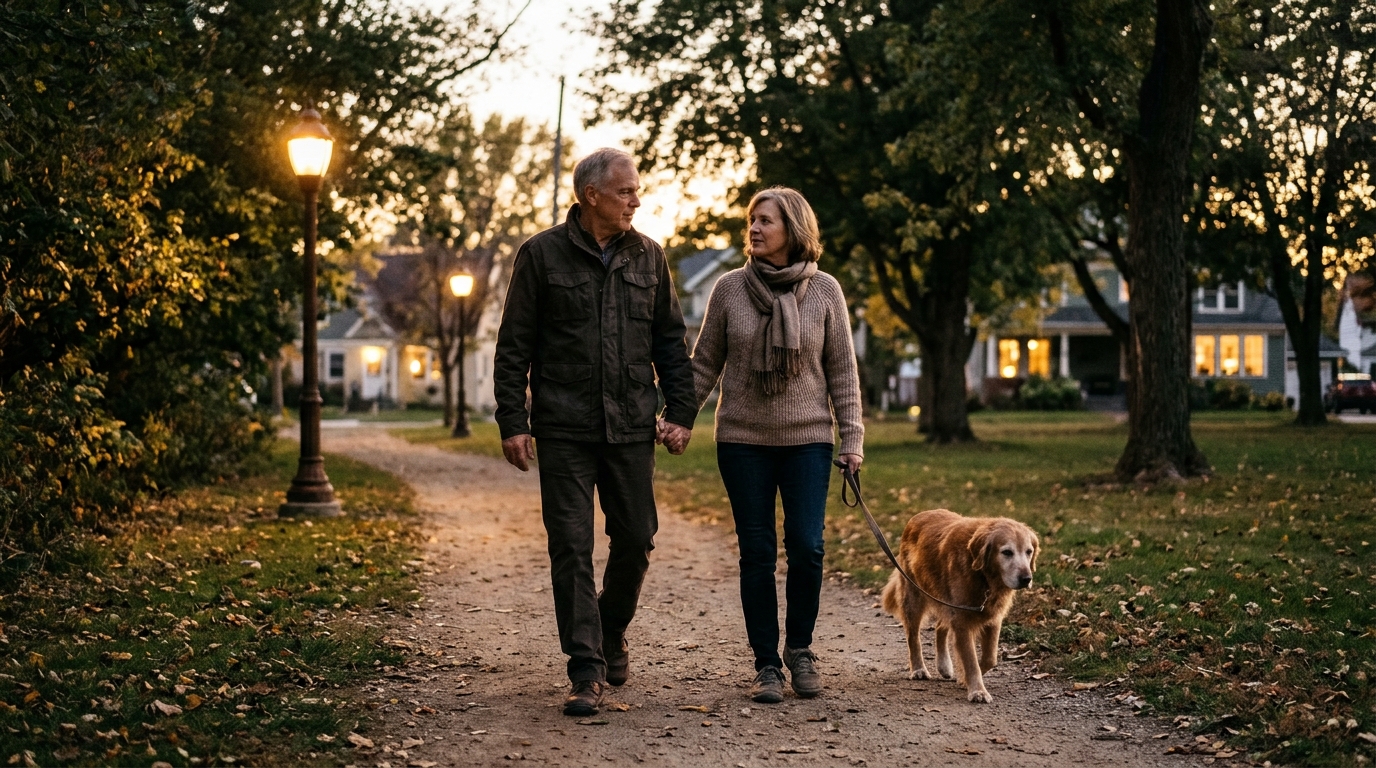
Last Sunday, I walked a few paces behind them for part of the route, with Walter’s permission and Dolores’s amused eye-roll. The sky was the color of peach and lavender, the kind of dusk that makes everything look forgiven. Dolores’s cane tapped a steady rhythm on the sidewalk. Walter’s hand hovered near her elbow, never gripping, always ready.
At her gate, she turned the key, stepped inside, and flipped the switch. The porch light bloomed warm and yellow against the darkening street. Walter waved. Dolores waved back. Then he turned and began his long walk home, whistling something I could not quite place.
Somewhere in those fifteen blocks, I imagine, he was already looking forward to next Sunday.
As the day winds down tonight and the noise fades, maybe you will think of someone whose evenings are quieter than they should be. And maybe, this week, you will find a way to say the same simple thing Walter said all those years ago: “I’m headed that direction anyway.”