🎧 Listen to this story
Narrated by Kore · 7,463 characters
There is a particular kind of quiet that settles over a hospice unit around eight in the evening. The visitors have gone home. The hallway lights dim to amber. The clatter of dinner trays fades, and the building seems to exhale. I did not know about this hour until I met Margaret, and I have not stopped thinking about it since.
I want to tell you about the woman who taught me what actually matters at the end of a life. I will call her Margaret, though that is not her real name. She asked me not to use it, and I have always honored that. She was seventy-one when I met her, a retired schoolteacher who had been volunteering on the evening shift at a small hospice for eleven years.
How I Ended Up There
I came to the hospice the way many people do: through loss. My father had died the winter before, in a hospital room full of beeping machines, and I had spent his final hours arguing with a vending machine and checking my phone. I told myself I was being practical. Really, I was terrified. I did not know what to do with my hands, my eyes, my voice.
Months later, a friend mentioned that the local hospice needed volunteers. I signed up half out of guilt and half out of a hunger I could not name. They paired me with Margaret for my first few shifts, and I followed her around like a nervous student.
The Evening Ritual
Margaret had a routine, and it never changed. At the start of every evening shift, she would walk the hallway slowly and stop at each door. She did not enter. She simply paused, listened, and then moved on.
“What are you doing?” I asked her on my first night.
“Taking the temperature of the evening,” she said. “Not the patients’ temperatures. The evening’s. Every night has one.”
I did not understand what she meant until the third week. Some nights were restless, full of low voices and soft footsteps. Others held a stillness so complete that you could hear the refrigerator humming in the kitchenette at the far end of the hall. Margaret said the stillest nights were often the ones when someone was getting ready to go.
What She Never Did
Over the weeks, I noticed the things Margaret did not do. She never filled silence with chatter. She never said “everything happens for a reason.” She never told anyone to stay strong or to keep fighting. When a family member asked her whether their mother could hear them, she did not offer a confident answer. She said, “I think hearing is the last thing to go. So I always assume it is still there.”
And then she would pull a chair close to the bed and say, quietly, whatever the family could not.
The Night Mr. Alvarez Died
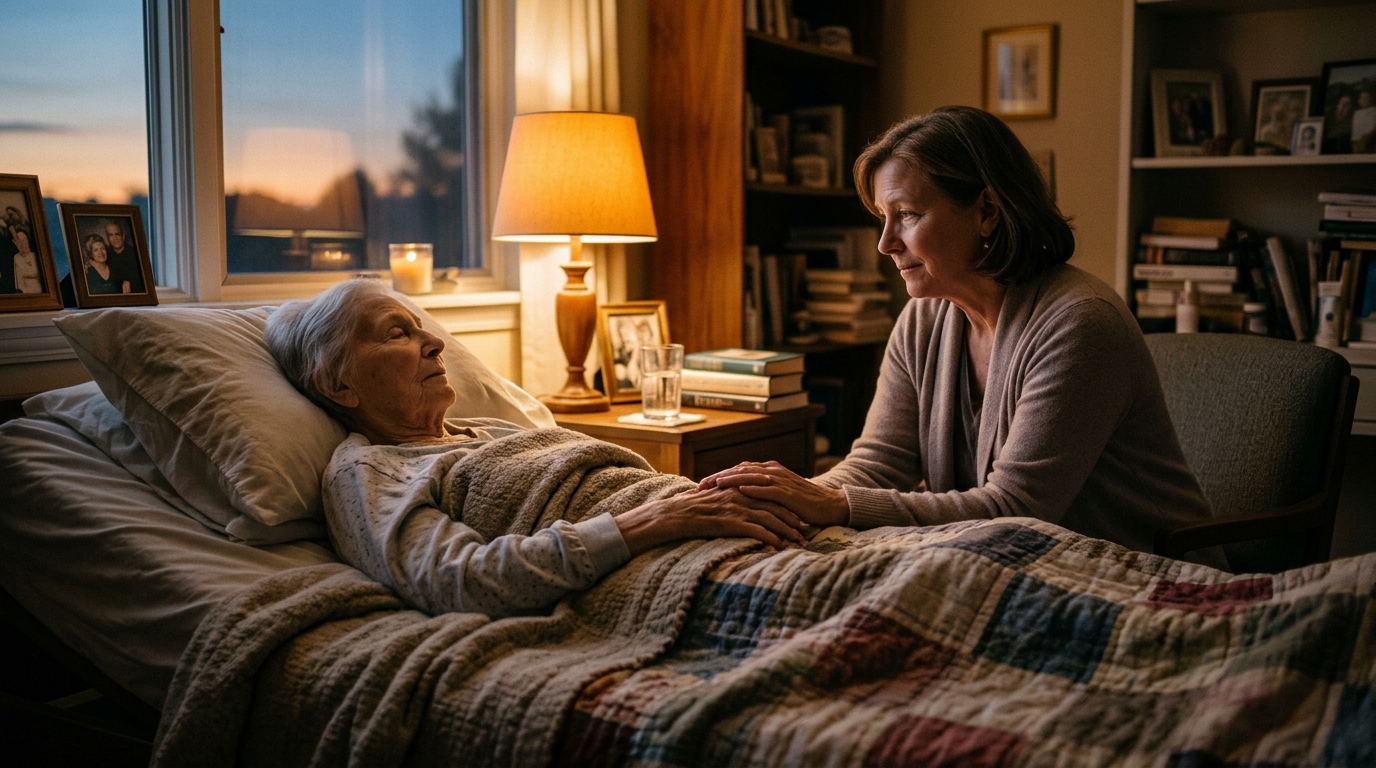
I remember one evening above all the others. A man in his eighties, whom I will call Mr. Alvarez, was in his final day. His family had been at his bedside for hours, but they were exhausted, and his daughter had finally gone to lie down in the family room down the hall.
Margaret sat with him. I sat in the corner, trying to be useful by being invisible.
She did not talk about his illness. She did not talk about heaven. She asked him, in a low and easy voice, about the sound of the ocean, because his daughter had mentioned he used to be a fisherman. She told him the tide was coming in. She told him the boats were all tied up for the night and that everyone was safe at the dock.
His breathing, which had been ragged, slowed and softened. His hand, resting on the blanket, relaxed. At some point in the hour after sunset, with the last orange light fading from the window, he simply was not breathing anymore. There was no struggle. There was only a gentle ending, the way a day ends.
Margaret sat for a long moment. Then she stood, smoothed the blanket, and went to wake his daughter, so that the family could be there for the first minutes of the quiet that came after.
What She Told Me Afterward
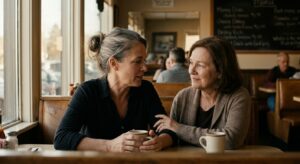
We sat in the kitchenette later, drinking weak tea from paper cups. I was shaking a little. I asked her how she did it, how she stayed so calm.
She thought about it for a while. “I am not calm,” she said finally. “I am just present. Those are very different things. Calm is about me. Presence is about them.”
Then she told me the thing I have carried ever since. She said that in eleven years, she had sat with hundreds of people at the end of their lives, and almost none of them talked about their accomplishments. Almost none asked about money, or work, or the things they had left undone on a to-do list.
What Actually Matters: Margaret’s Short List
She did not call it a list. She said it was just what she had noticed. But I wrote it down that night in the car, in the parking lot, under the yellow glow of a streetlight, and I have kept it ever since.
- People want to be touched. A hand held, a forehead stroked, a blanket tucked. Touch says what words cannot.
- People want to be forgiven, and to forgive. The unfinished quarrels weigh more than any regret about career or travel.
- People want to hear their own names. Not “sweetie” or “the patient in room four.” Their name, said gently, by someone who means it.
- People want familiar sounds. A favorite song, a voice they love, the memory of the ocean, the radio in the kitchen.
- People want someone to stay. Not to fix anything. Not to say anything profound. Just to stay.
The Lesson That Came Home With Me
I think about that list most evenings now, usually around the time the light turns gold and the house goes quiet. It is the hour when I used to scroll through my phone or answer one last email. Now I try to do something different.
Last week, I called my sister, whom I had not spoken to in months over a stupid disagreement. I did not rehearse. I did not plan what to say. I just said her name, and she said mine, and for a minute neither of us could speak. It was the best conversation we have had in years.
I used to believe that the big moments were the ones that counted: the promotions, the milestones, the grand gestures. Margaret showed me that what stays with people at the end is almost embarrassingly simple. It is who sat beside them. It is who said their name softly in the dark.
A Small Practice for Your Own Evening
You do not have to volunteer at a hospice to learn what Margaret taught me. You can begin tonight, in the wind-down hour, with something small:
- Put your phone in another room for ten minutes.
- Think of one person you have been meaning to reach out to.
- Say their name, out loud or in a message, with nothing attached to it. No agenda. Just a warm hello.
- Sit for a moment in the quiet afterward and notice how you feel.
That is all. It will not change the world. But it will change your evening, and evenings add up to a life.
Where Margaret Is Now
Margaret retired from the evening shift two springs ago. Her knees, she said, could no longer manage the long hallway. I visit her sometimes now. We sit on her porch as the sun goes down, and we do not talk about much. Sometimes a bird lands on the railing. Sometimes the street lamps flicker on, one by one, down the block.
Last month she told me she was not afraid of her own evening, whenever it arrives. “I have sat with enough people,” she said, “to know that it is usually gentler than we think. And that the people who love us are usually closer than we realize.”
I took her hand. She did not say anything. She did not need to.
The light was soft, the street was quiet, and for a moment the whole world seemed to be holding its breath, the way it does at the end of a good day. I stayed until the stars came out.