🎧 Listen to this story
Narrated by Kore · 6,041 characters
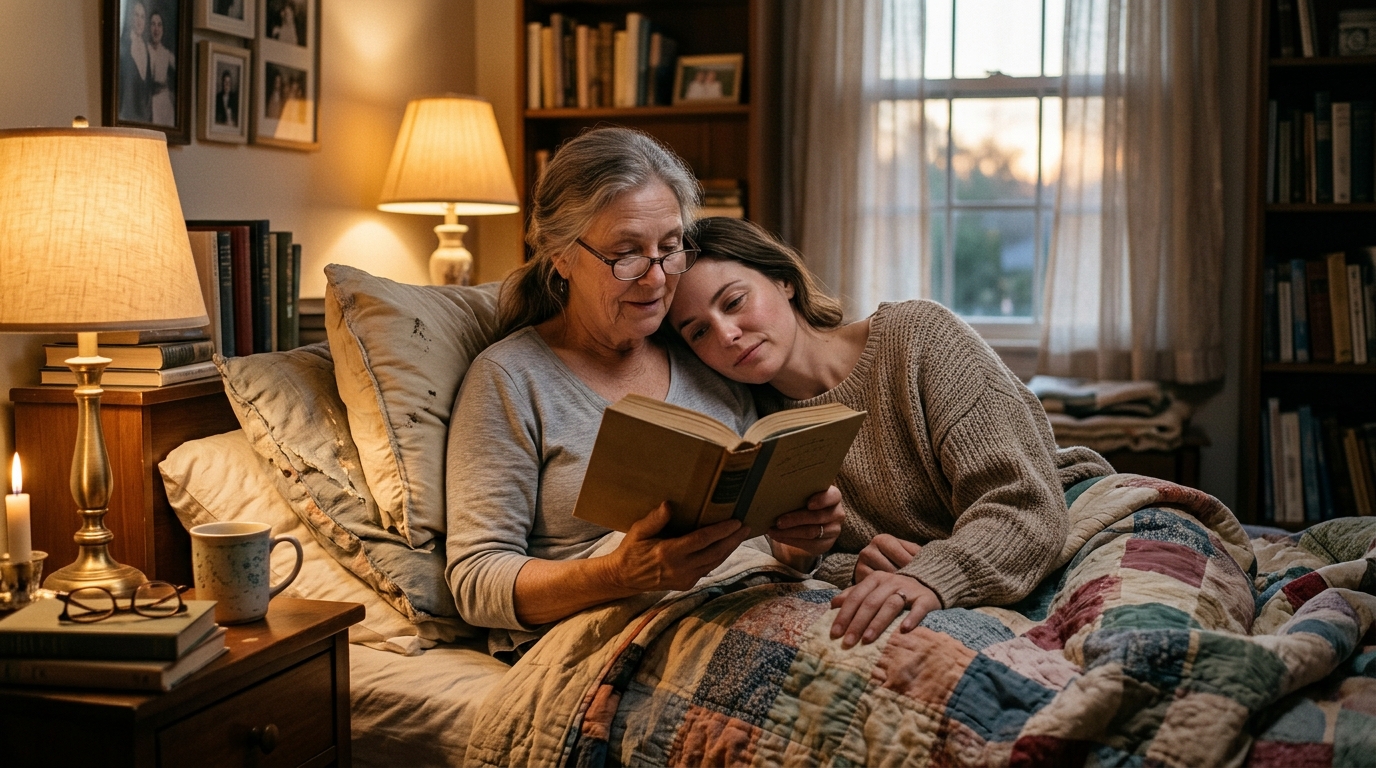
I was thirty-four years old, sitting on the edge of a guest bed in my childhood home, when my mother picked up a worn paperback and said, “Lie down. I’ll read you a chapter.”
I laughed. I had a mortgage, a career, and a gray hair or two I had stopped pulling out. But I lay down anyway, and something in my chest loosened that I hadn’t realized was clenched tight.
That was the winter my marriage ended, though I hadn’t told anyone yet. I had driven four hours home on a Friday night with a small overnight bag and no explanation. My mother didn’t ask for one. She simply made tea, turned down the covers in my old room, and waited for the evening to do what evenings do.
The Quiet After the Dishes Are Done
There is a particular hour in a home that belongs to no one’s schedule. The dishes are dry, the television has gone dark, the neighbors’ porch lights click off one by one. The day has finished arguing with you, and what is left is the truth of it, whatever you have been carrying around since morning.
For most of my adult life I had treated that hour as an enemy. I filled it with my phone, with work emails, with anything that kept me from sitting still with myself. In my mother’s house, there was nowhere to hide from it. The house was too quiet. The streetlight outside the window threw the same amber square on the ceiling it had thrown when I was seven.
She sat in the armchair beside the bed, the one with the sagging cushion she refuses to replace, and opened the book.
The Book We Had Both Forgotten
It was Charlotte’s Web. Of course it was. The spine was cracked in three places and the corners had gone soft as cloth. She had read it to me when I was six, then again when I was nine and asked for it, and apparently she had never given it away.
“I thought you might like to hear it again,” she said, as if it were nothing. As if she hadn’t been keeping it ready for a night like this one.
Then she began to read, and I stopped hearing the words almost immediately. What I heard instead was the voice.
The Voice That Said Everything Without Saying It
My mother’s reading voice is not her regular voice. Her everyday voice is brisk and practical, a voice that organizes, reminds, and corrects. But her reading voice drops lower and slows down. It rounds every sentence like a stone worn smooth by a river. She leaves long, unhurried pauses between paragraphs, as though she trusts the story to wait for her.
Lying there in the dark, I understood something I had missed for three decades. That voice had never been about the book. It was a message, delivered in the only language that does not need translating: You are safe. I am here. Nothing needs to be solved tonight.
When I was a child, I thought the stories were the gift. Now I understood that the gift was the willingness to sit in a hard chair at the end of a long day and give someone the full weight of your presence, with no agenda and no expectation of thanks.
What Staying Actually Looks Like
Somewhere in the middle of the chapter about Wilbur’s fear of the winter, I started to cry. Not loudly. Just a slow leak of tears into the pillow, the kind you can pretend isn’t happening if no one mentions it.
My mother did not stop reading. She did not say a word. She did not reach for me or rush to fix anything. She let her voice carry on at the same steady pace, a lamp left burning in a window, and in that steadiness I felt more held than any embrace could have made me feel.
I have thought about that moment more than almost any other in the years since. We spend so much energy believing that love means doing something, offering advice, delivering solutions, saying the perfect comforting phrase. My mother taught me, without a single lecture, that sometimes love simply means refusing to leave the room.
Three Things the Evening Taught Me
In the weeks that followed, I kept returning to that night, turning it over like a smooth stone in my pocket. Here is what has stayed with me:
- Presence is a form of speech. The most important thing my mother said that night was never spoken. She communicated everything by being exactly where she was, fully, until I was ready to rest.
- You never outgrow being cared for. We treat adulthood as a graduation from needing comfort. But the part of us that wants to be read to, tucked in, and kept company never expires. It only learns to be embarrassed.
- Small rituals are where love hides. A cracked paperback, a sagging armchair, a cup of tea going cold on the nightstand. These are not trivial details. They are the quiet architecture of belonging.
The Last Page
I fell asleep before the chapter ended. In the morning, the book was closed on the nightstand with a bookmark tucked inside, and my mother was downstairs frying eggs as though nothing extraordinary had happened.
Maybe, to her, nothing had. That is the strange and beautiful thing about the deepest kinds of love. The people who practice it rarely notice they are doing anything at all.
I stayed three more days. Each night, around the same hour, she appeared in the doorway with the book, and each night I lay back and let her voice carry me down into sleep. By the end of the week, I could finally say the words I had driven four hours to avoid. She nodded, set down her tea, and told me, “I know. I’ve known since you walked in.”
She had known all along. She had simply waited for me to be ready.
An Invitation for Tonight
If there is someone in your life whose voice once carried you to sleep, a parent, a grandparent, an old friend, consider calling them this evening. Not to fix anything or to report on your day, just to listen to them breathe and speak and be. And if you are the one who still holds the book, who is still willing to sit in the hard chair at the end of the day, know this: you are doing something that matters more than you will ever be told.
The lights go out on all of us eventually. What lingers in the dark is not what we accomplished, but who stayed beside us until we fell asleep.
Goodnight, Mom. Thank you for the chapter.