🎧 Listen to this story
Narrated by Kore · 6,770 characters
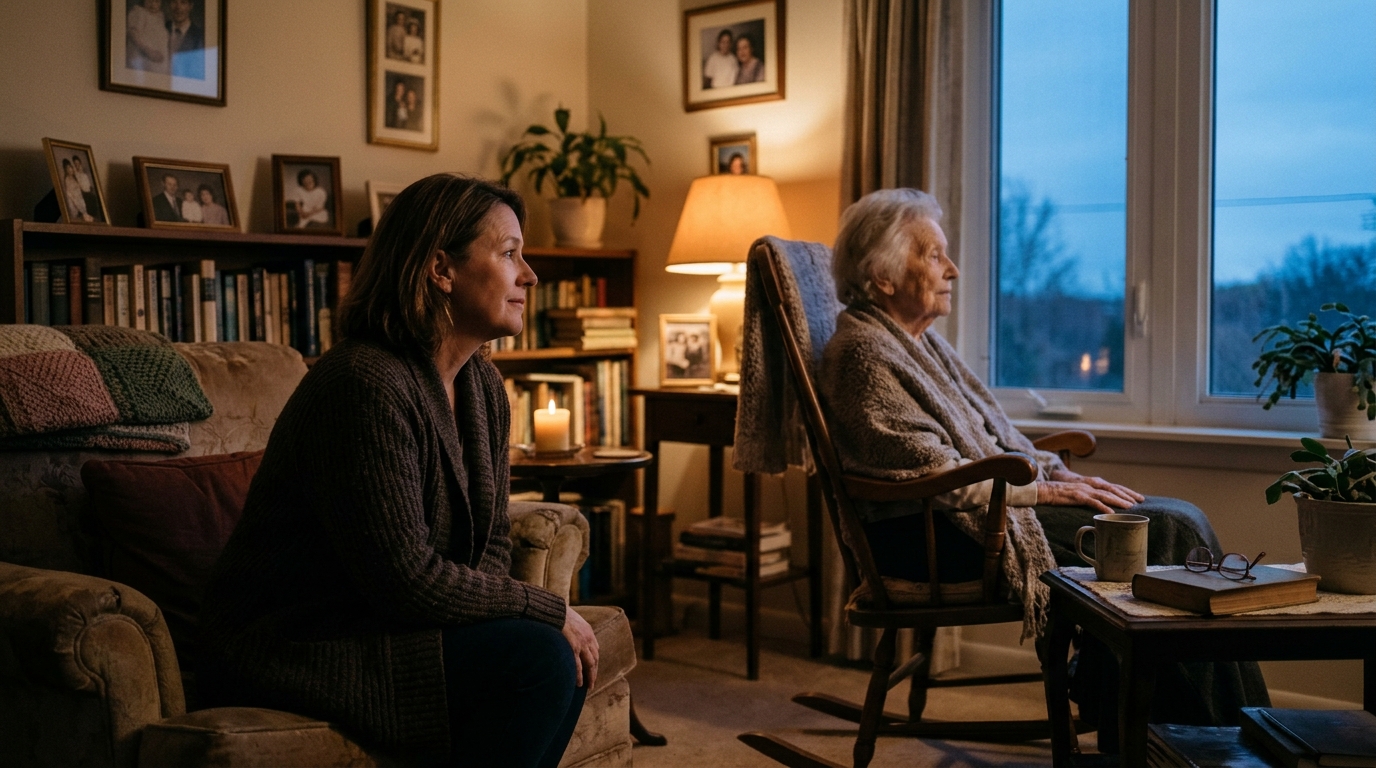
For most of my childhood, I thought my grandmother’s evening ritual was a kind of mystery she had no intention of explaining. Every night, after the dishes were dried and the porch light clicked on, she would sit in the same wooden chair by the window, fold her hands in her lap, and go still. No television. No radio. Just a small lamp, a worn rosary she never quite used the way the books said you should, and a quiet that seemed to fill the whole house.
I was eight the first time I asked her what she was doing. She smiled and said, ‘I’m closing the day, mija.’ I nodded as if I understood. I did not.
The Chair by the Window
Her name was Concepcion, though everyone called her Abuela Connie. She raised five children on a seamstress’s income, buried a husband at fifty-three, and still managed to make her kitchen the warmest room in three counties. She was not a woman who sat still during the day. She was always mending, stirring, scolding, feeding.
But at nine o’clock, she stopped. The change was so complete it startled me as a kid. One minute the house was alive with her humming and the clatter of pots, and the next she was in that chair, eyes closed, lips moving softly.
As a teenager, I found it a little embarrassing. As a young adult, I found it quaint. I was busy, ambitious, and convinced that rest was something you earned after you had finished everything, and since you never finished everything, rest could always wait.
What I Thought I Knew
I assumed her nightly prayer was simply habit, the way some people floss or lock the doors. A thing done because it had always been done. I never thought to ask what she was actually saying, or what she was actually doing in those quiet minutes.
I wish I had asked her more. I wish I had sat on the floor by her chair and just listened.
The Year Everything Got Loud
When I turned forty, my life looked successful from the outside. Good job, a house with a yard, two kids, a marriage I was grateful for. And yet I felt perpetually behind, as though the day were a train I was always running to catch.
My evenings had become a blur. I would collapse onto the couch with my phone, scrolling through news I could not change and photos of lives that were not mine, and then drag myself to bed carrying the entire weight of the day on my shoulders. I slept badly. I woke up already tired. I carried every unfinished task, every sharp word I had said to my daughter, every worry about money and time and aging parents, straight into the dark.
Abuela Connie had been gone for six years by then. I had not thought about her chair in a long while.
The Night It Clicked
It happened on an ordinary Tuesday in October. I had snapped at my son over a spilled glass of juice, a small thing I knew was small even as I said it. After the kids were asleep, I stood in the kitchen with the dishes half done and felt a wave of exhaustion so deep it surprised me.
I turned off the overhead light. The only glow came from the small lamp over the stove. And without planning to, I pulled a chair to the window, sat down, and did nothing.
At first, my mind raced. The list of undone things scrolled past like credits. But I stayed. The house ticked and settled around me. Outside, the sky had gone the deep blue of just after sunset, and a single neighbor’s window glowed yellow across the street.
Slowly, something loosened in my chest. And I thought, with a clarity that nearly made me laugh: This is it. This is what she was doing.
Closing the Day
She had not been escaping her life in that chair. She had been completing it. Closing the day, as she said. Gathering up the scattered pieces, the gratitude and the regret and the worry and the small joys, and setting them down before sleep, so she would not have to carry them into the dark.
Her prayer was not really about asking for things. It was a practice of arrival. A way of saying, I was here today. I did what I could. The rest I release.
What the Ritual Actually Teaches
In the weeks that followed, I started keeping my own small version of her evening hour. I did not borrow her words, since they were hers. But I borrowed her shape. And I began to see what she had known all along.
- The day needs an ending. Without a deliberate close, our worries bleed into sleep and our unfinished tasks follow us into dreams.
- Stillness is not laziness. It is the quiet work of making peace with what happened and what did not.
- Gratitude is easier to find at dusk. When the noise fades, the good things of the day become visible, the warm coffee, the funny thing a child said, the stranger who held a door.
- Regret loses its grip when spoken aloud. Naming the day’s mistakes, even silently, makes them smaller and easier to forgive.
- Ritual holds us when willpower cannot. A chair, a lamp, a few quiet minutes. The simplicity is the strength.
A Small Practice You Can Borrow
If this speaks to you, you do not need a religious tradition or a rosary to begin. You only need a few minutes and a willingness to stop. Here is the gentle version I now keep most nights:
- Dim the lights and sit somewhere that feels settled, a chair by a window works beautifully.
- Take three slow breaths. Let the day’s noise drain out with each one.
- Name one thing you are grateful for, however small.
- Name one thing you wish had gone differently, and then, quietly, forgive yourself for it.
- Name one hope for tomorrow, and let it go.
- Sit for a minute longer than feels necessary. That last minute is often where the peace arrives.
What I Wish I Could Tell Her
Sometimes, in that quiet hour, I imagine Abuela Connie in the chair beside mine. I imagine telling her that it took me forty years to understand what she gave me every single night for my entire childhood, a living example of how to end a hard day with grace.
I think she would smile the same way she did when I was eight. She would not say ‘I told you so.’ She never did. She would simply nod, fold her hands, and let the silence do the teaching, as it always had.
My own daughter is seven now. Last week, she wandered into the kitchen after bedtime, rubbing her eyes, and found me in my chair by the window. She did not ask what I was doing. She just climbed into my lap, rested her head against my shoulder, and was quiet with me.
I do not know if she will understand it yet. But one day, perhaps when she is forty and the world has grown loud, she might remember a lamp, a window, and a mother who knew how to close the day. And she might finally, gently, understand.
Tonight’s Gentle Invitation
As the light fades where you are, I hope you find a few minutes to sit with your own day. You do not have to fix it or finish it. You only have to be with it, and then set it down.
Somewhere, a grandmother’s chair is waiting. Maybe it is yours.