🎧 Listen to this story
Narrated by Kore · 6,485 characters
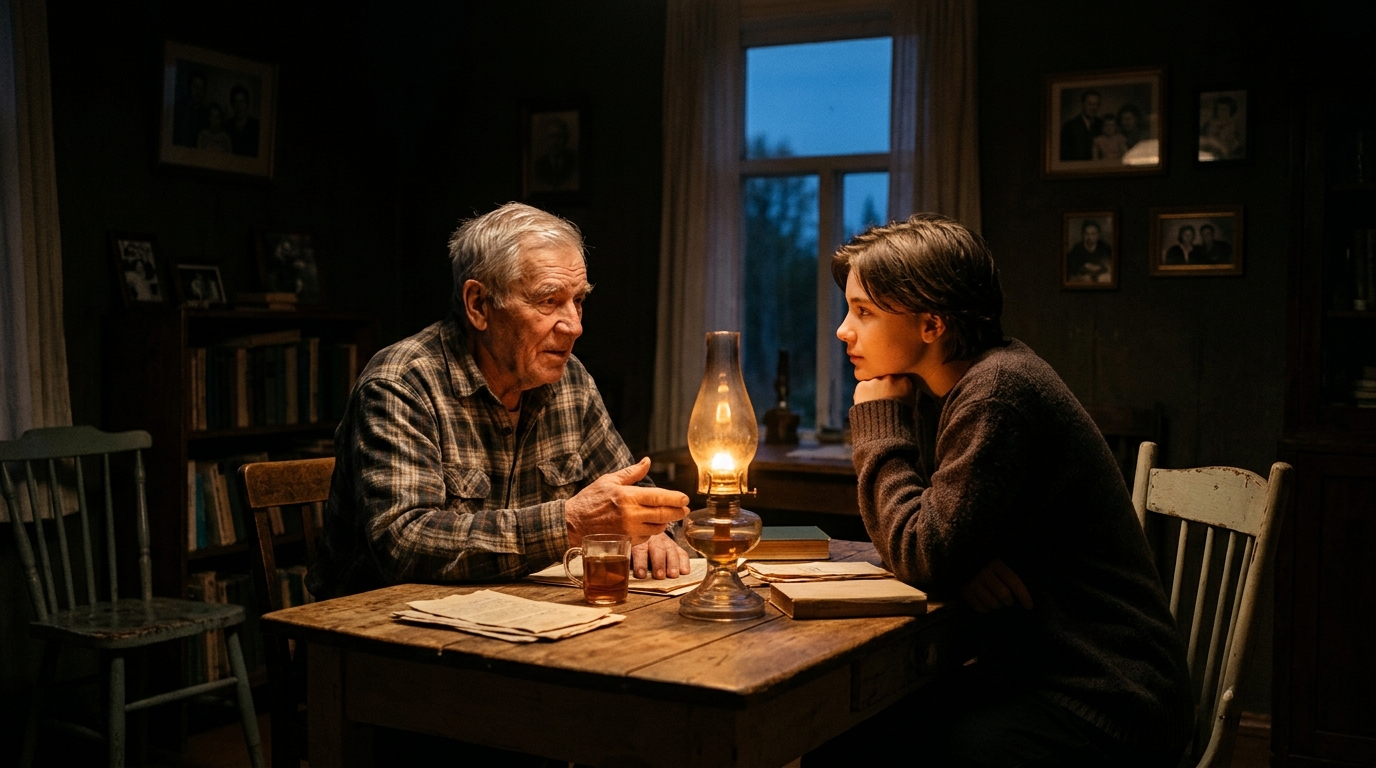
The house had gone quiet in the way houses do around eight o’clock in the evening, when the dishes are done and the last of the daylight has slid off the kitchen floor. I remember thinking that I should leave soon. I had a long drive home and a meeting the next morning. Instead, I pulled the wooden chair closer to my grandfather’s bed and sat down, not knowing it would be the last time I did.
The Hour Before Sleep
My grandfather, Walter, had always been a man of routines. Coffee at five-thirty. The crossword before breakfast. A walk to the mailbox that he insisted was exercise, even when the mailbox was only forty steps away. But the routine he cherished most was the one that happened at the end of the day: the lamp on the nightstand, a glass of water, and a few quiet minutes of talking before sleep.
When I was a child sleeping over at his house, those minutes were when the real conversations happened. Somehow, in the dimness, with the world pressed down to the size of one yellow circle of light, people say things they would never say at noon. He knew this. He had built his whole life around it.
By the time of that last visit, he was ninety-one and tired in a way that sleep no longer fixed. The nurse had told us gently that it might be soon. Nobody said when. We just moved a little slower around him and spoke a little softer.
What I Expected to Hear
I had rehearsed this moment for weeks, in the car, in the shower, in the quiet gaps of my own days. I thought there would be a grand statement. Some sweeping piece of wisdom, delivered with a squeeze of my hand, that I could carry for the rest of my life like a stone in my pocket.
That is not what happened. What happened was smaller and, I now believe, far more valuable.
He asked me whether I had eaten. I told him I had. He asked whether the traffic had been bad. I said it had not. Then he was quiet for a long while, and I thought he had drifted off. The lamp hummed. Somewhere outside a late bird was still arguing with the dark.
The Question He Asked Instead
Finally he opened his eyes and said, “Tell me something good that happened today.”
I almost laughed. Here was a man at the end of his life, asking me to name a small good thing. I started to say that nothing much had happened, that it had been an ordinary day. Then I stopped, because I realized he had asked me this question nearly every evening of my childhood, and I had forgotten.
So I thought about it. I told him that a woman in the checkout line had let me go ahead of her because I only had two items. I told him that the coffee that morning had tasted unusually good. I told him that I had noticed the light on the highway at sunset and had actually looked at it instead of scrolling through my phone at the red light.
He smiled at every one. Not politely, but with real delight, as though I had handed him treasure.
The Lesson in the Smallness
I have thought about that exchange almost every night since. My grandfather was not asking for an accomplishment or a headline. He was teaching me, one last time, a habit that had carried him through ninety-one years, a war, a lost business, the death of a wife, and more ordinary Tuesdays than anyone could count.
Here is what I understand now about that habit:
- Good things are usually small. If you wait for the big ones, you will miss nearly all of them.
- Attention is a form of gratitude. You cannot be grateful for what you never noticed.
- The end of the day is a gift. It is the one moment when the noise fades enough that you can finally hear what mattered.
- Saying it out loud makes it real. A good thing that stays unspoken tends to evaporate by morning.
The Last Thing He Said
After I finished my list, he reached over and patted the back of my hand. His fingers felt light, almost papery, but his grip was steady. He said, “That’s a good day. You had a good day.”
I said, “I did.”
He nodded slowly and said, “Keep counting them.” Then he closed his eyes, and his breathing settled into the slow, even rhythm of sleep. I sat there for a while longer, watching the lamp light rest on his face, listening to the house tick and settle around us. When I finally stood to leave, I turned off the lamp the way he always did, with two fingers, gently, as if not to wake the dark.
He passed in the early hours of the morning, peacefully, in the same bed, in the same quiet house. I was told he never woke again. That means the last words he spoke to anyone in this world were those three: Keep counting them.
How I Count Now
I did not understand at first why those words hit me so hard. Grief has a way of making everything feel enormous and nothing feel solid. But over the following weeks, I started doing what he asked, almost without deciding to.
Every night, before sleep, I name three good things from the day. Sometimes they are tiny: a stranger’s smile, a warm shower, a song that came on at the right moment. Sometimes, on harder days, I have to dig. But there is always something. That is the secret he knew. There is always something.
I have started teaching it to my own kids at bedtime. They roll their eyes a little, the way kids do, and then they answer anyway. Last week my youngest said, “I liked the way the dog’s ears flopped when he ran.” I told her that was a perfect answer. I did not tell her where I learned the question. Maybe one day I will.
A Small Practice for Your Own Evening
You do not need to wait for a hospital room or a goodbye to try this. Tonight, when the dishes are done and the house starts to settle, try it:
- Sit somewhere quiet, ideally with one soft light on.
- Ask yourself, out loud if you can: What good thing happened today?
- Name three, no matter how small. A warm cup, a kind word, a patch of sky.
- Let yourself feel each one for a breath before moving to the next.
- Turn off the light and let the day close.
That is all. It costs nothing. It takes five minutes. And it may quietly change the way you see everything that comes after.
The Light That Stays On
I still keep a lamp like his on my own nightstand, a little brass one with a pleated shade. Some nights, when the house is quiet and the day has finally let go of me, I switch it on and sit for a moment before sleep. I can almost hear his voice in the stillness, patient and warm, asking the only question he ever really needed to ask.
Tell me something good that happened today.
And I do. Because he asked me to keep counting, and I intend to count for as long as I have days left to count.