🎧 Listen to this story
Narrated by Iapetus · 8,130 characters
A Waiting Room Unlike Any Other
Walk into Dale Calloway’s auto shop in Knoxville, Tennessee on a Tuesday morning and you might notice something unusual. Alongside the usual smell of motor oil and the sound of pneumatic wrenches, there are children’s drawings taped to the waiting room wall. A small basket of juice boxes sits on the counter next to the coffee machine. And on the whiteboard near the front desk, instead of a price list, someone has written in blue marker: “You’ve got enough to worry about. Leave the car to us.”
Dale, 54, has been a licensed mechanic for over three decades. For the last eleven years, he has quietly operated what locals now call the “Secret Shop” program, offering free or heavily subsidized vehicle repairs to single mothers referred through Knoxville’s network of domestic violence shelters and transitional housing organizations. No invoices. No payment plans. No awkward conversations about what they can and cannot afford.
Just fixed cars, and a handshake on the way out.
How It Started: A Flat Tire and a Fork in the Road
Dale is quick to say the program was never some grand plan. It started with one woman and one flat tire in 2013.
“She came in pushing a stroller, two kids walking behind her, and she had this look on her face like she was already bracing for bad news,” Dale recalls, leaning against a workbench. “Her front tire was shredded. She told me she’d been driving on it for two weeks because she couldn’t afford to fix it and couldn’t afford not to drive. She needed the car to get to work, to get her kids to school. Everything depended on that car.”
He fixed the tire. He charged her nothing. And then he thought about how many other women were probably in the exact same position, one mechanical failure away from losing a job, missing a custody appointment, or being stranded somewhere unsafe.
Within six months, he had reached out to three local shelters and introduced himself. Within a year, the referrals had become a steady stream.
How the Program Works
The mechanics of the program, no pun intended, are straightforward but thoughtfully designed.
- Shelter staff refer clients directly. Women do not have to explain their situations to Dale or his team. The referral from a shelter coordinator is enough.
- All repairs are assessed honestly. Dale and his two full-time mechanics evaluate every vehicle and complete whatever work is needed, from oil changes to full transmission rebuilds.
- Parts costs are covered through donations. Dale established a small nonprofit account that local businesses and individuals contribute to throughout the year. A handful of auto parts suppliers also donate inventory.
- Labor is always free. No exceptions.
- Clients are treated like any other customer. Dale is firm about this. “They don’t come in the back door. They don’t get a lesser version of the service. They are customers and they are treated with respect, full stop.”
What a Working Car Actually Means
It is easy to underestimate what reliable transportation means to someone rebuilding their life after leaving an abusive relationship or escaping homelessness. For many of the women Dale has helped, a car is not a convenience. It is infrastructure.
Consider what transportation touches in a single day for a working mother with children: the morning school drop-off, the commute to a job she cannot afford to lose, a lunchtime call to a case worker, an after-school pickup, a trip to a food pantry or social services office. Remove the car and that entire scaffolding collapses.
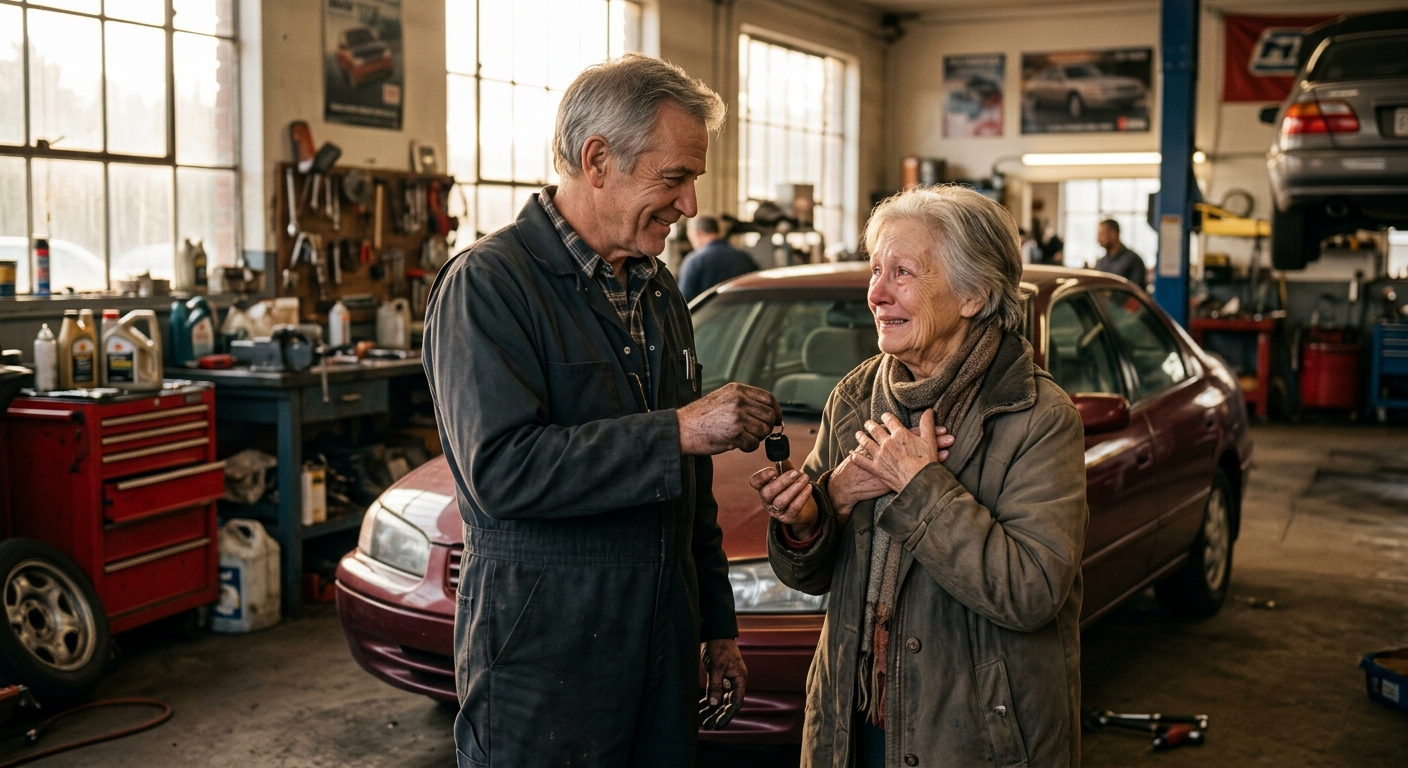
“I’ve had women cry in my waiting room,” says Brenda Okafor, a case coordinator at one of the partnering shelters. “Not because they’re sad, but because someone fixed something for them without asking for anything in return. After everything they’ve been through, that kind of uncomplicated kindness hits people hard.”
Brenda estimates that over the past several years, Dale’s program has directly supported more than 200 women across multiple shelter organizations in the Knoxville area.
The Team Behind the Wrench
Dale does not do this alone, and he is careful to point that out.
His lead mechanic, a 38-year-old named Marcus who has worked at the shop for nine years, donates roughly four hours of his own labor every week specifically to program vehicles. “Dale told me about it when I first started and asked if I was okay with it,” Marcus says with a shrug. “I told him I’d do him one better and put in my own hours. It’s not a sacrifice. It’s just the right thing.”
The shop’s part-time bookkeeper, Carolyn, manages the nonprofit account pro bono. Three local businesses, a diner, a hardware store, and a dental practice, have standing monthly donations that keep the parts fund solvent.
And Dale’s wife, Patricia, baked the idea of the juice box basket. “She said if a mom has to wait two hours for a brake job with her kids, the least we can do is make those two hours comfortable,” Dale laughs. “She was right, as usual.”
Criticism, Challenges, and Keeping the Lights On
Running a free service inside a for-profit business is not without friction. Dale has had to carefully manage the volume of referrals to avoid the program overwhelming his regular operations. There have been months where the parts fund ran low and he covered the gap personally. And not everyone has been supportive.
“I had a competitor tell me I was undercutting the market and that I was being naive,” Dale says, his tone matter-of-fact rather than defensive. “And look, I get it. Everyone has a business to run. But I’ve never seen a competitor’s waiting room with a kid’s drawing on the wall. So I’m okay with the tradeoff.”
He has also, on rare occasions, had to decline referrals simply because the backlog was too long. Those moments bother him most. “That’s the part that keeps me up at night. Knowing someone’s sitting somewhere with a car that doesn’t run and I had to say, not yet.”
Seven Things Dale’s Program Teaches Us About Everyday Heroism
- You don’t need a nonprofit to start. Dale began with zero organizational structure. Just a decision and a willingness to act.
- Dignity is part of the service. How you help matters as much as whether you help.
- Skills are gifts. Everyone has expertise that someone else desperately needs. Mechanic, nurse, accountant, teacher, it doesn’t matter.
- Small businesses can lead. Corporate philanthropy gets the headlines, but a shop with four bays and a whiteboard is changing real lives quietly.
- Community multiplies impact. Dale’s reach expanded dramatically once shelters became partners. Institutions and individuals are stronger together.
- Sustainability requires honesty. Dale limits intake to protect the program’s long-term viability. Knowing your limits is wisdom, not selfishness.
- The ripple effect is real. Every woman who gets her car fixed keeps her job, keeps her kids in school, builds her credit, rebuilds her life. Dale’s work doesn’t end in the shop bay. It travels forward in ways he will never fully see.
What Comes Next
Dale has no plans to expand into a franchise or turn his story into a speaking career. When asked if he hopes others will replicate the model, he pauses for a moment before answering.
“I hope someone reads this and thinks, what’s the version of this that I can do? Because it doesn’t have to be cars. It could be legal advice, or haircuts, or tutoring, or groceries. The need is everywhere. The skills are everywhere. We’re just not always paying attention to the connection between them.”
Back in the waiting room, a woman named Sandra is waiting for a brake line repair. She has her youngest daughter on her lap and is reading her a picture book. When asked how she heard about the shop, she smiles.
“The shelter told me a man here fixes cars for free. I didn’t believe it at first.” She glances down at her daughter, then back up. “I believe it now.”
And with that, Dale’s name is called from the garage. He wipes his hands on a rag, nods to Sandra, and disappears back through the door. Just another Tuesday. Just another car. Just another life, quietly steadied by someone who decided his skills were not just for profit.