
🎧 Listen to this story
Narrated by Vindemiatrix · 6,056 characters
The Morning Before the Rain
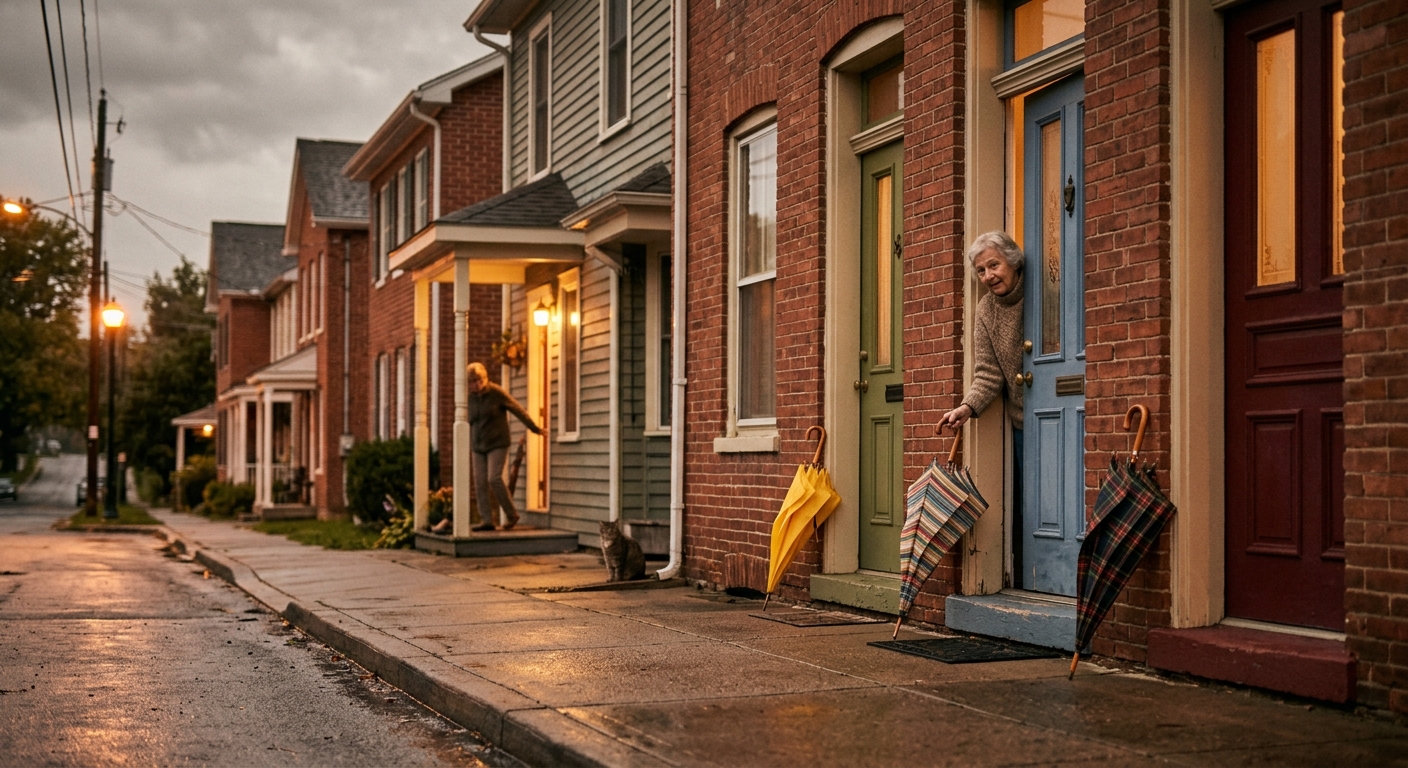
It started, as most quiet miracles do, without fanfare. On a Tuesday morning in early October, residents of Clover Street in Portland, Oregon, stepped outside to find something unexpected sitting on their front stoops: a brand new umbrella, still in its plastic sleeve, leaning against each door like a small, silent promise.
No note. No name. No explanation.
By 2 p.m. that afternoon, the skies opened up in what meteorologists would later call the heaviest single-day rainfall the city had seen in eleven years. And every single person on that block stayed dry.
What the Neighbors Saw
We spoke with several residents of Clover Street to piece together what happened that morning. The accounts were remarkably consistent, and remarkably brief: nobody saw a thing.
“I walked out at around 7:15 to grab my newspaper,” said Margaret Osei, a retired schoolteacher who has lived on the block for over two decades. “And there it was. A nice one too, not some dollar-store throwaway. One of those sturdy ones with the wooden handle. I looked up and down the street and there was nobody around. I thought maybe I was dreaming.”
Her neighbor, a young father named David Chu, noticed his around 6:45 a.m. when he stepped out to warm up his car before the school run. “There were umbrellas on every door as far as I could see,” he said. “My first thought was that it was some kind of marketing stunt. But there was no logo, no flyer, nothing. Just the umbrella.”
A college student named Priya Nair, who rents a basement apartment at the far end of the street, said the umbrella probably saved her morning. “I had a presentation at 9 a.m. I had completely forgotten about the storm warning. I would have been absolutely soaked. Whoever did this, they thought of everyone. Even the basement apartment. They didn’t skip a single door.”
The Numbers Tell a Story
Clover Street has 34 residential properties. Each umbrella, residents estimated, was a mid-range model worth approximately $18 to $22. That means whoever did this spent somewhere between $600 and $750, plus the time to quietly visit every single doorstep before sunrise, without being seen, without leaving a trace.
This was not an impulse. This was a plan.
The Internet Tries to Find the Answer
By Wednesday morning, a post in the Clover Street neighborhood Facebook group had attracted over 400 comments and been shared more than 1,200 times. The theories ranged from the touching to the conspiratorial.
- A recently widowed man on the block who was known for his generosity
- A local church group doing anonymous outreach
- A wealthy teenager doing a school community service project
- A tech worker who had just received a bonus and wanted to “do something real with it”
- A woman who had once been caught in a terrible storm herself and never forgot it
None of the theories were confirmed. The leading candidate, an elderly man named Frank Delgado who neighbors described as “exactly the kind of person who would do this,” flatly denied it with a wide smile that convinced absolutely no one. “I wish I had thought of it,” he said.
What This Moment Taught a Whole Block of Strangers
What’s most striking about this story isn’t the umbrellas. It’s what happened after.
Margaret says she now waves at her neighbors every morning, something she admits she had stopped doing sometime around 2019. David organized a block barbecue the following weekend, the first one Clover Street had seen in years. Priya says she introduced herself to the couple upstairs for the first time, even though she had lived below them for eight months.
“Something about not knowing who did it made us all look at each other differently,” Priya explained. “Like, it could have been any of them. And that made me think, well, maybe these are good people. Maybe I should actually know them.”
The Gift of Anonymous Kindness
There is something uniquely powerful about generosity without a face. When kindness is anonymous, it cannot be about reputation. It cannot be about reward. It strips the act down to its most essential form: one human being quietly deciding that strangers deserve to be looked after.
In a world that rewards visibility, that insists on credit, that runs on likes and follows and recognition, someone on Clover Street made a different choice. They gave something real to 34 households and then disappeared into the morning before anyone could thank them.
And maybe that’s the lesson. Not every good deed needs an audience. Sometimes the most powerful thing you can do is help people and then simply walk away.
Could You Be the Next Umbrella Person?
Before we close, here are a few ways the Clover Street story can inspire something small but meaningful in your own neighborhood:
- Leave something useful, not just decorative. Think about what people actually need in the next 24 hours.
- Think about everyone. The person on the street didn’t skip the basement apartment. Make sure your act includes the people who are easiest to overlook.
- Do it before they know they need it. The storm hadn’t arrived yet. The gift came before the problem.
- Stay anonymous if you can. There’s a quiet magic in letting the kindness speak for itself.
- Don’t wait for a big occasion. A random Tuesday in October. That’s all it took.
The Umbrella Is Still Up There
Margaret Osei keeps her umbrella in the stand by her front door. She’s used it several times since that October morning, and every time she opens it, she thinks about the person who left it.
“I hope they know it mattered,” she said. “I hope somehow, in whatever way these things work, they felt it.”
She paused for a moment, then added: “I’ve been trying to think of my own version of it. Something I could do for someone else without them knowing. I haven’t figured it out yet. But I will.”
And maybe that’s the most remarkable thing about what happened on Clover Street. One person’s quiet act of kindness sent 34 households quietly looking for someone else to take care of. The storm passed. But something else arrived that morning, and it hasn’t left.