
🎧 Listen to this story
Narrated by Aoede · 6,891 characters
A Meeting That Defied the Rules of Nature
In the cold, steel-grey waters of the North Atlantic, something happened that marine biologists struggled to explain with their usual frameworks. A lone bottlenose dolphin, separated from its own kind and adrift in unfamiliar territory, did not vanish into the statistics of ocean survival. Instead, it was taken in. Welcomed. Incorporated into the daily rhythms of a pod that, by every biological measure, should have treated it as something other than family.
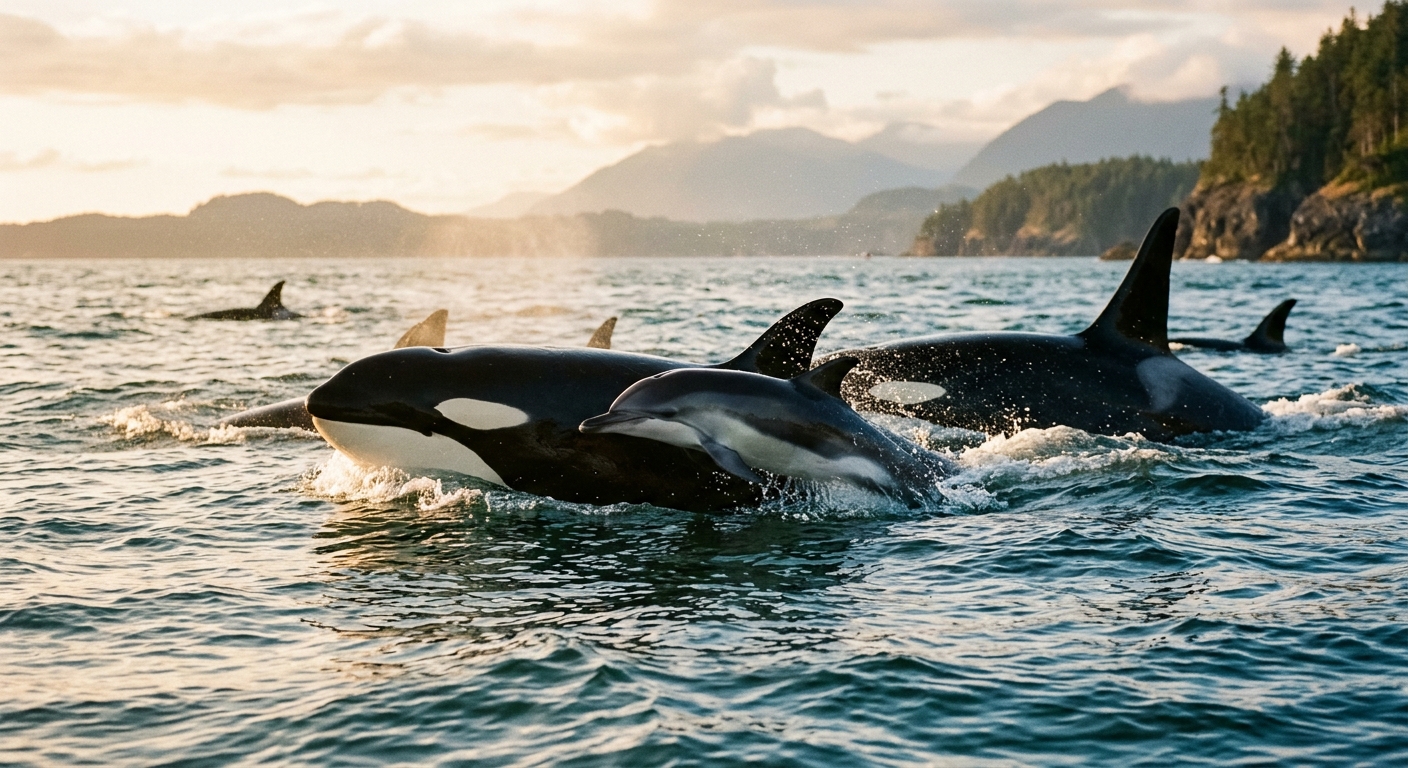
The pod in question was a group of orcas, also known as killer whales, and for more than eight years, researchers observed this dolphin traveling, feeding, and playing alongside them. It was not a fluke sighting. It was not a temporary truce. It was, by all observable evidence, adoption.
What does this tell us? Perhaps more than we are comfortable admitting about the nature of empathy, the boundaries of compassion, and the stories we tell ourselves about which creatures are capable of both.
The Science Behind the Story
The case gained significant attention after researchers from the Canary Islands documented a bottlenose dolphin living within a small group of short-finned pilot whales, a species closely related to orcas. Similar observations have since been recorded in multiple ocean regions, suggesting this is not an isolated anomaly but a pattern worth examining seriously.
Dr. Tilen Genov, a marine biologist who has studied cetacean social behavior for over a decade, has noted that dolphins and orcas share surprisingly complex emotional architectures. Both species demonstrate mourning behaviors, cooperative hunting strategies, and the capacity to form bonds outside of immediate kin groups. In short, they are not operating on pure instinct alone.
What makes the orca adoption story particularly striking is the difference in size, diet, and communication between the two species. Orcas are apex predators. Bottlenose dolphins are frequently prey for some orca populations. Yet this dolphin showed none of the stress behaviors, such as erratic swimming or avoidance patterns, that would indicate fear. It played. It mimicked. According to one research team, it even began adopting physical postures more commonly associated with orca body language than dolphin behavior.
What Researchers Actually Observed
- The dolphin consistently swam in the center of the pod formation, the safest position typically reserved for juveniles and vulnerable members.
- It was observed engaging in play behaviors with younger orcas, behaviors that included tail slapping and synchronized swimming.
- Adult orcas were seen redirecting the dolphin away from potential hazards, a behavior consistent with protective parenting.
- The dolphin showed no attempts to seek out its own species during the observation period, suggesting genuine social integration rather than temporary proximity.
- Vocalizations recorded near the dolphin included hybrid patterns, elements of dolphin clicks blended with orca calls, hinting at a kind of learned language adaptation.
Empathy Is Not Uniquely Human. We Just Pretend It Is.
For a long time, the dominant narrative in both science and popular culture drew a firm line between human emotional complexity and animal behavior. Animals, the story went, acted on instinct, on hunger, on territorial drive. Empathy, compassion, the impulse to care for a stranger at personal cost, those were the exclusive territories of humanity.
The orca and the dolphin challenge that narrative in a way that is difficult to dismiss.
Empathy, at its most functional level, is the capacity to recognize distress or need in another being and respond in a way that alleviates it. When the orca pod positioned the dolphin in a protected center formation, when they redirected it away from danger, they were doing exactly that. They were responding to vulnerability with care. Whether or not they felt it in the way humans do is a question we cannot fully answer. But the behavior, the observable, documentable behavior, is empathy by any reasonable definition.
Frans de Waal, the celebrated primatologist and author of Mama’s Last Hug, has spent decades arguing that human emotions are not a departure from animal nature but an extension of it. The orca story is another data point in a growing body of evidence that supports his view. We did not invent empathy. We inherited it.
What the Dolphin Taught the Pod (and What the Pod Taught Us)
There is a quieter lesson here, one that sits beneath the headlines and the research papers. It is about what happens when something unfamiliar enters your circle and you choose curiosity over fear.
The dolphin was different. It communicated differently, moved differently, and looked different from every other member of the pod. The orcas had every evolutionary justification to ignore it, drive it away, or worse. Instead, something in them leaned toward inclusion.
This is the part of the story that feels less like a nature documentary and more like something a person might read on a rainy afternoon and carry with them for a while.
Three Lessons This Story Carries for Human Life
1. Belonging is not always biological. Family, as the orca pod quietly demonstrated, is something that can be chosen as much as inherited. The bonds that matter most are often the ones we build across difference rather than within the comfort of sameness.
2. Communication can evolve to meet connection. The hybrid vocalizations observed in the dolphin suggest it was not simply tolerated but genuinely integrated. It changed how it communicated to stay close to those it had bonded with. How often do we do the same, learning the language of someone we love, adjusting our vocabulary of affection to fit another person’s needs?
3. Empathy does not require explanation. The orcas did not appear to deliberate. There is no evidence of a pod meeting, a vote, a debate about whether to help. They simply responded to vulnerability with protection. The lesson there is almost embarrassingly simple. Sometimes you do not need a reason to care for something that needs caring for. You just do it.
A Reminder From the Deep
We live in a time that makes empathy feel exhausting, political, or naive. The world is loud and divided, and it is easy to retreat into the idea that compassion is a limited resource that must be rationed carefully.
And then you hear about an orca pod and a lone dolphin, swimming together in the Atlantic for eight years, and something in you recalibrates.
The ocean, it turns out, is not just a place of survival and competition. It is also a place where a stranger can become family, where difference can be met with welcome, where the instinct to protect extends beyond the boundaries of species.
If a pod of orcas can find room in their formation for one small, lost dolphin, it is worth asking what we might make room for in ours.