🎧 Listen to this story
Narrated by Rasalgethi · 7,588 characters
The Bridge, the Stranger, and a Five-Dollar Bill
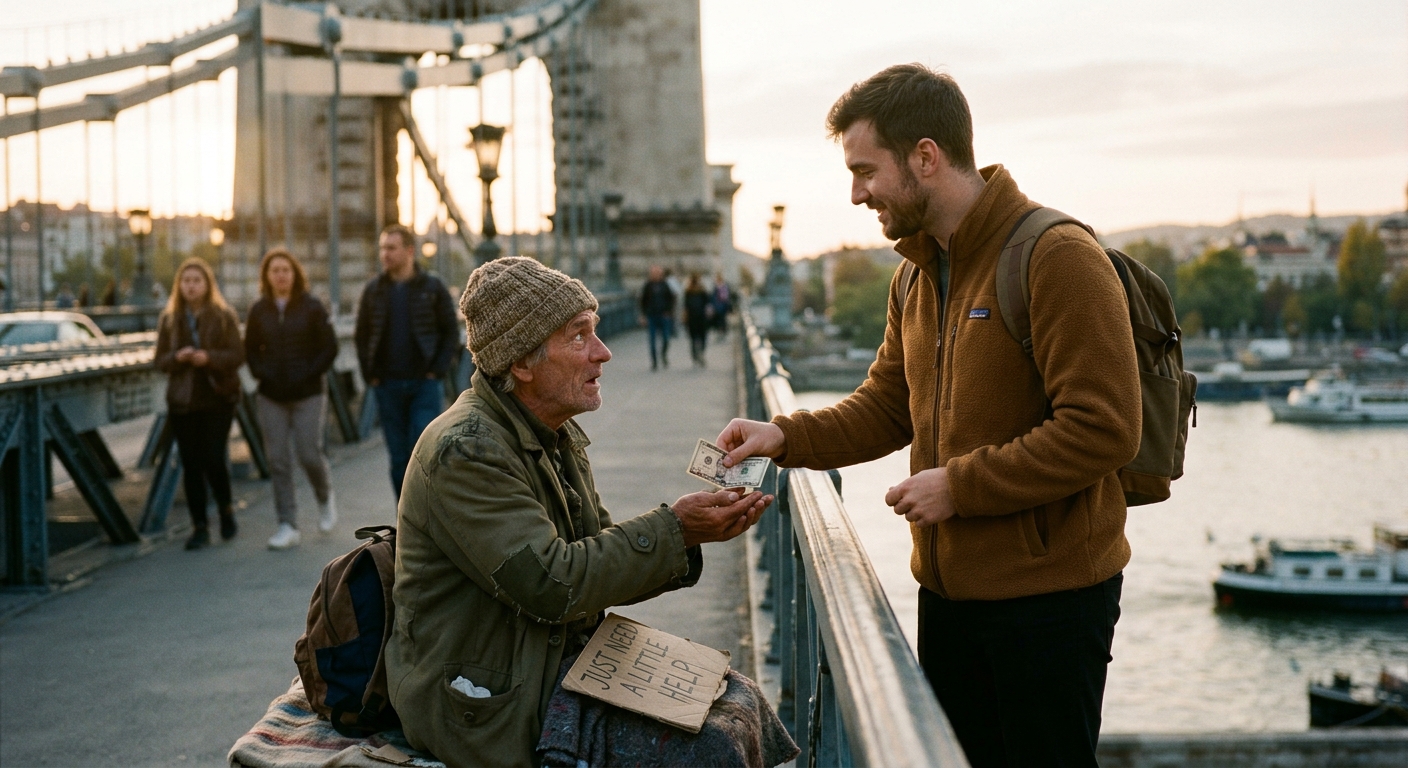
It was a Tuesday morning in late November, the kind of cold that makes people walk faster and look down at their shoes. Marcus Webb, a 34-year-old electrician from Columbus, Ohio, was crossing the Broad Street pedestrian bridge on his way to a job site when he noticed a woman standing very still near the railing. She wasn’t looking at the water. She wasn’t looking at anything in particular. She was just standing there, shoulders hunched, a paper coffee cup empty in her hand.
Marcus almost kept walking. He was already running late. His toolbox was heavy. He had three stops to make before noon. But something made him slow down. Maybe it was the way she stood. Maybe it was the cold. Maybe it was something he still can’t fully explain.
He stopped beside her. “You okay?” he asked. She looked up, startled, as if she had forgotten the rest of the world existed. Her name was Diane. She had just been evicted. Her phone was about to die. She hadn’t eaten since the previous afternoon. She wasn’t in crisis in the dramatic sense, but she was deeply, quietly lost.
Marcus reached into his jacket pocket. He had exactly $27 in cash. He handed her a five-dollar bill and pointed to the diner two blocks away. “Get something warm,” he said. “It’s going to be okay.” He didn’t know if that was true. He just knew it was the right thing to say.
He walked away. Diane walked toward the diner. And without either of them realizing it, something had just been set in motion.
The Ripple Begins
Diane used the five dollars to buy a bowl of oatmeal and a coffee. The warmth of that meal, small as it was, steadied her enough to call her sister in Dayton. Her sister came and got her. Within two weeks, Diane had a temporary place to stay and had enrolled in a job retraining program through a local nonprofit.
But here is where the story shifts gears.
While waiting at the diner counter, Diane told the server, a young man named Tobias, what had just happened on the bridge. Not because she wanted sympathy, but because she was genuinely moved and needed to tell someone. Tobias, who was 22 and saving up to move out of his mother’s house, listened carefully. That afternoon, when an older gentleman sat down at the counter and couldn’t find his wallet, Tobias covered the $8.50 tab out of his own tips without being asked.
The older gentleman, whose name was Gerald, was so surprised that he sat there for a moment in silence. Then he asked Tobias why he had done it. Tobias shrugged and said, “Someone was kind to someone this morning. I guess it just stayed with me.”
Gerald was a retired high school principal. He went home and wrote a letter, an actual handwritten letter, to a former student he had lost touch with, a young woman named Priya who had struggled during her junior year and whom he had always felt he hadn’t supported enough. He told her he was proud of her. He didn’t know where she was or what she was doing. He found her address through a mutual contact and mailed it anyway.
A Letter That Arrived at Exactly the Right Moment
Priya was 29 and in the middle of seriously questioning whether to keep pursuing her career as a graphic designer or take a stable corporate job she didn’t care about. Gerald’s letter arrived on a Friday. She read it three times. She kept her design business.
Within six months, one of her clients was a local nonprofit. The nonprofit used her work to launch a fundraising campaign that exceeded its goal by 40 percent. That campaign funded after-school art programs for 60 kids in underserved neighborhoods.
One of those kids, a 12-year-old named Jordan, made a painting in that after-school program that his teacher entered into a regional youth art contest. Jordan won. The local newspaper covered it. The story ran with a photo of Jordan holding his painting, grinning from ear to ear, his mother standing proudly beside him.
Marcus Webb saw that photo in the paper while eating breakfast one Sunday morning, almost exactly one year after the morning on the bridge. He had no idea. He had no way of knowing. He just saw a kid who looked happy and thought, “Good for him.”
What the Science Says About Kindness Chains
This story might sound like a feel-good coincidence, but researchers have been studying the mechanics of what they call “prosocial contagion” for years. Here is what the data consistently shows:
- Kindness is literally contagious. A 2010 study published in the Proceedings of the National Academy of Sciences found that acts of generosity spread through social networks up to three degrees of separation.
- Witnessing kindness is almost as powerful as receiving it. People who observe a generous act are measurably more likely to act generously themselves within the following hours.
- The emotional residue of a kind act lasts longer than we think. Psychologists at the University of California found that recipients of unexpected kindness reported elevated mood and increased empathy for up to 72 hours afterward.
- Small acts carry disproportionate weight. The size of the gesture matters far less than the unexpectedness and sincerity of it.
In other words, Marcus didn’t need to write a check. He didn’t need to solve Diane’s problems. He just needed to stop, see her, and do something small and true. The rest, as this story shows, had a way of taking care of itself.
What Marcus Says Now
When a local community blog tracked Marcus down a year later and told him the thread of events his five dollars had set off, he was quiet for a long moment. Then he said something worth holding onto.
“I didn’t do it because I thought it would go anywhere,” he said. “I did it because I didn’t want to be the kind of person who keeps walking. That’s all. I just didn’t want to be that guy.”
He paused, then added: “But if it helped that kid get his picture in the paper, then I guess maybe stopping is worth being late sometimes.”
7 Things This Story Teaches Us About Everyday Kindness
- You don’t need a plan. Marcus had no strategy. He just reacted with his gut and his pocket.
- You rarely see the full impact. The chain reaction was invisible to everyone inside it until it was over.
- Stories spread kindness just as much as actions do. Diane telling Tobias what happened was its own act of generosity.
- Kindness doesn’t require resources. A five-dollar bill, a covered diner tab, a handwritten letter: none of these are expensive.
- Timing is everything, and you can’t control it. Gerald’s letter arriving when Priya needed it most was not planned. It just happened because someone acted.
- Kindness builds identity. Marcus didn’t want to be “the guy who kept walking.” That self-concept drove his action more than any calculation of reward.
- The ripple doesn’t need your permission to keep going. Once you act, the chain belongs to the world.
The Bridge Is Still There
The Broad Street pedestrian bridge in Columbus is not a famous landmark. It is not particularly beautiful. It carries foot traffic over a stretch of road, and most people cross it without a second thought.
But on a cold Tuesday in November, it was the place where one man decided not to keep walking. And that decision, $5 and a sentence long, moved through a city like a quiet current, touching six lives in ways that none of them fully understood until much later, if ever.
You pass your own version of that bridge every single day. The question is not whether you have enough to give. The question Marcus asked himself, the one that matters, is simply this: what kind of person do you want to be when you get to the other side?