🎧 Listen to this story
Narrated by Rasalgethi · 8,721 characters
A Different Kind of House Call
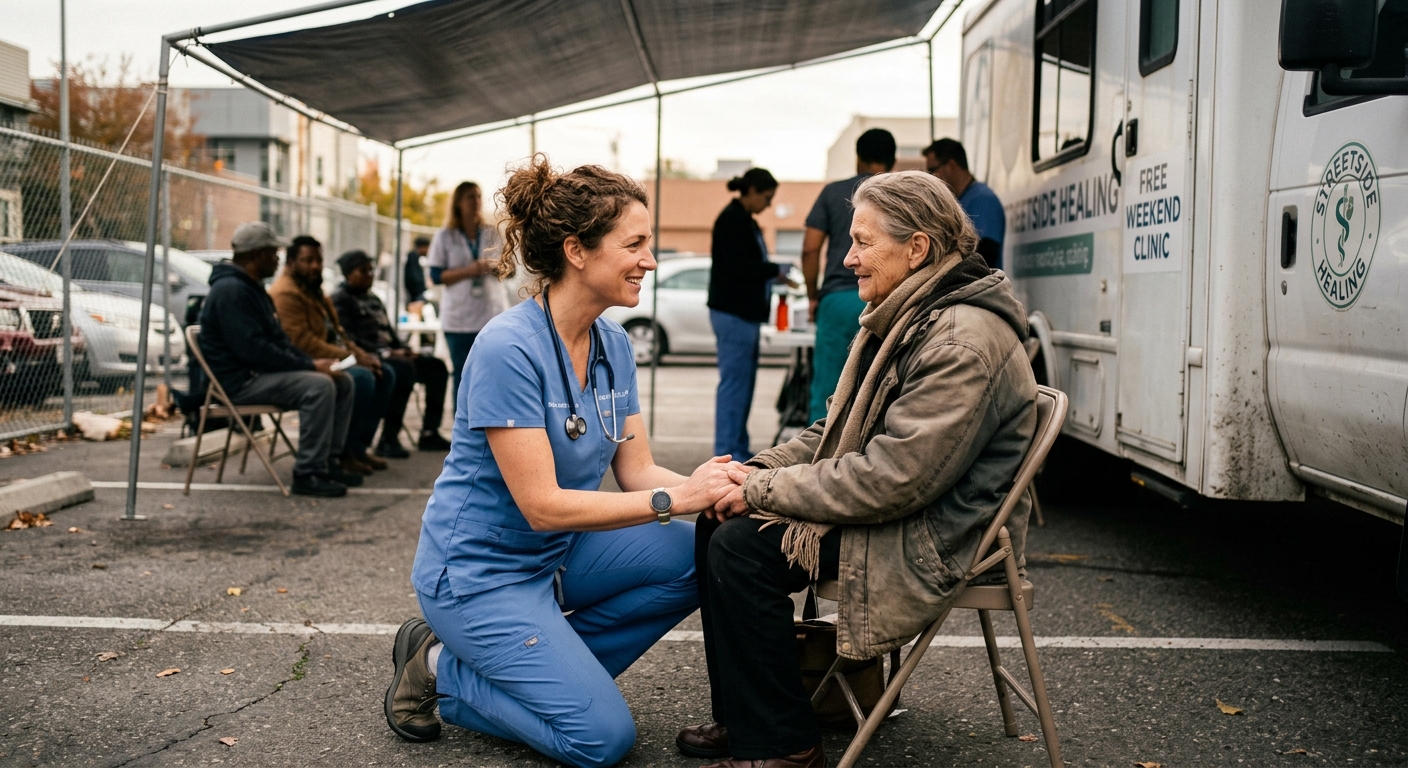
On most Saturday mornings in Riverside County, California, people are sleeping in, brewing coffee, or heading out for a run. Sarah Okonkwo is doing none of those things. By 7:30 a.m., she has already driven her converted 1998 Winnebago to a church parking lot in a low-income neighborhood, set up her blood pressure cuffs, stocked her mini-fridge with insulin samples, and turned on a small fan to combat the heat building inside the vehicle she calls ‘The Rolling Clinic.’
Okonkwo is a licensed family nurse practitioner with seventeen years of experience. She works a full caseload at a regional urgent care center Monday through Friday. But on weekends, she belongs to the people who cannot afford to walk through any clinic door at all.
‘I kept seeing patients at work who had waited too long,’ she said, leaning against the RV’s doorframe while a line of people formed quietly outside. ‘They had infections that had spread, diabetes that had gone unmanaged for years, blood pressure that was a stroke waiting to happen. And every single time I asked why they had waited, the answer was the same: they had no insurance and no money.’
That answer became impossible for her to accept.
How a Used RV Became a Healthcare Revolution
The idea came to Okonkwo three years ago after a patient, a 54-year-old dishwasher named Armando, came in with a gangrenous toe. He had been a type 2 diabetic for over a decade, he said, but had not seen a doctor in six years. He lost the toe. She never forgot his face.
‘I could not stop thinking about what six years of small interventions could have done for him,’ she recalled. ‘A prescription here, a conversation about diet there. None of it is glamorous medicine, but it is the medicine that saves people from the dramatic stuff.’
She spent four months researching mobile clinic models across the country, then used a combination of personal savings and a small grant from a local health equity nonprofit to purchase the RV for $4,200. Over two weekends, with help from her brother and a retired plumber from her church, she gutted the interior and rebuilt it as a functional examination space, complete with a fold-out table, a locking medication cabinet, a portable EKG machine, and even a privacy curtain.
She named the project Open Road Health and launched it on the first Saturday of March two years ago. Eleven patients came that day. Last month, she saw sixty-three.
What a Weekend Actually Looks Like
Spending a Saturday with Okonkwo is to witness both the profound need in American communities and the equally profound capacity of one person to respond to it. Here is what a typical day looks like inside The Rolling Clinic:
- 7:30 a.m. Setup begins. Okonkwo is joined by two rotating volunteers, usually nursing students from a nearby university who earn clinical hours by assisting.
- 8:00 a.m. The first patients arrive, often having walked significant distances. Many hold handwritten notes listing their symptoms, afraid of forgetting something important once they are face to face with a clinician.
- 8:00 a.m. to 1:00 p.m. A steady stream of consultations, averaging twelve to fifteen minutes each. Conditions treated include hypertension, upper respiratory infections, urinary tract infections, wound care, glucose management, skin conditions, and mental health check-ins.
- 1:00 p.m. A short break, during which Okonkwo eats a granola bar and returns calls to pharmacies that partner with Open Road Health to provide discounted prescriptions.
- 1:30 to 4:00 p.m. Afternoon patients, which often include working adults who could not come in the morning due to overnight shifts.
- 4:30 p.m. Breakdown, cleaning, and restocking. Okonkwo keeps detailed notes on each patient in a HIPAA-compliant digital system she accesses from her phone.
She does this every Saturday and most Sundays, rotating between three parking lot locations negotiated with local churches and a community center.
The Patients She Carries With Her
Among the regular faces at the Rolling Clinic is Maria, a 67-year-old grandmother from Guatemala who has no documentation and, until two years ago, had not had a blood pressure check in over a decade. Okonkwo caught her at 190 over 110 on her first visit, immediately started her on a low-cost antihypertensive regimen, and has monitored her monthly ever since. Maria’s numbers are now stable. She brings Okonkwo tamales on the last Saturday of every month.
There is also James, 41, a veteran whose VA coverage had lapsed due to a paperwork error. He came to the RV for what he thought was a simple chest cold. Okonkwo’s examination raised enough concern that she referred him urgently to the county hospital’s free care program. He was subsequently diagnosed with early-stage heart disease. ‘She caught something that would have killed me in a couple of years,’ he said, standing outside the RV one recent morning. ‘And she did it in a parking lot on a Saturday. That is something.’
The Barriers She Fights Every Single Week
Operating a mobile clinic outside the traditional healthcare system is not without obstacles. Okonkwo navigates a complicated web of legal, logistical, and financial challenges that would exhaust most people before they ever treated a single patient.
Licensing and Liability
She operates under California’s nurse practitioner laws, which allow her to practice with physician collaboration rather than direct supervision. She has a formal collaboration agreement with a physician colleague who reviews her complex cases. Still, she notes, the legal framework for mobile healthcare providers is inconsistent from state to state, making it difficult to replicate models like hers without significant legal consultation.
Medication Access
Prescribing medications to uninsured patients who cannot pay pharmacy prices requires creative problem-solving. Okonkwo has cultivated relationships with three local pharmacies, enrolled Open Road Health in GoodRx’s clinic partnership program, and maintains a stock of physician samples donated through professional networks. ‘Getting someone a $4 metformin prescription is a solved problem if you know where to look,’ she said. ‘Getting them a specialty medication is a different story entirely.’
Funding the Mission
Open Road Health runs on a yearly budget of approximately $28,000, covering supplies, fuel, vehicle maintenance, discounted medications, and the part-time administrative help of a college student who manages her scheduling. About 40 percent comes from small private donors, 35 percent from two healthcare nonprofits, and the remaining 25 percent, she acknowledges with a quiet laugh, comes directly from her own paycheck.
‘I do not take vacations,’ she said simply. ‘This is my vacation.’
What Other Clinicians Can Learn From This Model
Healthcare professionals across the country have reached out to Okonkwo after word of Open Road Health spread through social media and a local news segment. She has begun informally consulting with two nurses in Texas and a physician assistant in rural Tennessee who are building similar models. Her advice, distilled from hard-won experience, comes down to four principles:
- Start smaller than you think you need to. A folding table, a blood pressure cuff, and a parking lot are enough to begin. The RV came later.
- Build community trust before you build anything else. She spent three months visiting the neighborhoods she would serve before her first clinic day, meeting pastors, school principals, and grocery store owners. ‘If the community does not trust you, they will not come,’ she said.
- Find your collaborators early. Nursing students, retired clinicians, pharmacists willing to discount, local faith leaders, bilingual volunteers. ‘Nobody does this alone.’
- Document everything. Not just for legal protection, but because data tells the story of impact in a language that grant committees and potential donors understand.
A Quiet Kind of Heroism
There are no television cameras most Saturdays in that parking lot. No reporters. No ribbon cuttings. There is only a slightly battered RV, a long line of people who have nowhere else to go, and a woman in scrubs who decided that her days off were better spent this way.
When asked if she ever resents the sacrifice, Okonkwo considers the question seriously before answering. ‘Resentment would require me to feel like I was giving something up,’ she said. ‘But when I see Maria’s blood pressure holding steady, or when James tells me he is still here, I do not feel like I gave anything up. I feel like I found out what I was supposed to be doing all along.’
The next patient is already knocking softly on the RV door. She smiles, turns around, and opens it.