🎧 Listen to this story
Narrated by Kore · 9,002 characters
Margaret Ellison remembers the exact moment the house became too quiet to bear. It was about six weeks after the funeral, a Tuesday evening in late October. The casseroles had stopped arriving. The sympathy cards had been stacked into a neat, terrible pile on the sideboard. And the clock in the kitchen, which she had never once noticed in forty-one years of marriage, was suddenly the loudest thing in the world.
She stood at the sink with a single plate in her hands. One plate. One fork. One cup. And she realized she had been holding her breath for what felt like days, shallow little sips of air that never reached the bottom of her lungs.
This is the story of how a woman in her late sixties, with no plan and very little hope, found her way back to a full breath by doing something almost embarrassingly simple: walking around her block at dusk and naming what she was thankful for.
The Silence After Everything
Margaret’s husband, Walter, had died after a short illness. There was no long goodbye, no time to prepare. One month he was complaining about the gutters, and the next she was signing paperwork in a hospital corridor under lights that hummed.
Grief, she says, is not what people describe. It is not only sadness. It is physical. Her chest felt tight, as if someone had cinched a belt around her ribs. She slept in fragments. She forgot to eat, then ate cereal for dinner standing at the counter. Her doctor, a kind woman who had known the family for years, listened carefully and then said something Margaret has never forgotten.
“Your body is still bracing for a blow that already landed,” the doctor told her. “It needs a reason to unclench.”
The doctor did not prescribe anything dramatic. She suggested movement, fresh air, and a small daily ritual that had nothing to do with productivity. Margaret nodded politely and went home fully intending to ignore the advice.
The Evening She Finally Put on Her Shoes
It was loneliness, not discipline, that got her out the door. Evenings were the worst. Walter had always been the one to say, “Shall we take a turn before supper?” and they would circle the neighborhood together, arm in arm, commenting on other people’s gardens.
One cold evening, with the sky going the color of a bruised peach, Margaret laced up her old walking shoes by the front door. She did not intend to go far. She told herself she would walk to the corner and back.
At the corner, she kept going.
The Rule She Invented by Accident
Somewhere around the second block, a small thought arrived uninvited. She noticed the smell of woodsmoke from a neighbor’s chimney, warm and sweet against the chill. Without quite meaning to, she whispered, “Thank you for that.”
It felt silly. It also felt, for the first time in weeks, like something in her chest loosened by a single notch.
The next evening she did it again. And the evening after that. Slowly, the habit took shape, and she gave it a few simple rules:
- Walk at dusk. She chose the hour when the light softens, because that was when the house felt emptiest.
- Name three things. Each walk, she would say aloud three small things she was grateful for. They could be tiny.
- No gratitude for the big things unless they came naturally. She refused to force thankfulness for grief itself. She just looked for what was quietly good.
- Breathe on the pause. After each thank you, she took one slow breath, in through the nose and out through the mouth.
What Three Small Things Looked Like
In the beginning, her lists were almost comically modest. A porch light left on for no one. The way a cat sat motionless on a fence post. The crunch of dry leaves. A stranger’s wave from a passing car.
But she kept going, and something shifted in the noticing. Margaret began to realize that grief had narrowed her whole world down to a single tunnel. Gratitude did not remove the tunnel. It simply cut small windows into the walls.
She told me that one evening in November, she thanked the evening itself. She was standing at the top of a gentle hill, watching the streetlights flicker on one by one, and she suddenly understood that the day was done. It had asked everything of her, and she had survived it. There was a strange, soft permission in that. The hard part was over. Whatever she had managed to do, or failed to do, was finished, and the night could simply hold her.
The Evening Quiet
She says dusk became sacred in a way she never expected. The world exhales at that hour. Dogs are called in. Kitchen windows glow gold. People are moving toward their own small rest. For years that hour had belonged to Walter and her together. Now she was learning to share it with the neighborhood instead, a quiet participant in the evening’s slow settling.
The Science Behind the Simple Habit
Margaret is not a scientist, but her doctor was curious about the change she saw. Several things were likely working in her favor at once.
- Gentle movement helps regulate stress hormones and can ease the physical tension that grief creates in the body.
- Slow breathing signals the nervous system that it is safe to relax, which is exactly what her bracing body needed.
- Daily gratitude practice has been linked in many studies to improved mood and better sleep, particularly when it is specific and sincere rather than forced.
- Routine offers structure when life feels shapeless, giving the mind something steady to hold onto.
- Time outdoors in softer light can help settle the body toward rest, which matters when evenings are hardest.
None of this is a cure for grief, and Margaret is careful to say so. Walking did not erase Walter’s absence. What it did was give her lungs room to work while she carried it.
The Night She Noticed She Was Breathing Deeply
About two months into her walks, something quietly remarkable happened. Margaret was halfway through her loop when she realized she had been breathing all the way down into her belly without trying. The cinched belt around her ribs was gone. She stopped right there on the sidewalk and put a hand on her chest.
She cried then, but it was a different kind of crying. It was not the sharp, gasping kind. It was softer, like rain after a long drought. She stood under a maple tree with her hand over her heart and understood that she was not forgetting Walter. She was simply learning to live in the same world he had left, one breath at a time.
The Neighbors Who Joined In
Word travels on a small street. A neighbor named Odette, who had lost her sister the previous spring, fell into step with Margaret one evening and asked what she was murmuring about. Margaret, a little shy, explained.
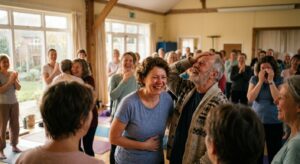
The next night Odette brought her dog. The night after that, a young father pushing a stroller asked if he could tag along. Without any announcement or organization, a small, unofficial walking circle formed at dusk. They do not talk much. They share their three things, sometimes aloud, sometimes silently, and they breathe together under the turning leaves.
Margaret says the best part is that no one asks her to be fine. Grief and gratitude walk side by side in that little group, and neither is required to leave.
Gentle Ways to Begin Your Own Evening Walk
If you are carrying a heavy loss, or simply a heavy day, you do not need a grand plan. Margaret’s advice is to start smaller than you think you should.
- Pick one short route. Around the block is plenty. Ten minutes or less is a perfectly good start.
- Choose the hour that hurts most. If evenings are lonely, meet them on purpose.
- Look for three small things. Smells, sounds, colors, kindnesses. Specific beats grand.
- Take one slow breath after each. Let the gratitude and the breath travel together.
- Skip the guilt. Miss a night, and simply begin again the next.
- Talk to someone if it feels like too much. Walking is a companion to support, not a replacement for it.
Where Margaret Is Now
It has been nearly three years. Margaret still walks at dusk, though the loop has grown longer and her pace has grown easier. The house is still quiet, but it no longer frightens her. She keeps Walter’s reading glasses on the windowsill where the evening light catches them, and some nights she thanks him out loud for the forty-one years.
She does not say she is healed. She says she is breathing, and that for a long time she was not sure that would be possible.
On the evenings when the sky turns that bruised peach color and the first porch lights flicker on, she laces up her shoes, steps out the door, and begins her list. A smell of woodsmoke. A neighbor’s wave. A breath that finally reaches the bottom.
And at the end of the loop, as the day folds itself away and the stars begin to appear, she whispers the same thing every night before heading inside: Thank you for today. I made it through.
Tonight, as your own day winds down, consider stepping outside for just a few minutes. You do not have to feel grateful. You only have to notice one small, quiet thing and let yourself take one slow breath. Sometimes that is where healing begins.