🎧 Listen to this story
Narrated by Kore · 7,241 characters
Most people think a crossing guard’s day ends when the final school bell rings and the last yellow bus pulls away. For a man we will call Mr. Delgado, that is only the beginning of the part of the day that matters most to him.
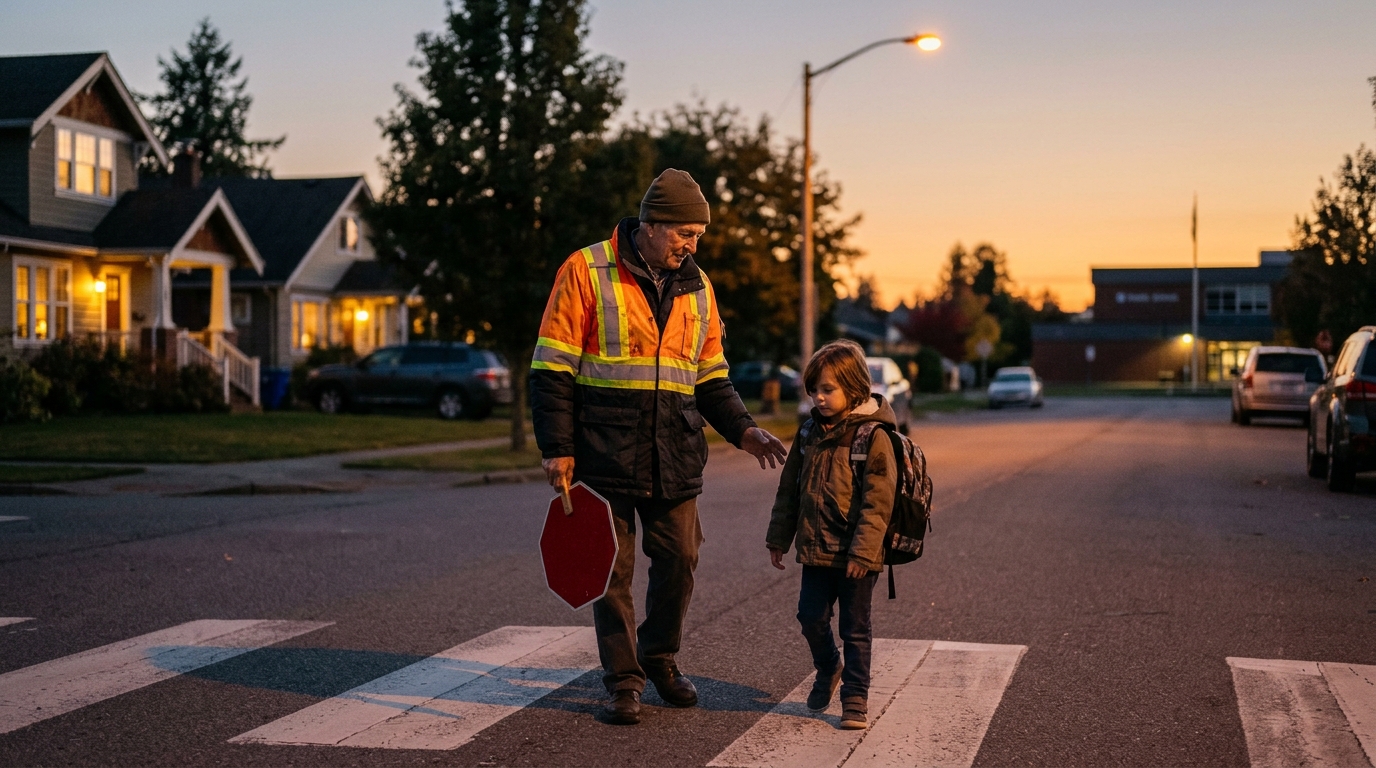
The afternoon light was already turning soft and amber when I first noticed him. I was walking home from the pharmacy, a little worn out, my mind still tangled in a dozen small worries. And there he stood at the corner of Alder and Fifth, a bright orange vest glowing against the fading sky, one hand resting on a stop sign, the other raised in a gentle wave to a girl in a purple backpack who was skipping toward her front gate.
The crowds were long gone. The street had gone quiet. And still he stood there, watching, until she turned and waved back from her porch.
The Job Nobody Sees at Sunset
Ask most people what a crossing guard does and they will describe the morning rush and the afternoon dismissal. The whistle, the raised stop sign, the steady voice saying wait, wait, okay now, go.
But Mr. Delgado has built something quieter on top of that official duty. After the main wave of children has crossed, he stays. Not because anyone asked him to, and not because it is in his job description, but because he knows that the children who linger are often the ones who need a safe passage the most.
There is the boy who stays late for tutoring. The twin sisters whose mother works until six. The fifth grader who likes to walk slowly because home is noisy and the sidewalk is peaceful. These are the kids who come through when the light is low and the traffic is picking up, when drivers are tired and hurrying toward their own dinners.
So he waits. He has done it for eleven years.
A Lesson That Settles In When the Day Goes Quiet
There is a particular kind of wisdom that only arrives in the evening. During the day we are busy, reactive, pulled in every direction. But when the noise fades and the sky shifts toward violet, we finally have room to notice what truly mattered.
Mr. Delgado told a neighbor once that evening is when he does his best thinking. Standing at that corner as the streetlights flicker on, he watches the neighborhood exhale. Porch lights come up. Kitchen windows glow gold. Somewhere a screen door slams and a dog barks hello.
“That’s the sound of a child who made it home,” he reportedly said. “Everything else in my day is just getting ready for that.”
It is a simple idea, but it stays with you. The most important work is often the part nobody applauds, the part that happens after the crowd has gone.
What He Does Differently
Over the years, neighbors have noticed a few small habits that set him apart. None of them are dramatic. All of them add up to something remarkable.
- He learns every name. Not just the children, but their siblings, their dogs, and which house is theirs.
- He watches until the door closes. He does not stop at the curb. He waits until each child is safely inside or greeted by a grown-up.
- He notices changes. A child who is suddenly quiet, a coat that is too thin for the weather, a backpack that looks too heavy. He passes concerns along to the school gently and without fuss.
- He keeps a few small things in his pocket. Extra bandages, a tissue, a spare hair tie. You would be surprised how often these save a tough afternoon.
- He always says the same goodbye. “See you tomorrow.” Not goodbye, not take care. Just a quiet promise that tomorrow will come and he will be there.
The Night a Small Girl Got Lost in the Dusk
One autumn evening, a kindergartner missed her usual route. Her older brother had stayed late at a club, and she had wandered off the main path, unsure which way home lay. The sky was darkening and the temperature was dropping.
Mr. Delgado spotted her small figure at the far end of the block, hesitating at an intersection she was not meant to cross alone. He did not shout or rush. He walked toward her slowly, crouched down to her level, and asked her name.
Then he did what he always does. He asked what her porch looked like. A blue door, she said. A pumpkin on the step. Together they walked, hand in a tiny mitten, until they found it. The light was on. Her mother was already stepping outside, her face pale with worry, then flooding with relief.
He did not stay for thanks. He nodded, touched the brim of his cap, and walked back to his corner as the stars began to appear.
Why Small Guardians Matter So Much
We tend to celebrate the loud, visible kinds of heroism. The rescues, the headlines, the dramatic moments. But a community is really held together by people like Mr. Delgado, the ones who show up at the same corner every single day and quietly refuse to look away.
Safety is not only about traffic. It is about being seen. A child who knows that a friendly face will be waiting at the end of the school day carries that certainty with them. It becomes part of how they understand the world: that there are people who care whether you arrive, that someone is counting.
The ripple effect of being noticed
Parents on the street say their children talk about him at dinner. They repeat his little jokes. They describe the way he waves with his whole arm. Some of the older kids, now in middle school, still circle back to say hello. One former student, now a teenager, started volunteering at the school’s safety patrol because of him.
That is how kindness travels. Not through speeches, but through consistency.
A Gentle Evening Practice You Can Borrow
You do not need an orange vest or a stop sign to carry this spirit into your own life. Tonight, as the day winds down, consider a small ritual inspired by a man who waits until everyone is home.
- Do a quiet check-in. Before bed, think of one person in your life who might be struggling. Send a short message. Nothing grand, just a signal that you are thinking of them.
- Notice the people who stay late. The cleaner, the shop clerk, the neighbor who always takes out the bins. Thank someone whose work happens after the crowd leaves.
- Be the one who waits. Whether it is a friend finishing a hard conversation or a child brushing their teeth slowly, practice patience. Sometimes the greatest gift is simply not rushing someone.
- End with a promise. Borrow his goodbye. “See you tomorrow” is a surprisingly powerful thing to say to someone you love.
The Light Goes On, One Window at a Time
The last time I passed that corner, the sun had nearly disappeared behind the rooftops. The sky was a wash of rose and gold. A small boy in a green jacket was crossing, kicking a pebble ahead of him, and Mr. Delgado stood with his hand lifted, steady as a lighthouse.
The boy reached the far curb, turned, and gave a big, clumsy wave. Mr. Delgado waved back with his whole arm. A porch light flicked on down the street. A door opened. A voice called a name into the cool air.
Only then did he lower his stop sign and begin the slow walk back to his own home, where a warm dinner was likely waiting.
It is easy to think that the world runs on grand gestures. But as the evening settles and the streetlights hum awake, it is worth remembering that it also runs on people willing to stand at a corner a little longer than they have to, making sure the very last child is safely home.