
🎧 Listen to this story
Narrated by Gacrux · 8,023 characters
The Resume Nobody Would Touch
In 2015, Gerald Nwosu walked into a career counselor’s office in Columbus, Ohio, carrying a folder of transcripts, recommendation letters, and a dream that most people in his life had already written off as a midlife crisis. He was 55 years old, a retired civil engineer with a pension, a mortgage that was nearly paid off, and grandchildren who called him every Sunday. By every conventional measure, Gerald had made it. He was supposed to be coasting.
Instead, he sat across from a counselor who looked at his paperwork, looked at him, and said with practiced gentleness: “Gerald, medical school takes four years minimum. Then residency. You’d be 60 before you even started practicing. Have you really thought this through?”
Gerald had thought about almost nothing else for thirty years.
The Dream That Refused to Die
Gerald grew up in Lagos, Nigeria, the son of a schoolteacher and a seamstress. Medicine was always the plan, the destination his parents pointed him toward from the time he could read. But life, as it tends to do, intervened. A family financial crisis in his early twenties pushed him toward engineering instead, a field that offered faster employment and a more immediate salary. He emigrated to the United States at 27, built a career, raised three children with his wife, Adaeze, and filed the dream of medicine somewhere in the back of his mind where it hummed quietly but never went silent.
“Every time I went to the doctor, I would watch what they were doing,” Gerald told us during a conversation at his clinic in Columbus. “I wasn’t just a patient. I was studying. I was always studying, even when I wasn’t in school.”
When he retired from engineering at 54, the hum got louder. Within a year, it was deafening.
What the Statistics Say (and Why Gerald Ignored Them)
The concerns raised by his career counselor were not baseless. Medical schools in the United States receive applications from older candidates every year, but acceptance rates for applicants over 40 are significantly lower than for traditional students. The reasons are both practical and, critics argue, quietly discriminatory. Admissions committees cite concerns about return on investment, the physical demands of residency, and the shorter projected career span of older physicians.
Gerald was not unaware of these obstacles. He researched them thoroughly. He also found something else in his research: stories of people who had done it anyway. A woman who became a physician at 58 after raising five children. A former military officer who graduated at 64. A retired teacher who now runs a rural clinic in Vermont. These were not myths. These were people.
“I printed out every one of those stories and put them in a binder,” he said. “When someone told me it was impossible, I opened the binder.”
The Long Road Back to School
Before he could even apply to medical school, Gerald had to rebuild his academic credentials from scratch. His engineering degree was decades old. His science prerequisites, the biology, chemistry, biochemistry, and physics that medical schools require, needed to be retaken at an accredited institution with current grades. At 55, he enrolled as a post-baccalaureate student at Ohio State University, sitting in lecture halls alongside students young enough to be his grandchildren.
He was not always welcomed warmly.
“Some students thought it was funny, an old man in orgo,” he recalled. “My lab partner the first week asked me if I was an administrator sitting in. I told him I was there to learn chemistry. By the end of the semester, he was asking me for study help.”
Gerald completed his prerequisites over two years, earning a 3.94 GPA. He took the MCAT at 57. He scored in the 90th percentile.
The Rejection Letters
The applications went out. The rejection letters came back. Eight of them, in the first cycle. Gerald describes reading them at the kitchen table with Adaeze sitting across from him, her hands folded, her face carefully neutral in the way that long marriages develop as a form of armor.
“She didn’t say anything negative. She never has,” he said. “She just asked, ‘What do you want to do?’ I said I want to apply again. She said, ‘Then we apply again.'”
The second cycle, he applied to fifteen schools. He received two interview offers. One of those interviews, at a Caribbean medical school with a strong residency placement record, resulted in an acceptance letter. Gerald Nwosu enrolled in medical school at 58.
Four Years of Fire
Medical school is brutal for students of any age. The volume of material, the sleep deprivation, the emotional weight of clinical rotations, these challenges do not soften for anyone. For Gerald, there were additional layers. He was often the oldest person in any room by twenty years or more. He had a wife at home, adult children who still called with problems, and a body that, unlike his 22-year-old classmates, did not bounce back from all-nighters the way it once had.
What he had that many of them did not: perspective, patience, and an almost preternatural calm in high-pressure situations. His engineering background gave him a systems-thinking approach to diagnosis that his professors noticed early. His life experience gave him a bedside manner that patients responded to with unusual trust.
“When an 80-year-old patient talks to me, I’m not a kid to them,” he explained. “I’m a peer. That matters. People tell me things they might not tell a younger doctor. And those things are often the things that save their lives.”
Residency and the Finish Line
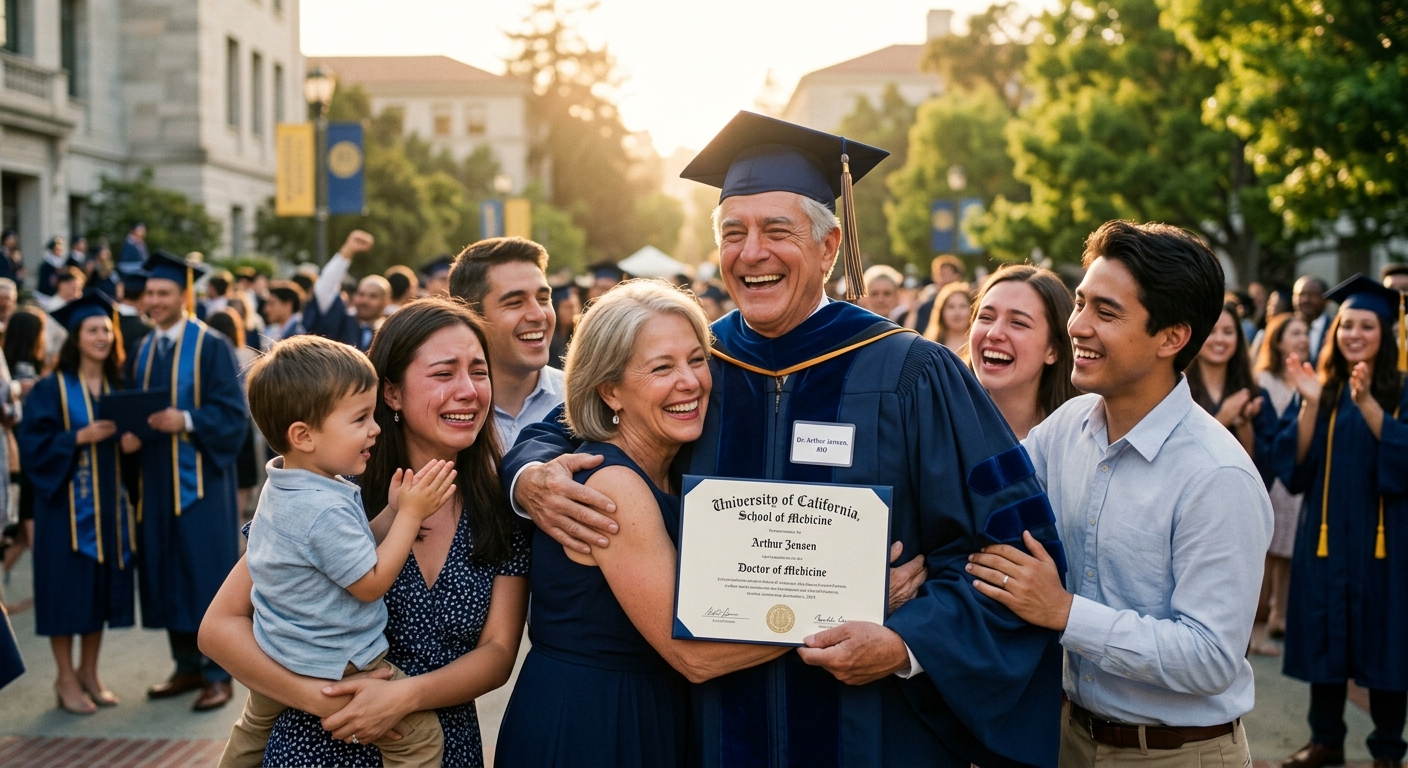
Gerald matched into a family medicine residency in Ohio at 62. Three years later, at 65, he completed his training and opened a general practice clinic in a medically underserved neighborhood in Columbus, a community where he himself once lived when he first arrived in the United States.
He was, by any reasonable measure, starting over at an age when most people are fully retired.
He was also, by any reasonable measure, exactly where he was supposed to be.
What Gerald Wants You to Know
We asked Gerald what he would say to someone sitting where he sat in that career counselor’s office in 2015, being told the dream is impractical, the timeline too long, the odds too steep. He thought about it for a long moment before answering.
- The math is not the enemy. “Yes, I started late. Yes, my career will be shorter than someone who started at 28. But it will still be a career. It will still matter. Do the math on meaning, not just years.”
- Find your binder. “Collect proof that people have done what you want to do. Not to copy them. To remind yourself it is real.”
- Choose your support circle carefully. “The people around you will either be fuel or they will be friction. You get to choose which voices you listen to.”
- Respect the process, but don’t be intimidated by it. “Medical school is hard. It was hard for me. But hard and impossible are not the same thing.”
- Let your age be an asset. “I walked in with thirty years of working with people, solving problems under pressure, communicating across cultures. That is not nothing. That is everything.”
A Different Kind of Doctor
Today, Dr. Gerald Nwosu sees patients five days a week. He speaks three languages in his clinic, English, Igbo, and enough Spanish to make his patients from Central America laugh and relax. He has a waiting list. His patient satisfaction scores are, by his clinic’s own accounting, among the highest in the practice network.
He is 68 years old. He has no plans to retire.
“People ask me when I’m going to stop,” he said, smiling in the unhurried way of a man who has made peace with time. “I tell them, I just started. Give me a few years.”
The career counselor who told him the dream was impractical? Gerald bears no ill will. “She was being practical,” he said. “That’s her job. My job was to be something else.”
He was. He is. And somewhere out there, in a folder or a binder or the quiet back corner of someone’s mind, a dream is humming, waiting to be chosen.