
🎧 Listen to this story
Narrated by Iapetus · 7,699 characters
The Kitchen Goes Dark
There is a moment in every chef’s career when the pressure feels unbearable. The heat, the noise, the split-second timing, the relentless pursuit of perfection on a plate. For most chefs, that pressure is a crucible they either survive or don’t. For Carlos Meraz, that crucible came in a form no culinary school could ever prepare a student for.
At thirty-two years old, Carlos was diagnosed with a degenerative retinal condition that would rob him of his sight within eighteen months. He was, at the time, the head chef at a well-regarded restaurant in Seville, Spain, earning steady praise from critics and building toward what everyone around him believed would be a brilliant career. The diagnosis, he later said in a 2019 interview with Gastronomia Viva, felt like someone had reached into his chest and turned off a switch.
“I remember standing in my kitchen the night I got the news,” he recalled. “I looked at everything. The copper pots, the herbs hanging by the window, the way the light came in at six in the evening and made everything gold. I tried to memorize it all.”
Within a year and a half, the light was gone.
What the Darkness Taught Him
Here is what most people do not understand about cooking: vision, while useful, is not the soul of the craft. Taste is. Smell is. The texture of a sauce between two fingers, the sound of a perfect sear, the weight of a well-balanced knife in the hand. These are the languages a great chef truly speaks, and Carlos had been speaking them fluently for over a decade.
Still, the transition was brutal. He spent the better part of six months away from professional kitchens entirely, relearning how to navigate his own apartment, how to organize a pantry by touch, how to move through space with confidence and without fear. He worked with rehabilitation specialists, with occupational therapists, and with a remarkable cooking instructor named Beatriz Soler, who herself had been cooking without sight for over two decades after an accident in her youth.
“Beatriz did not treat me like someone who had lost something,” Carlos said. “She treated me like someone who was starting over, which is a completely different thing.”
That distinction matters enormously. Starting over implies possibility. Loss implies a ceiling. Carlos chose possibility.
Building a New System
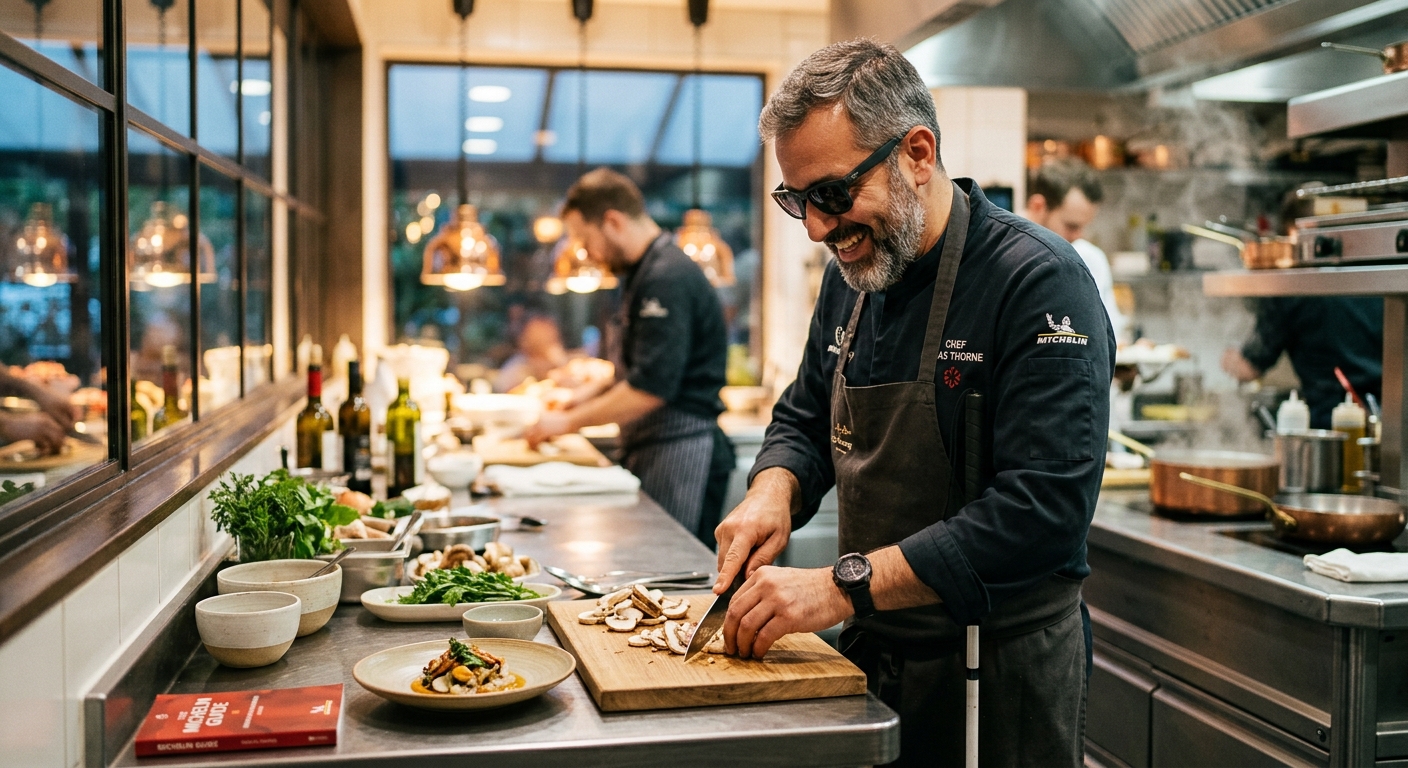
Returning to a professional kitchen as a blind chef required more than courage. It required radical reorganization, both physical and mental. Carlos, along with a small team of trusted cooks, developed a system for his kitchen that was meticulous and almost architectural in its precision.
- Station memory: Every single item on every station was assigned a fixed, permanent location. Nothing moved without Carlos knowing. His team were trained to treat this rule as non-negotiable.
- Tactile labeling: Spice containers, oils, and sauces were labeled with embossed Braille tags and distinctive textured bands, so identification was instant and accurate.
- Verbal communication protocols: His sous chefs developed a specific shorthand for communicating what was happening across the kitchen in real time, giving Carlos a constant audio map of the space.
- Heightened sensory tasting: Carlos began conducting extended tasting sessions during development, training his palate to detect subtleties that most sighted chefs might catch visually, such as the moment a caramel begins to tip from amber to bitter, or the exact texture of a perfectly emulsified butter sauce.
The result was not a compromised kitchen. It was, by many accounts from the chefs who worked in it, one of the most organized and intentional kitchens any of them had ever experienced.
The Restaurant: Raiz
In 2016, Carlos opened Raiz, meaning “root” in Spanish, in a modest space in Granada. The concept was intensely personal: a menu rooted in the flavors of his Andalusian childhood, built around memory and sensation rather than presentation. Dishes were designed to be experienced through smell, texture, and taste first. The visual element, while never ignored entirely, was consciously secondary.
Food critics who visited in the first year were intrigued but cautious. A few were openly skeptical that a blind chef could maintain the consistency demanded at the highest levels of fine dining. Those critics, nearly without exception, left converted.
El Pais food correspondent Marta Villanueva wrote after her first visit: “Raiz is the most honest restaurant I have eaten in in fifteen years. Every plate feels like a memory made edible. I could not tell you what the room looks like. I could not stop thinking about the food.”
The Michelin Moment
In the spring of 2018, Raiz was awarded one Michelin star. The announcement rippled through the culinary world not just as a recognition of exceptional food, but as something larger. Food media covered it extensively. Social media erupted with a rare kind of genuine celebration, the kind that happens when a story feels true and earned and important.
Carlos heard the news from his sous chef, Elena, who read the announcement aloud to him in the kitchen on an otherwise ordinary Tuesday morning. By his own account, he sat down on an upturned crate, put his face in his hands, and stayed that way for a long time.
“I was not crying because I was happy,” he clarified later, with his characteristic precision. “I was crying because I realized that the thing I had been afraid of, which was that losing my sight meant losing my identity, had not happened. I was still a chef. I was more of a chef than I had ever been.”
What Carlos Meraz Teaches Us
It would be easy, and perhaps lazy, to reduce this story to a simple lesson about perseverance. Carlos himself resists that framing. He does not see his story as primarily a story about overcoming a disability. He sees it as a story about attention.
“Sight is a shortcut,” he has said. “When you remove it, you are forced to pay full attention to everything else. The food became more honest because I had to be more honest with it.”
There is something in that idea that reaches far beyond the kitchen. The ways we are forced to slow down, to rely on senses we have neglected, to rebuild systems we took for granted, these are not only the tools of survival. They are, often, the conditions under which mastery is finally achieved.
Lessons from Carlos Meraz
- Identity is more durable than circumstance. What defines us is not the tools we use but the values and instincts we carry.
- Starting over is not the same as giving up. There is a powerful difference between accepting loss and choosing a new beginning.
- Constraints can create excellence. The limitations placed on Carlos forced a level of intentionality that elevated his cooking rather than diminishing it.
- Community makes the impossible possible. Without Beatriz, without Elena, without his kitchen team, Carlos’s return would not have happened. None of our greatest achievements are truly solo efforts.
Still Cooking
As of the time of writing, Raiz continues to operate in Granada with a full reservation list and a loyal following that includes chefs who travel specifically to eat there and to learn. Carlos has begun mentoring young blind and visually impaired cooks who want to pursue professional culinary careers, working to dismantle the assumptions that have historically kept them out of professional kitchens.
He has also begun work on a cookbook, a project that presents its own considerable challenges and that he describes, with a laugh, as “the most complicated thing I have ever tried to do, which means it is probably worth doing.”
The kitchen, for Carlos Meraz, never went dark. It simply changed the way it was lit.