🎧 Listen to this story
Narrated by Kore · 6,988 characters
My father was not a man who gave speeches. He fixed things. He ironed his work shirts on Sunday nights, wound the kitchen clock every week, and checked the locks twice before bed. If you wanted to know what he felt, you watched what he did. Words were for other people.
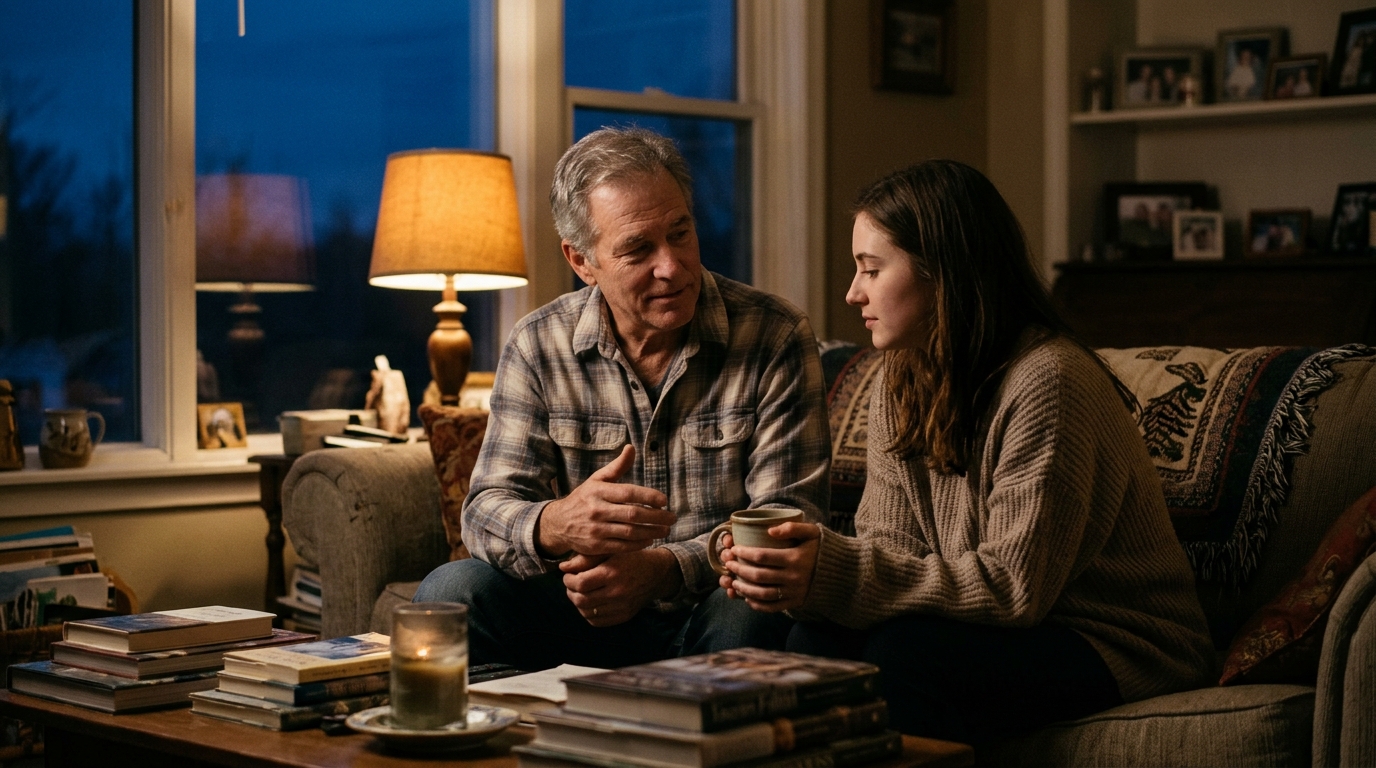
But there was one hour of the day when something in him loosened. It happened after the house had gone quiet, after the dishes were dry and the television was off, when the only light left was the small lamp in the hallway. That was when my father talked. And it took me most of my life to understand why.
The Hallway Lamp
When I was nine, I had a terrible fear of the dark. Not monsters exactly, just a heavy, swallowing feeling that came when the lights went out and the house started making its small night noises. My mother would tuck me in, and then, a few minutes later, I would hear my father’s slippers on the floorboards.
He never turned on my bedroom light. He would sit on the edge of the bed, a shape against the glow from the hallway, and he would say, “Can’t sleep?” Then he would just stay. Sometimes for ten minutes, sometimes for an hour.
At first he said nothing at all. Then, slowly, over weeks and months and years, he began to say things. Small things at first. What his own father had been like. The name of a dog he had loved as a boy. And then, as I grew older, bigger things, the kind of things a man cannot say in daylight, when he is expected to be strong and certain and finished with wondering.
What the Dark Made Possible
I have thought a great deal about why it had to be dark. I think it was simple. In the dark, he did not have to be seen. He did not have to hold his face in the shape of a father. He could simply be a person talking to another person, and the dark kept the secret.
Looking back, I can sort the things he taught me into a handful of lessons. He never labeled them as lessons. They arrived sideways, tucked inside stories, and I only recognized them years later.
- You are allowed to stop carrying things. He told me once about a business he had built and lost in his thirties. For years he had gone on defending it in his own head, arguing with people who were no longer listening. “One night I just put it down,” he said. “Nothing happened. The house was still standing in the morning.”
- Not every problem is yours to fix. This one was hard for a man who fixed everything. He admitted that his need to repair things had sometimes kept him from simply sitting beside the people he loved.
- Grief is just love with nowhere to go. He said this about his own father, who had died when my dad was twenty-six. He had never cried at the funeral. He cried, he told me, eleven years later, in a parking lot, over nothing at all.
- Forgiveness is mostly about unclenching. He did not say forgiveness was a gift to the other person. He said it was a hand that had been closed so long it had forgotten how to open.
The Night He Taught Me to Let Go of Him
The lesson I understood last, and least willingly, came when I was thirty-four.
My father had been ill for most of a year. By the time they moved him to the quiet room at the end of the hospital corridor, we all knew. I sat with him through the evenings, because the days belonged to the nurses and the visitors and the noise.
One night, after the staff had dimmed the lights and the hallway had gone still, he woke and looked at me. For a moment I was nine years old again, small and afraid of the dark that was coming.
“Can’t sleep?” he asked. His voice was thin, but it was the same question.
I laughed and cried at the same time. “No, Dad. Can’t sleep.”
He was quiet for a while. Then he said, “You’re going to want to hold on to me. After. Don’t. I held on to my father for eleven years too long. It’s all right to let the person go and keep what they gave you. Those are two different things.”
I did not answer. I could not. But I held his hand, and in the low light of that room, with the machines humming softly and the night pressing gently at the window, I understood that he was not giving me advice. He was giving me permission.
The Quiet After
He died four days later, in the early hours, when the world was at its stillest. I was not surprised, somehow, that it happened at night. He had always been most himself then.
The weeks that followed were heavy. I did what he had warned me against. I held on. I kept his voicemail. I wore his old cardigan around the house. I replayed our last conversations until the edges wore smooth and thin.
And then one evening, months later, I was sitting in the dark of my own living room, not reading, not watching anything, just sitting. And I heard it, as clearly as if he were in the room: it’s all right to let the person go and keep what they gave you.
So I tried. Not all at once. I started by deleting nothing and keeping everything, but loosening my grip. I let myself remember him without needing to rewind. I let the grief be what it was, love with nowhere to go, and I let it sit beside me instead of fighting it.
How I Practice It Now
I have turned my father’s habit into a small ritual of my own. Every evening, once the house is quiet, I sit for a few minutes with one lamp on and the rest of the lights off. I ask myself what I am carrying that I could put down.
If you would like to try it, here is what I do:
- Dim the room. Not darkness exactly, just enough softness that you no longer feel watched, even by yourself.
- Name one thing you are holding. A worry, a resentment, a conversation you keep rehearsing.
- Ask if it is yours to carry. Often it is not. Sometimes it is, but you can set it down for the night.
- Keep the gift, release the grip. Remember what a person or a season of life gave you, and let that be enough.
Some nights I put down very little. Other nights something heavy slides off my shoulders and I feel almost embarrassed by how much lighter I am. Either way, the house is still standing in the morning.
What the Dark Taught Me
I used to think my father’s honesty after dark was a kind of weakness, a place where his guard slipped. I understand now that it was his deepest strength. He knew that some truths cannot survive the glare of daytime, that they need dimness and quiet and a listener who will not flinch.
He taught me to be that listener for others. When someone I love is struggling, I do not rush to fix. I sit on the edge of the bed, so to speak, and I stay. I say very little. I let the dark do its work.
And when my own small fears come, as they still do, I think of the hallway lamp and the sound of slippers on the floorboards. I think of a man who could not say it in daylight, saying it anyway, because someone he loved needed to hear it.
Tonight, when your own house goes quiet, maybe you will find something you have been carrying too long. Maybe you will set it down, just for a while. And maybe, in the stillness, you will hear someone you love telling you that it is all right.
It is. Let it go, and keep what they gave you.