🎧 Listen to this story
Narrated by Rasalgethi · 8,256 characters
The Conversation I Did Not Expect to Have
I was not supposed to be there that long. I had stopped by my grandmother’s assisted living facility for what I figured would be a quick Tuesday visit: drop off some fruit, chat for twenty minutes, maybe watch a little television together before heading back to my packed afternoon schedule. I had emails to answer. A meeting at three. A to-do list that had quietly become a monument to my own anxiety.
But then Eleanor started talking. And I forgot about all of it.
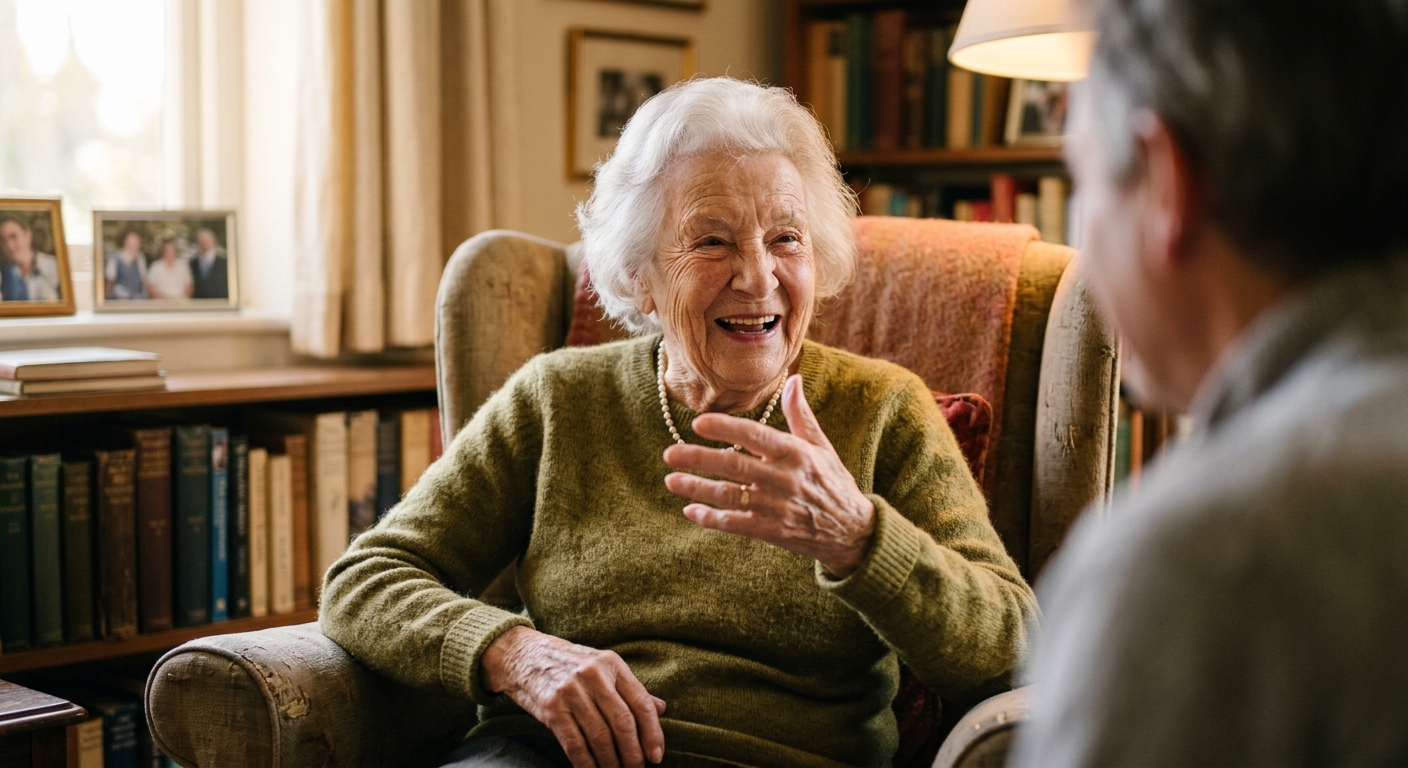
Eleanor is not my grandmother. She lives down the hall from her, in room 114, and she has been at Maplewood Gardens for about three years now. She is ninety years old, sharp as a tack, and has the kind of eyes that make you feel like she is reading a book that is written somewhere just behind your face. I had exchanged pleasantries with her before, little hallway hellos, but I had never really sat with her. That Tuesday, I did. And what she told me about regret in the span of forty-five minutes quietly rearranged something inside me.
How It Started: A Simple Question
I sat down next to Eleanor because she was alone and looked like she wanted company. Her television was off, which I had learned was a rarity. She had her hands folded in her lap and was looking out the window at the parking lot like it was a beautiful coastline.
I asked her, mostly just to make conversation, “Do you ever think about the past much?”
She turned to me slowly, smiled, and said, “Honey, at my age, the past is most of what you have. The question is what you do with it.”
That answer alone stopped me. But what followed stopped me even more.
What She Said About Regret
Eleanor told me she had spent a lot of her sixties and seventies carrying what she called “the heavy bag.” That was her phrase for regret. A bag you packed yourself, she said, filled with all the things you did not do, all the words you swallowed, all the roads you did not take because you were too afraid or too busy or too convinced that there would be more time later.
“The worst part,” she said, leaning toward me a little, “is that most of what is in that bag? It is not the big things. It is not the dramatic mistakes. It is the small ones. The Tuesday afternoons you spent worrying instead of living.”
I felt that land somewhere specific in my chest.
She went on. She told me about her late husband, Gerald, who had asked her for years to take a trip to Ireland with him. He had family roots there. It meant something to him. And Eleanor had always said yes, yes, soon, after the kids are older, after we save a bit more, after things settle down. Things never fully settled down, of course, because they never do. Gerald passed away at seventy-two, having never seen Ireland. Eleanor made the trip alone at seventy-eight. She said it was beautiful and heartbreaking in equal measure, and that she would trade every moment of it for a single afternoon there with him.
“I do not tell you this to make you sad,” she said. “I tell you this because you are young and you still have the chance to put less in the bag.”
The Regrets Nobody Talks About
Eleanor was surprisingly specific about the kinds of regrets that filled her heavy bag, and none of them were what I expected. She was not talking about career choices or missed opportunities in the conventional sense. She was talking about something quieter and more intimate.
- Not saying “I love you” enough, especially to people who seemed like they would always be around.
- Letting pride win arguments that did not need to be won at all.
- Skipping ordinary moments because they did not seem important yet.
- Waiting to be happy until some condition was met, some goal was reached, some season of life arrived.
- Not asking people about their lives because she assumed she already knew the answers.
“That last one,” she said, tapping her knee, “that one I am still learning from. People are deeper than you think. Everyone is carrying something. If you ask, really ask, they will usually tell you. And that is a gift, for both of you.”
The Thing She Said That I Will Never Forget
Toward the end of our conversation, I asked Eleanor if she thought regret was unavoidable. If it was just part of being human, something we all had to make peace with eventually.
She thought about it for a long moment. Long enough that I wondered if she had drifted somewhere else.
Then she said this:
“Regret is not the problem. Regret is the teacher. The problem is when you meet the teacher and do nothing with the lesson.”
I have written that sentence down in three different places since that afternoon. On a sticky note on my laptop. In the notes app on my phone. In a small journal I keep on my nightstand. I keep writing it down because I keep needing to find it again.
What I Did Differently the Next Day
I am not going to pretend that one conversation with a ninety-year-old woman turned me into an enlightened person overnight. Life does not really work that way, and Eleanor herself would probably laugh at that idea. But I did do some things differently in the days that followed, small things, and they mattered.
I called my dad just to talk, not because something was wrong or a birthday was coming up, just to hear his voice and ask him how he was doing. Really ask him. He talked for forty minutes about a woodworking project he had been working on in his garage. I did not know he did woodworking. I am his child and I did not know that about him.
I also told a friend of mine, someone I had been slightly distant with over a busy few months, that I missed her and that I was sorry I had been hard to reach. She cried a little. So did I.
And I took an afternoon off, a real afternoon, with no agenda, no productivity goals, no sense that I was somehow wasting it. I sat outside and read a book and ate a good meal and let the afternoon be exactly what it was.
None of these things are extraordinary. That is kind of the point.
What We Can Learn from People Who Have Lived Longer Than Us
There is a quiet tragedy in the way modern life tends to sideline its oldest members. We store our wisdom in search engines and podcasts and self-help books, and we overlook the people sitting in room 114 who have already lived the very questions we are frantically Googling.
Eleanor had no particular credentials. She was not a philosopher or a therapist or a bestselling author. She was a retired schoolteacher from a small town in Ohio who had raised three kids, buried a husband, and lived long enough to know what actually mattered. And she was generous enough to share it with someone who almost walked right past her.
Here is what I think we owe the Eleanors of the world: our time and our genuine curiosity. Not as a charity, but as a trade. Because they have something we desperately need, and most of them are willing to give it freely if we would only sit down and ask.
A Few Questions Worth Asking Yourself Today
Eleanor’s words stayed with me, and I have since turned them into a small set of questions I try to ask myself regularly. Maybe they will be useful to you too.
- What is already in your heavy bag, and is it too late to do something about any of it?
- Who in your life have you been meaning to connect with, and what are you actually waiting for?
- Is there something you keep deferring to “later” that deserves a place in your life right now?
- When is the last time you asked someone you love a real question and truly listened to the answer?
- Are you waiting to be happy, or are you letting yourself be happy now?
None of these questions are comfortable. That is how you know they are the right ones.
The Last Thing Eleanor Said to Me
When I finally got up to leave that afternoon, well past the twenty minutes I had planned, Eleanor reached out and patted my hand.
“Come back sometime,” she said. “Not because I am lonely. I am fine. But because you are a good listener, and good listeners need someone to practice on.”
I laughed more genuinely than I had in weeks.
I have been back four times since. Each visit, I leave lighter than I arrived. Eleanor would probably say that is not a coincidence. She would probably say that is just what happens when you finally put something down instead of carrying it.
She would probably be right.