
🎧 Listen to this story
Narrated by Leda · 7,348 characters
The Day I Finally Opened the Drawer
It had been eleven months since my father passed away. Eleven months of sorting through his belongings in short, painful bursts, taking breaks that sometimes lasted weeks. His old house still smelled like him, a mixture of cedar, engine oil, and the particular brand of instant coffee he drank every single morning without fail. I had been putting off the small wooden nightstand by his bed. Something about it felt final in a way the rest of the house did not.
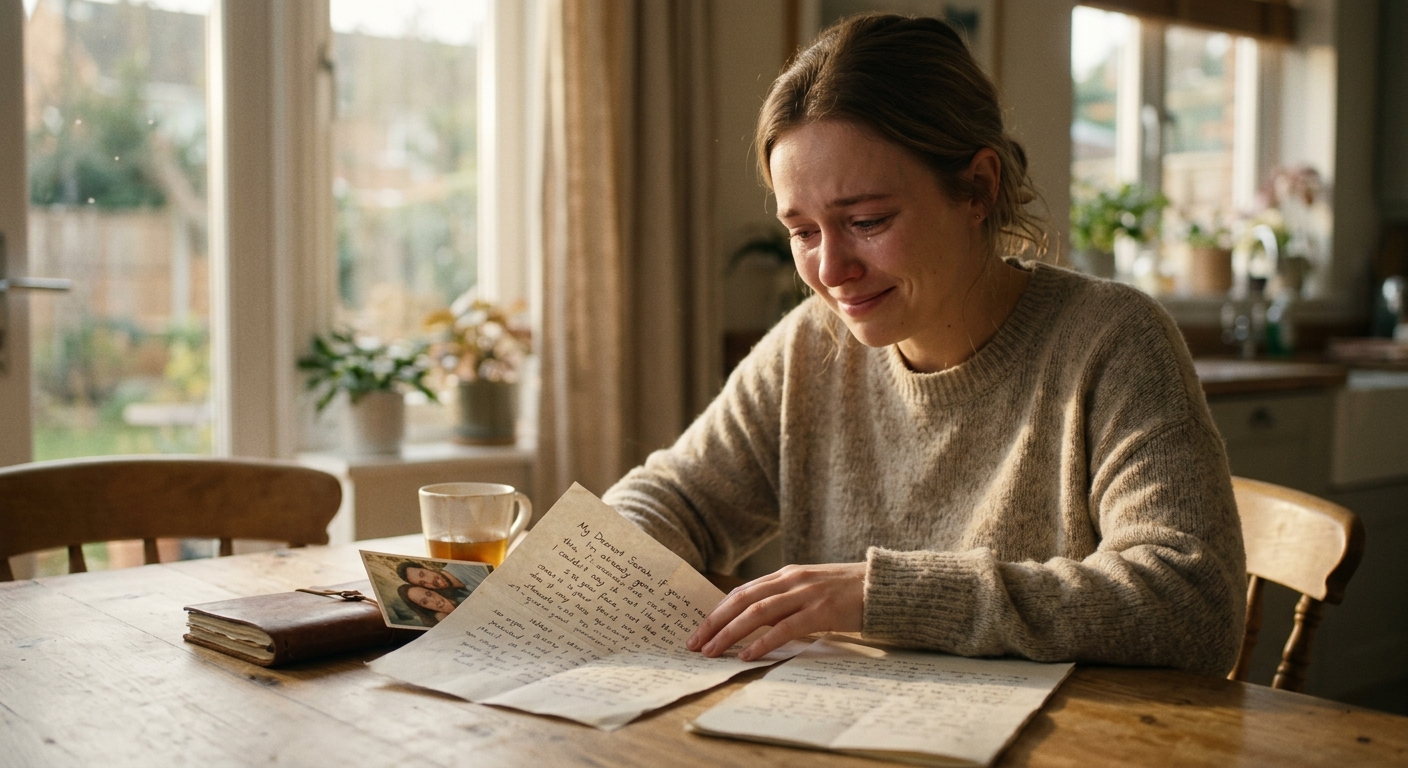
When I finally pulled open that bottom drawer on a gray Tuesday afternoon in October, I was not expecting to find anything significant. I thought I would find what I usually found in my father’s spaces: old receipts, spare change, maybe a pocket knife. Instead, I found a white envelope with my name written on the front in his unmistakable handwriting. Shaky, capital letters, slightly too large for the line. My name, just my name, sitting there like it had been waiting patiently for me all year.
My father was not a man of words. He was the kind of man who showed love through action, through showing up, through fixing things without being asked. He once drove four hours in a snowstorm just to help me move a couch. He never said “I love you” easily, and I spent a long portion of my adult life quietly aching over that fact. So finding a letter, an actual handwritten letter, felt like discovering something that should not have existed. It felt like a small miracle sitting in a cedar-scented drawer.
What the Letter Said
I am not going to share every word of the letter here, because some of it belongs only to me. But I will share the parts that I believe belong to everyone who has ever lost someone before they felt ready, before the important conversations could happen, before the things left unsaid found their way to the surface.
He started by apologizing. Not for anything dramatic or catastrophic, but for the ordinary failures of fatherhood. For the baseball games he missed because of work. For the time he criticized my first apartment instead of just being proud that I had one. For not knowing how to say the things he felt. “I always thought there would be more time,” he wrote. “That is the lie we all tell ourselves.”
He talked about watching me grow up and feeling something he described as “a wonder he never had words for.” He said he used to stand in the doorway of my bedroom when I was small and just watch me sleep, not out of worry, but because he could not quite believe that something so good had come from his life.
And then, near the end, he wrote something that answered a question I had been carrying for decades without ever speaking out loud. I had always wondered if my choices, the unconventional career path, the late marriage, the road I took that looked nothing like the one he would have chosen, had disappointed him. He wrote: “Every single thing you did that I did not understand, I was secretly proud of. I just did not know how to say so without sounding like I had been wrong. I was wrong. And I was proud. Both were true.”
Why Letters Like This Matter So Much
After I shared a small piece of this story with a close friend, she told me about a similar experience. Her grandmother had tucked handwritten notes inside the pages of recipe books, little asides and memories that turned a collection of cooking instructions into something like a memoir. Another friend found his father’s journal and discovered, for the first time, that his stoic, distant dad had written about him with tenderness every single week.
These discoveries share something important in common. They reveal the gap between what people feel and what they manage to say out loud. And they raise an uncomfortable but necessary question: how many people in our lives are walking around full of things they mean to say someday?
The Things We Assume Are Understood
One of the most common human mistakes is assuming that the people we love know how we feel. We think that showing up is enough. We think that history speaks for itself. We think that “of course they know” is a safe place to live. But grief has a way of exposing all the cracks in that logic. When someone is gone, the things that were “understood” suddenly feel terrifyingly unconfirmed.
My father understood this, at least enough to put something on paper. What I do not know is when he wrote it. I do not know if he always intended for me to find it, or if it was something he wrote during a hard night and simply never threw away. It does not matter. It found me when I needed it.
What I Learned From a Single Piece of Paper
In the months since finding the letter, I have turned its lessons over and over like a smooth stone in my pocket. Here is what I keep coming back to:
- Silence is not the same as absence of feeling. Many people, especially of older generations, were never taught to verbalize emotion. That silence can look like coldness when it is actually just a different language.
- Pride and criticism can coexist. My father was hard on me because he was hard on himself. His criticism was not the opposite of his pride. They lived side by side in him, and I spent years not knowing that.
- Time is genuinely not guaranteed. This is not a cliche when you are holding a letter from someone who is no longer alive to say the words themselves. It becomes a fact with weight and texture.
- The people who struggle to say things often feel them the deepest. I have come to believe that my father’s love was so large he did not have a container for it. It spilled out sideways, in actions, in presence, in a letter tucked into a drawer.
- It is never too late to write it down. Even if you never send it. Even if you are not sure the person will read it. There is healing in the act of writing the truth.
A Challenge I Am Passing On to You
If you are reading this and someone comes to mind, someone you love but have not quite told in full, someone you are proud of but have never said so directly, I want to gently suggest something. Write it down. Send a text if a letter feels too large. Leave a voicemail. Stick a note inside a book you lend them. Find any container for the thing that lives in you unspoken.
Do not wait for the right moment, because the right moment has a frustrating habit of not arriving on schedule. Do not wait until you have the perfect words, because imperfect words delivered in time are infinitely more valuable than perfect words delivered too late.
My father was many things. He was complicated and stubborn and sometimes maddening. He was also a man who, in the end, found a way to say what he needed to say. He gave me something to hold onto when holding on felt impossible. He gave me the answer to a question I had been afraid to ask out loud.
The Drawer Is Empty Now
I kept the letter. I have read it more times than I can count. Some days I read it and feel only grief. Other days I read it and feel something closer to peace. Most days, I feel both at once, which I have come to understand is just what love feels like when the person is gone and the love stays behind.
The drawer is empty now, but I am not. He made sure of that.
If your person is still here, please do not wait for a drawer. Tell them. Tell them now, today, in whatever clumsy and imperfect way you can manage. You will not regret it. And neither will they.