🎧 Listen to this story
Narrated by Kore · 8,085 characters
There is a particular kind of quiet that settles over a house around nine o’clock at night. The dishes are done. The television hums low in another room. Somewhere upstairs, a floorboard creaks as someone turns over in bed. For most of us, this is the sound of ordinary life winding down. For Marisol Delacroix, it is the sound of a promise being kept.
Every night, before she locks up the front office of Lantern House, she walks out onto the wide wooden porch, checks the old brass-colored bulb above the door, and makes sure it is burning warm and steady. It has not been switched off in eleven years. Not once.
This is the story of why.
The Girl Who Learned to Watch the Door
Marisol entered the foster care system at age seven. By the time she turned eighteen, she had lived in fourteen different homes. Some were kind. Some were merely functional. A few were places she still does not talk about. What she remembers most, though, are not the big moments. It is the small, aching ones.
She remembers sitting on the edge of a stranger’s guest bed at night, her belongings packed in a black trash bag because no one had given her a suitcase, listening to a family she did not belong to laugh downstairs. She remembers learning to read the rhythm of a new house: which stairs groaned, when the adults went quiet, how long it took before the light under the door went dark.
“Evenings were the hardest,” she told me when we spoke last month. “During the day you have school, you have noise, you have things to do. But when the sun goes down, a child in the system has nothing to hold onto except the question: will someone leave a light on for me?”
In one placement, a foster mother used to leave the hallway lamp glowing all night because she had noticed Marisol would not sleep in the dark. She never mentioned it. She never made it a thing. She simply did it, night after night, for the four months Marisol stayed.
“I have thought about that woman almost every evening of my adult life,” Marisol said. “She will never know that a hallway lamp became the blueprint for everything I built.”
Aging Out With Nowhere to Go
On the day she turned eighteen, Marisol was handed a folder of paperwork, a bus pass, and a wish of good luck. That was the system’s farewell. She had a part-time job at a bakery and no place to sleep.
For the next two years, she moved between couches, a church basement, and, on the worst nights, a twenty-four-hour laundromat where she would sit with warm clothes in her lap just to stay comfortable until morning. She was not alone in this. Nationally, a significant share of young people who age out of foster care experience homelessness within a few years of leaving the system.
It was during those laundromat nights that an idea began to form, slowly, the way most true ideas do. She did not dream of becoming a hero. She dreamed of a door that would open when you knocked, no matter the hour, no matter the reason.
Building Lantern House
Marisol worked double shifts for years. She took night classes in social work. She saved every dollar she could and eventually partnered with a retired schoolteacher named Walter, who owned a worn-down, six-bedroom house at the edge of town and was looking for someone who would love it.
The first night Lantern House opened, it had two beds made up and a single lamp hanging by the front door. Marisol sat on the porch steps until well past midnight, half afraid no one would come.
Around eleven, a teenage boy appeared at the end of the walkway, backpack clutched to his chest. He stood at the edge of the light for a long moment, as if deciding whether it was safe to step into it.
“He just looked at the porch light,” Marisol remembers. “And I said, ‘It stays on all night. It always will.’ And he finally walked up the steps.”
What Evening Looks Like at Lantern House
Today, Lantern House serves young people between the ages of sixteen and twenty-four who are aging out of care or have nowhere else to turn. It has grown from one house to a small campus with a kitchen, a study hall, and a counseling room. But the evening routine, Marisol insists, has never changed.
As dusk settles, the house begins to exhale. The residents drift in from jobs and classes. The smell of dinner fills the hallways, usually something simple and warm, served family style around a long table that Walter built by hand. No one is required to talk. Some nights the conversation is lively. Other nights it is just the clink of forks and the comfort of being among people who understand.
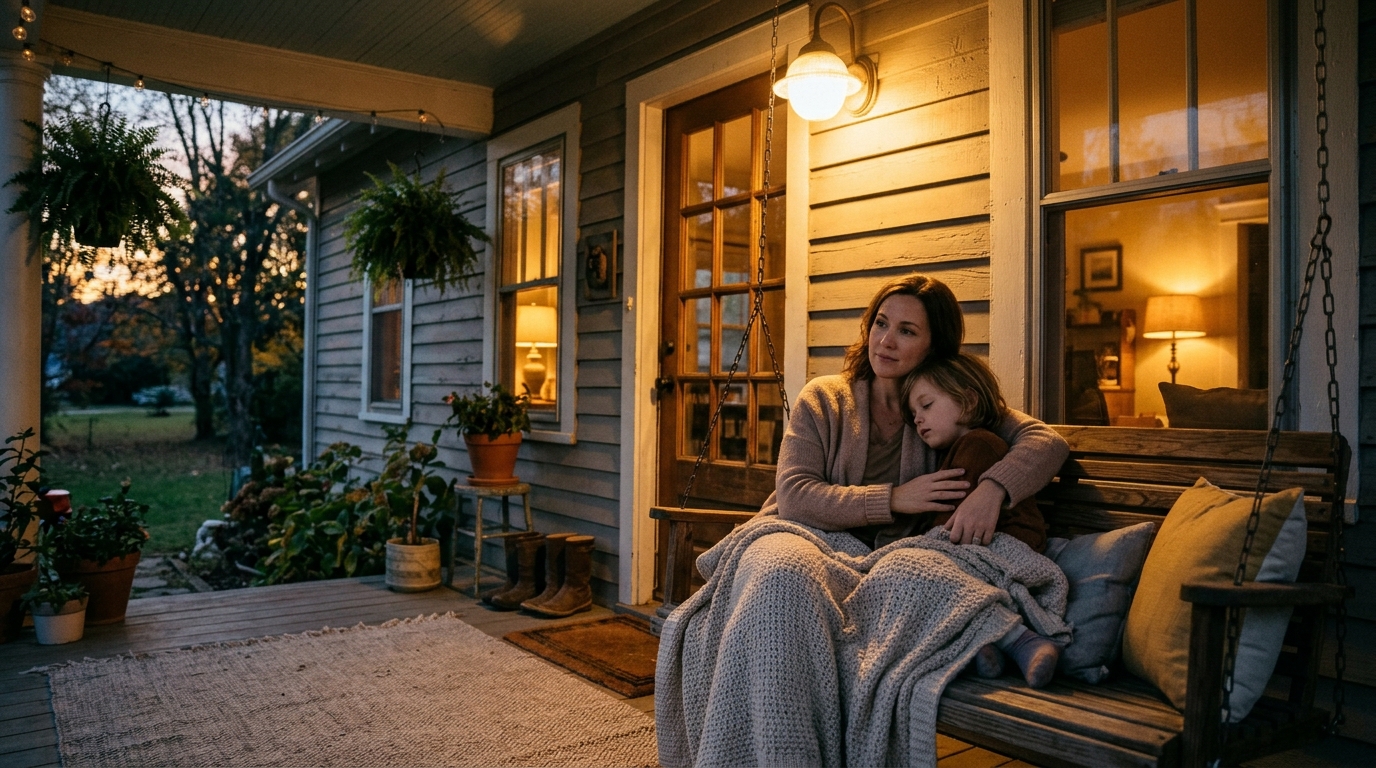
After dinner, there is a tradition the residents call “the porch hour.” Anyone who wants to can sit outside as the sky darkens, wrapped in blankets, with mugs of hot chocolate in their hands. The porch light flickers on above them, and for a while, nobody needs to be anything other than safe.
“That’s where the real healing happens,” Marisol says. “Not in the meetings or the paperwork. It happens at dusk, when someone finally lets their shoulders drop.”
The Small Rituals That Matter
Marisol believes that stability is built from tiny, repeated gestures, not grand ones. At Lantern House, the evenings are stitched together with them:
- The Welcome Bag: Every new resident receives a real suitcase, not a trash bag, filled with a blanket, toiletries, and a handwritten note from a previous resident.
- The Hallway Lamp: Every bedroom corridor keeps a soft light on all night, in honor of that long-ago foster mother.
- The Open Kitchen: No one ever has to ask for food. The pantry and refrigerator are always unlocked, because Marisol remembers what it felt like to be hungry and ashamed to say so.
- The Goodnight Check: A gentle knock and a quiet “goodnight” at each door, never intrusive, simply a reminder that someone notices.
The Ones Who Came Back
Perhaps the most moving part of Lantern House is not what happens inside it, but who returns to it.
Residents who have moved on, who now have apartments, careers, and families of their own, often drive back on random weeknights. They do not call ahead. They simply appear on the porch, sometimes with a bag of groceries, sometimes with nothing but a need to sit under that light again.
One former resident, now a nurse, comes every Thursday evening to teach the newer kids how to budget and cook cheap, hearty meals. Another, a young man who arrived with nothing, recently brought his newborn daughter to meet “the house that raised me.”
“That’s when I know it’s working,” Marisol says, her voice catching. “When a kid who once stood at the edge of the walkway, afraid to step into the light, comes back as someone who is lighting the way for others.”
What the Porch Light Teaches Us
When I asked Marisol what she would say to someone who wants to make a difference but does not know where to begin, she laughed softly and shook her head.
“You do not have to build a shelter,” she said. “Leave a light on for somebody. Be the hallway lamp. That foster mother never knew she was changing a life. She just did a small, steady, kind thing every night.”
It is a lesson that settles deeply in the hush of evening. We are so often convinced that kindness must be loud and dramatic to count. But the most enduring acts of love tend to be quiet and consistent, the kind that ask for no recognition and simply keep the light burning.
A Gentle Question for Tonight
As you wind down your own day, perhaps with the dishes done and the world growing still, consider this:
- Who in your life might be sitting at the edge of the light, waiting to be invited in?
- What small, steady kindness could you offer, not once, but regularly?
- Who left a light on for you, and have you ever thanked them?
Marisol still makes her nightly walk to the porch, still checks the bulb, still lingers a moment in the cool dark before heading inside. Somewhere out there, she knows, there is a young person walking alone, wondering if anyone will be waiting.
And at the edge of town, on a quiet street, the answer glows warm and golden, as it has every night for eleven years.
The porch light is on. It will be there when you need it.