🎧 Listen to this story
Narrated by Kore · 6,545 characters
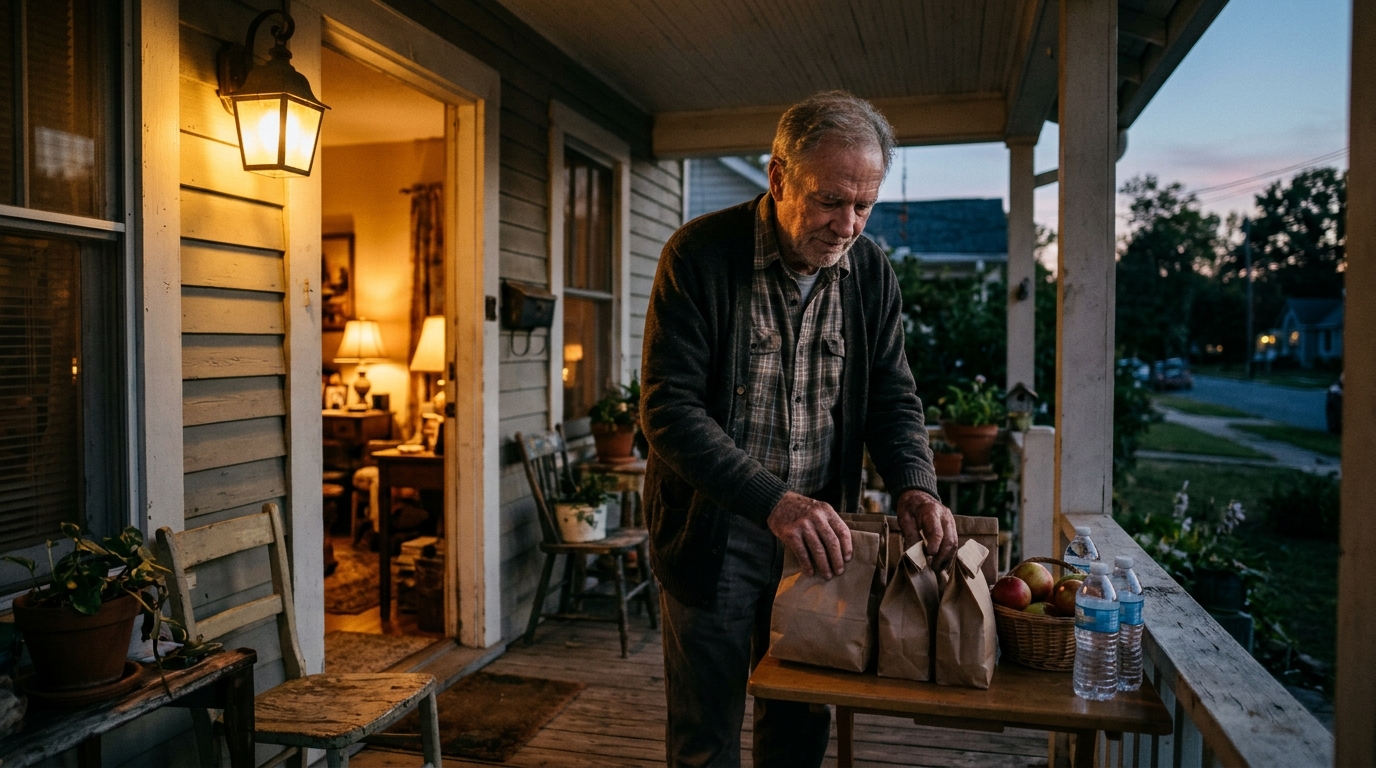
There is a particular hour on Maple Hollow Road when the day seems to exhale. The mail carrier is long gone, the school buses have rumbled home, and the sky turns the color of weak tea with honey stirred in. It is at this hour, every single evening, that Walter Dunmore steps onto his front porch, flips a small brass switch, and waits for the yellow bulb to glow.
Then he sets a plate on the little wooden table beside the door, covers it with a clean dish towel, and goes back inside. He does not knock on anyone’s window. He does not post about it. The light simply stays on, and the plate simply waits.
The Habit That Started With a Single Cold Evening
Walter, a retired bus mechanic in his early seventies, will tell you the whole thing began by accident. Four winters ago, his wife Odalys had passed, and the house had gone quiet in a way he had not known a house could. He found himself cooking for two out of pure muscle memory, then staring at the extra portion with nowhere to put it.
One night, a young man walked past on his way home from a double shift at the distribution warehouse. He slowed when he saw the porch light and the steam rising off a pot of soup Walter had carried out to cool. Walter, caught between embarrassment and instinct, simply said, “There’s more than I can eat. Take a bowl.”
The young man did. He came back the next night. Then the next.
What the Light Actually Says
Walter never intended to build anything. But a porch light, he says, speaks in a language everyone already understands. It says: someone is awake, someone is home, and you are not invisible.
“People think hunger is about the stomach,” he told a neighbor who asked about it once. “It is, mostly. But there’s a second kind, the kind where you walk home and nobody has noticed you were gone all day. The plate handles the first kind. The light handles the second.”
The Quiet Rules of the Porch
Over time, Walter developed a few unspoken rules. He never wrote them down, but anyone who has spent an evening watching from across the street could recite them.
- The light goes on at dusk and stays on until the last person has passed, however late that is.
- The plate is always covered, so the food stays warm and the person taking it can do so without being watched.
- No questions are asked. Ever. Not a name, not a reason, not a thank you required.
- The dish towel is clean every night, because dignity lives in small details.
- If the plate is still there in the morning, it simply becomes his breakfast. Nothing is wasted, and nothing is owed.
A Menu Built on Leftovers and Love
He is not a fancy cook. Most nights it is a hearty stew, a pan of baked pasta, rice with beans, or sandwiches wrapped in wax paper when his arthritis flares. On Sundays he makes Odalys’s recipe for chicken with roasted potatoes, and he says those are the plates that disappear fastest. He does not charge a dime, and he accepts no donations, though neighbors have quietly begun leaving grocery bags on his step.
What the Evening Teaches You
There is something about the end of the day that strips away our pretenses. At noon we are busy and defended, armored by our schedules. But at dusk, when the light goes soft and the house settles, we become more honest about what we need. A tired body wants rest. A tired heart wants to be seen.
Walter has noticed this over his many evenings on the porch. The people who come by rarely look hungry in the way you would expect. They look worn. They look like people who held it together for ten hours and are only now allowed to feel how heavy it was.
“The evening is when it all catches up with you,” he says. “That’s when a kind word, or a warm plate, does the most good. Nobody needs rescuing at lunchtime.”
The Night a Plate Became a Friendship
One of Walter’s regulars was a woman in her thirties who worked nights cleaning offices downtown. She took a plate for weeks without a word. Then one evening, she left something in return: a small jar of wildflowers, tucked beside the empty dish.
The next night there was another jar. Over the seasons, the little table filled with an unlikely collection of mismatched jars, each one a quiet thank you. Today, a row of them lines his windowsill, catching the last of the sun every afternoon.
The Ripple on Maple Hollow Road
Kindness has a way of being contagious when it is done without fanfare. The family next door began leaving extra produce from their garden. A teenager down the block offered to mow Walter’s lawn without being asked. Another neighbor, a nurse, started a tradition of leaving a thermos of coffee on the porch table for the folks who come by on cold mornings.
Nobody organized this. There is no committee, no logo, no hashtag. There is only a street full of people who noticed one old man’s light and decided to add a little of their own.
Small Ways to Leave Your Own Light On
You do not need a porch, a stove, or a spare bowl of stew to do something like this. The spirit of Walter’s habit travels well. Here are a few ways to carry it into your own evenings:
- Leave an extra portion of dinner with a neighbor who lives alone, no occasion required.
- Keep a few wrapped snacks and a water bottle in your car for someone who looks like they need them.
- Send a short message to a friend who has been quiet lately, just to say you were thinking of them.
- Turn your own porch light on at dusk, a small signal that your home is a safe place on your street.
- Practice noticing: ask yourself each evening who in your life might be walking home tired.
The Last Light of the Day
When the sky finally darkens on Maple Hollow Road, Walter does his last round. He checks the plate, straightens the dish towel, and glances up the street one more time. Most nights, someone is coming. Some nights, no one is. Either way, he leaves the light burning.
“It’s not really for them,” he admitted once, with a small laugh. “Or not only for them. It’s for me, too. Every night I turn it on, I remember there’s still a reason to.”
And so the little brass switch stays flipped, the yellow bulb keeps glowing, and a covered plate waits patiently in the dark. Somewhere down the road, a tired person turns a corner and sees that warm circle of light, and for the first time all day, feels expected.
That, perhaps, is the whole lesson of the evening. We spend so many hours chasing big things, grand gestures, important work. But when the day finally quiets down, what lingers is almost always small: a light left on, a plate set out, a door that says without a word, you are welcome here.