🎧 Listen to this story
Narrated by Kore · 7,533 characters
There is a particular kind of quiet that settles over a small town when the working day ends. Porch lights flicker on. Dishes clink behind kitchen windows. And in the town of Marrow Creek, for one long stretch of seasons, that quiet was broken every evening at six o’clock by something unexpected: the sound of two hundred neighbors showing up to build a school.
This is the story of how it happened, told the way it was told to me by the people who lived it, on the folding chairs and overturned buckets where they used to rest at the end of each long, dusty night.
The Morning Everything Changed
Marrow Creek is the kind of place where everyone knows whose truck is whose. About nine hundred people live there, spread across farms, a handful of shops, and one main road. For generations it had exactly one school, a low brick building where children learned to read, where the whole town gathered for winter pageants, and where the gym doubled as the polling place every November.
Then came the night a storm ripped through the valley. By morning, the roof of the old school had collapsed into the classrooms, and the walls had buckled under the weight of water. There was no question of patching it. The building that had held three generations of Marrow Creek children was gone.
The nearest school was forty minutes away by bus. For families with young children and long workdays, that distance felt impossible. A retired teacher named Dolores Whitfield, who had taught second grade in that building for thirty-one years, stood in the wreckage with her coat pulled tight and said something her neighbors still repeat. “A town that cannot teach its own children is a town that has stopped believing in tomorrow. I am not ready to stop.”
The Promise Made at Dusk
The insurance money would cover only a fraction of the cost. The district offered a long timeline and a smaller, plainer building. The people of Marrow Creek wanted neither the wait nor the compromise. So that first week, as the sun dropped low and the light turned amber across the ruined schoolyard, someone rang the old brass bell, which had survived the storm, and people began to gather.
There was no formal plan. A farmer named Teodoro Alvarez, who worked fourteen hours a day with his cattle, suggested the thing that changed everything. “We all work during the day,” he said. “But we all have evenings. What if we gave the school our evenings?”
They shook on it, right there in the dust. Every evening, at six o’clock, they would meet at the site. They would work until the light failed. And they would keep doing it, however long it took, until the doors were open again.
What an Evening Looked Like
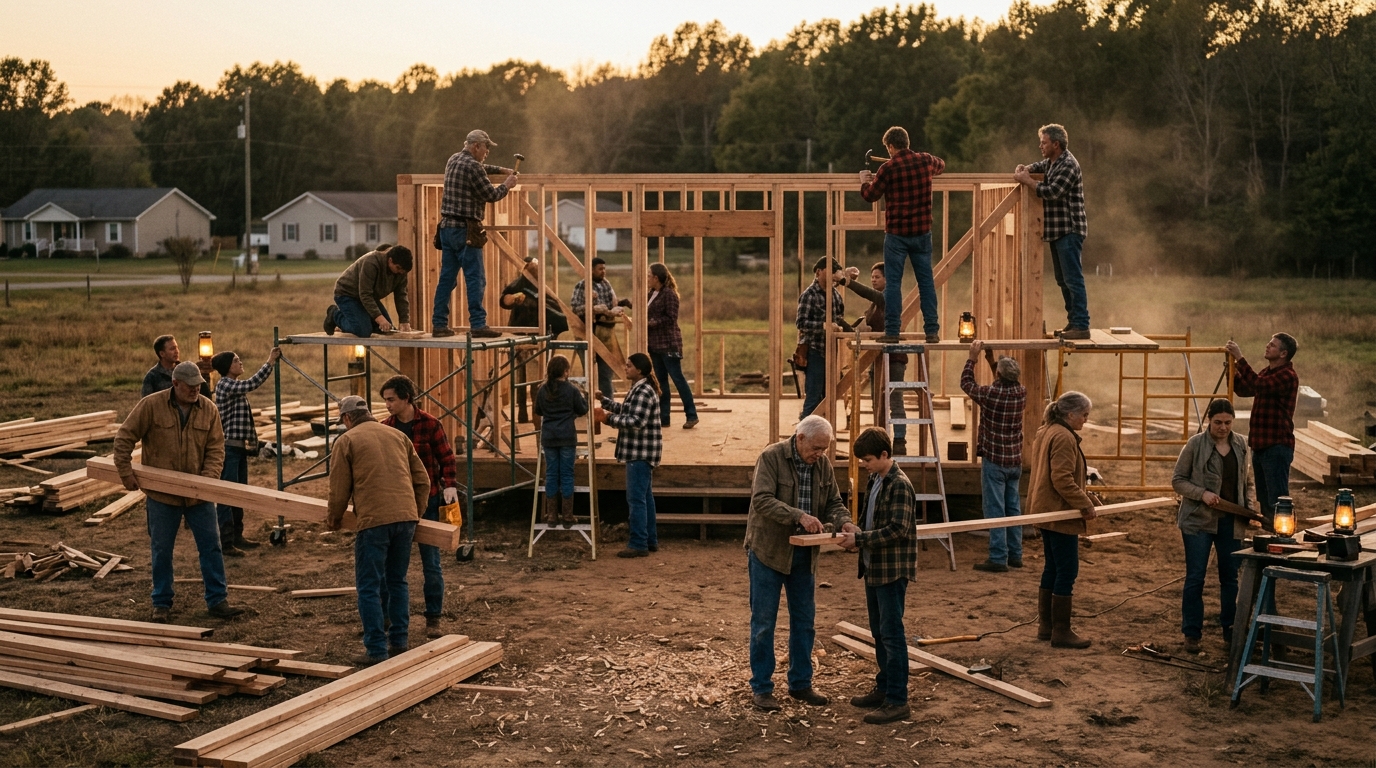
It would be easy to imagine a dramatic construction montage, but the truth was humbler and more beautiful. The work happened in the gentle hours between supper and dark. It looked something like this:
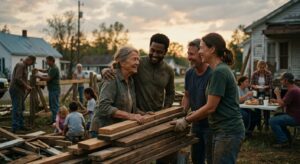
- Six o’clock: The bell rang and people arrived straight from their jobs, still in work boots and school clothes, carrying thermoses and tool belts.
- Six-thirty: The electricians, carpenters, and plumbers among them directed the volunteers who had never held a nail gun in their lives.
- Seven-thirty: A rotating group of neighbors set out dinner on long tables, simple casseroles, sandwiches, and pitchers of sweet tea.
- Eight o’clock: The children, who were not supposed to be there but always were, swept sawdust into little piles and declared themselves the official cleanup crew.
- Dark: Work lamps came on, and the last hour was often the quietest, full of low voices and the steady rhythm of hammers.
Some nights, thirty people came. Some nights, over a hundred. A man who had not spoken to his brother in six years found himself holding one end of a beam while his brother held the other. Neither said a word about the feud. They simply finished the beam, and the next night they worked side by side again.
The Lesson That Settled In After Dark
I asked Dolores what she remembered most from those months. She was quiet for a while, the way people are when they are choosing which memory to pull from a full shelf.
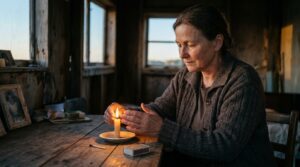
“It was the walking home,” she told me. “At the end of each night, when everyone drifted off down the road in the blue light, I would stop at the edge of the field and look back at what we had done that day. One more wall. One more window frame. It never looked like much, but it was always more than the night before.”
That, she said, was the lesson. Not the grand finish, but the small, steady accumulation of ordinary evenings. Nobody in Marrow Creek could have built a school in a single heroic burst. But nine hundred people could build one if they simply refused to skip a night.
The Hard Evenings
It was not all warmth and casseroles. There were nights in the dead of winter when the cold bit through gloves and the ground was too frozen to work. There were evenings when a delivery of lumber fell through and spirits sank. One week, three of the most dedicated volunteers came down with the flu, and the crowd thinned to a handful.
On one of those thin nights, a nine-year-old girl named Pilar, whose family had lost their small farm the previous spring, showed up with a toolbox that was nearly as big as she was. “My mom says if we all stop coming, it stops being ours,” she told the adults. They put her in charge of sorting screws. She took the job so seriously that the crew started asking her permission before they opened a new box.
The next evening, the crowd was back, larger than before.
The Night the Lights Came On
It took one hundred and forty-one evenings. Almost five months of dusk after dusk. On the final night, the last coat of paint was drying on the entry hall, and someone flipped a switch that had not been touched since the storm. Every window of the new school glowed gold against the darkening valley.
Nobody cheered at first. They just stood in the schoolyard, in the cool evening air, looking up. Then Teodoro, the farmer who had suggested the whole thing, quietly rang the old brass bell, and the whole town finally let out the breath it had been holding for months.
The first day of classes began that autumn. Dolores, at seventy-three, was invited to read the opening story to the new kindergarten class. She chose a book about a little train that kept saying, “I think I can.”
What We Can Carry Home
There is something worth taking from Marrow Creek into our own evenings, wherever we are. A few quiet thoughts to settle with before sleep:
- Big things are built in small, consistent hours. Showing up tonight matters more than a perfect plan for next year.
- Evenings belong to us. Even when our days are claimed by work, the hours after can be given to something that outlasts us.
- Everyone has a tool to offer. A hammer, a casserole, a broom, or a box of sorted screws. None of it is too small.
- Showing up together heals old wounds. Common work can quietly mend what words cannot.
A Last Light on the Hill
If you drive through the valley at dusk today, you will see the school sitting low and warm against the hills, a few windows still lit where a teacher is grading papers or a janitor is finishing his rounds. Above the front door, carved into a plank of reclaimed wood, are the words the town chose for itself: Built one evening at a time.
Tonight, as the day softens and the noise fades, you might ask yourself a gentle question. What is the thing in your own life worth showing up for, again and again, until it is done? You do not have to finish it tonight. You only have to ring the bell and begin.