🎧 Listen to this story
Narrated by Kore · 7,702 characters
The first thing Marguerite noticed was that her granddaughter had stopped asking for the porch light.
For most of Nora’s seven years, the porch light had been her nighttime ritual. Leave it on, Grandma. Just in case. But in the weeks after her father’s funeral, the light stayed off, and Nora sat in the dark on the back steps, staring at nothing, saying nothing. Marguerite understood. Grief has a way of making brightness feel like an insult.
The Quiet After the Casseroles
Everyone knows the first days of loss. The house fills up. Neighbors arrive with casseroles, cousins sleep on couches, the phone rings and rings. But Marguerite had learned something over her own long life: the real grief arrives afterward, in the hush that follows. When the dishes are returned and the cars drive away, the evenings become the hardest hours of all.
Evenings were when Nora’s father used to read to her. Evenings were when he used to carry her up the stairs, pretending to be too tired, groaning dramatically, then tucking her in anyway. Now the sun went down and the silence came up to take its place.
Nora’s mother, worn thin by sorrow and paperwork, had asked Marguerite to take Nora for the summer, just until things settled. So the two of them found themselves in a small farmhouse at the edge of a meadow, with no plan except to get through each day and reach the next one.
The Night Everything Blinked
It was a warm evening in late June, the kind where the air feels like a held breath. Marguerite was washing dishes when she glanced out the window and stopped.
The meadow was glowing.
Not all at once, but in slow, scattered pulses, little yellow-green sparks rising out of the tall grass. She had seen fireflies a thousand times in her life, but she had forgotten how they arrive: quietly, without announcement, as if the dusk itself were exhaling light.
She dried her hands and stepped onto the porch. Nora was already there, sitting on the top step with her knees pulled to her chest. She did not turn around.
Marguerite lowered herself down beside her and said nothing. The fireflies drifted higher. One landed on the porch rail, flashed twice, and rose again.
After a long while, in a voice barely louder than the crickets, Nora asked, “Why do they do that?”
What the Fireflies Are Really Saying
Marguerite was no scientist, but she had once read a little about them, and she shared what she remembered. Fireflies are not flies at all. They are beetles. The light they make comes from a chemical reaction inside their bodies, one of the most efficient forms of light in nature, producing almost no heat at all. And the flashing is a language.
- Each species has its own pattern, a kind of signature rhythm in the dark.
- The males fly and flash, searching.
- The females, resting in the grass, answer back with a flash of their own.
- It is, in the simplest terms, a conversation conducted entirely in light: I am here. Are you there?
Nora was quiet for a moment. Then she said something Marguerite would remember for the rest of her life.
“Maybe Daddy’s answering.”
A Child’s Theory, Gently Held
There is a temptation, when a grieving child says something like that, to correct it or to inflate it. To say, Yes, sweetheart, that’s exactly what’s happening. Or to say, Oh honey, that’s not how it works.
Marguerite did neither. She simply said, “What do you think he’s saying?”
Nora thought about it with the seriousness only children can bring to such questions. “I think he’s saying he’s still here,” she said. “Just not in the way I want.”
Marguerite blinked hard and looked up at the sky so Nora wouldn’t see her face. “That sounds right to me,” she said.
The Evening Ritual
Something shifted after that night. Not dramatically, because healing rarely works that way, but in small, steady increments. Every evening after supper, the two of them walked out to the porch and waited for dusk to deepen. It became the quiet center of their days.
Nora began to keep a notebook. She counted the fireflies she saw each night and wrote the numbers in careful, wobbly handwriting. Some nights it was twelve. Some nights it was over a hundred. She noted the weather beside each count: cloudy, warm, after rain.
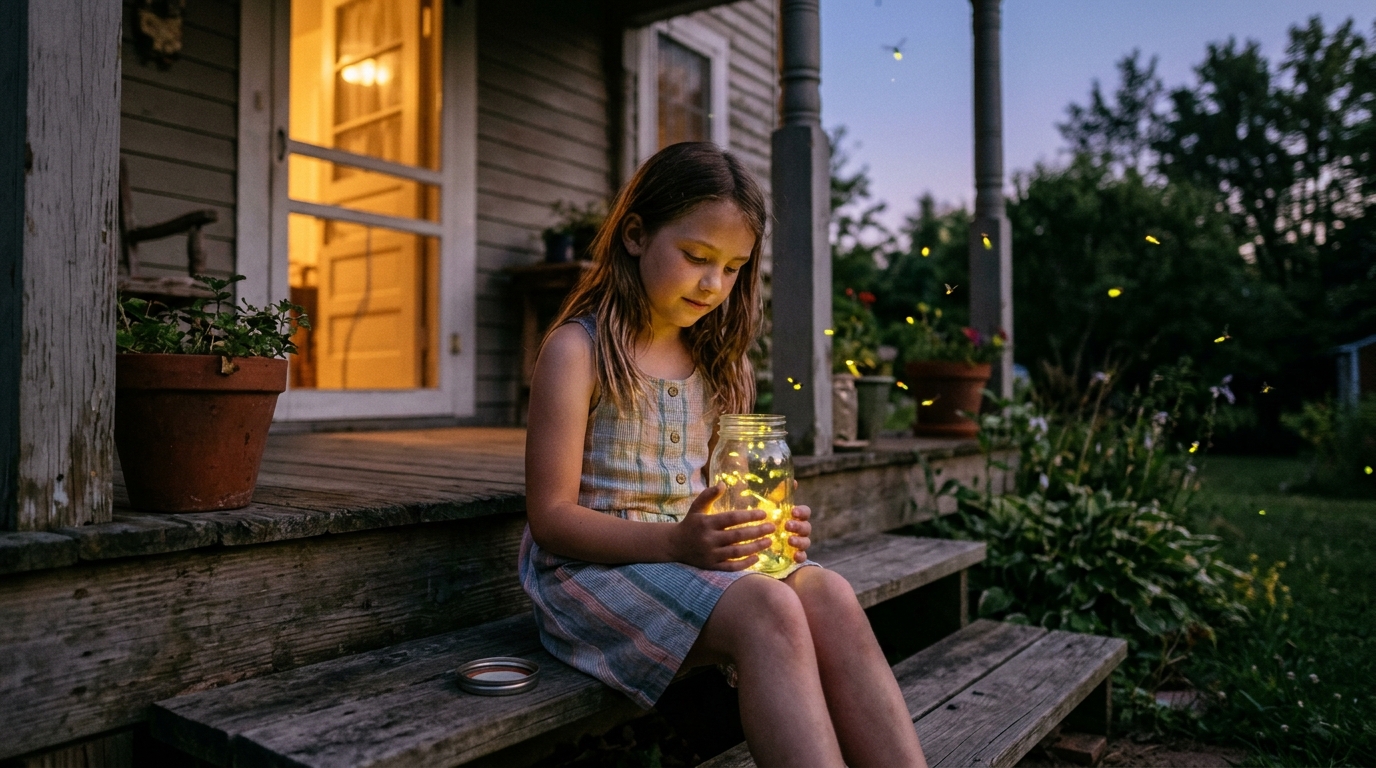
One evening she asked if they could catch a few in a jar, the way she had done with her father in the backyard of their old house. Marguerite hesitated, then found a clean mason jar, poked holes in the lid, and handed it over.
Nora caught three. She held the jar up, and the little bodies pulsed gold against the dark glass. She watched them for a long time.
Then she walked to the edge of the meadow, unscrewed the lid, and tipped the jar open.
“They’re not supposed to stay in a jar,” she said. “They’re supposed to talk to each other.”
The three of them rose into the night, flashing, and joined the rest.
What the Dark Is Actually For
That, perhaps, is the lesson tucked inside this story, and it is one that settles most deeply when the day’s noise has gone quiet: fireflies only glow because it is dark. In daylight, you would never know they were there. Their light is not despite the darkness but because of it, a small and stubborn brightness that only shows itself when everything else has dimmed.
Grief works a little like that, Marguerite thought. In the loud bright days, we can pretend we are fine. But in the evening, when the world quiets, the love we carry for the ones we have lost begins to flicker into view. It is painful, but it is also proof. You cannot grieve what you did not love, and the grieving is just love with nowhere to go.
Small Ways to Find Your Own Evening Light
You do not need a meadow or a farmhouse to borrow some of what Nora learned. If you or someone you love is moving through loss, a few gentle practices can help the evening hours feel less heavy:
- Create a small, repeatable ritual. Grief thrives on unpredictability. A simple nightly habit, like sitting outside for ten minutes at dusk, gives the heart something steady to lean on.
- Let children lead the meaning-making. Ask what they think rather than telling them what to believe. Their own theories are often the ones that heal them.
- Count something small. Nora’s notebook gave her a way to pay attention to the world again. Attention is the first step back toward wonder.
- Make room for stillness. You do not have to fill the quiet with talking. Sometimes sitting beside someone in the dark is the kindest thing you can do.
- Look for the things that glow in the dark. Stars, fireflies, a lit window across the field. Let them remind you that light and darkness are not enemies.
The Last Night of Summer
When August began to fade and the fireflies grew fewer, Nora’s mother came to take her home. On their final evening at the farmhouse, Nora and Marguerite sat on the porch one more time. Only a handful of lights drifted over the meadow now, sparse and slow.
Nora watched them for a while, then did something Marguerite had not seen her do in months. She reached up and switched on the porch light.
“For the fireflies,” she said. “So they know where to find us.”
Marguerite smiled, and it was the first smile that did not hurt.
Before You Turn Out Your Own Light
Tonight, when the dishes are done and the house settles into its nighttime quiet, step outside for a moment if you can. Look at whatever small light is out there. Think of someone you carry with you, someone whose absence still echoes in the evening hours.
You may not see a single firefly. But the light is still there, in the way a good memory is still there, in the way love keeps its own quiet rhythm long after the day has gone dark.
And somewhere out in the grass, in a language older than words, something is still answering back.