🎧 Listen to this story
Narrated by Kore · 6,121 characters
My mother never believed in wasting daylight. She was the kind of woman who had the laundry folded by seven in the morning and a casserole in the oven before most people had finished their coffee. So it surprised me, in the last months of her life, to watch her become someone who simply sat. Every evening, around the time the light turned amber, she asked to be wheeled to the window.
I want to tell you what those evenings taught me. I am still sorting it out, the way you sort through a drawer after someone is gone, holding each thing up to the light.
The Evening Ritual Nobody Planned
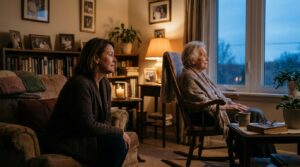
It began by accident. In early autumn, the hospice nurse suggested we move her bed closer to the west-facing window of the living room. The idea was comfort: more air, more light, less of the closed-in feeling of a sickroom. I pulled the armchair up beside her, and that first evening we did not say much. The sun slid down behind the neighbor’s maple tree, and the whole room turned the color of honey.
“Look at that,” she said, as if she had never seen a sunset before. She had watched perhaps twenty thousand of them in her life. But this one, she said, was the first she had ever really watched.
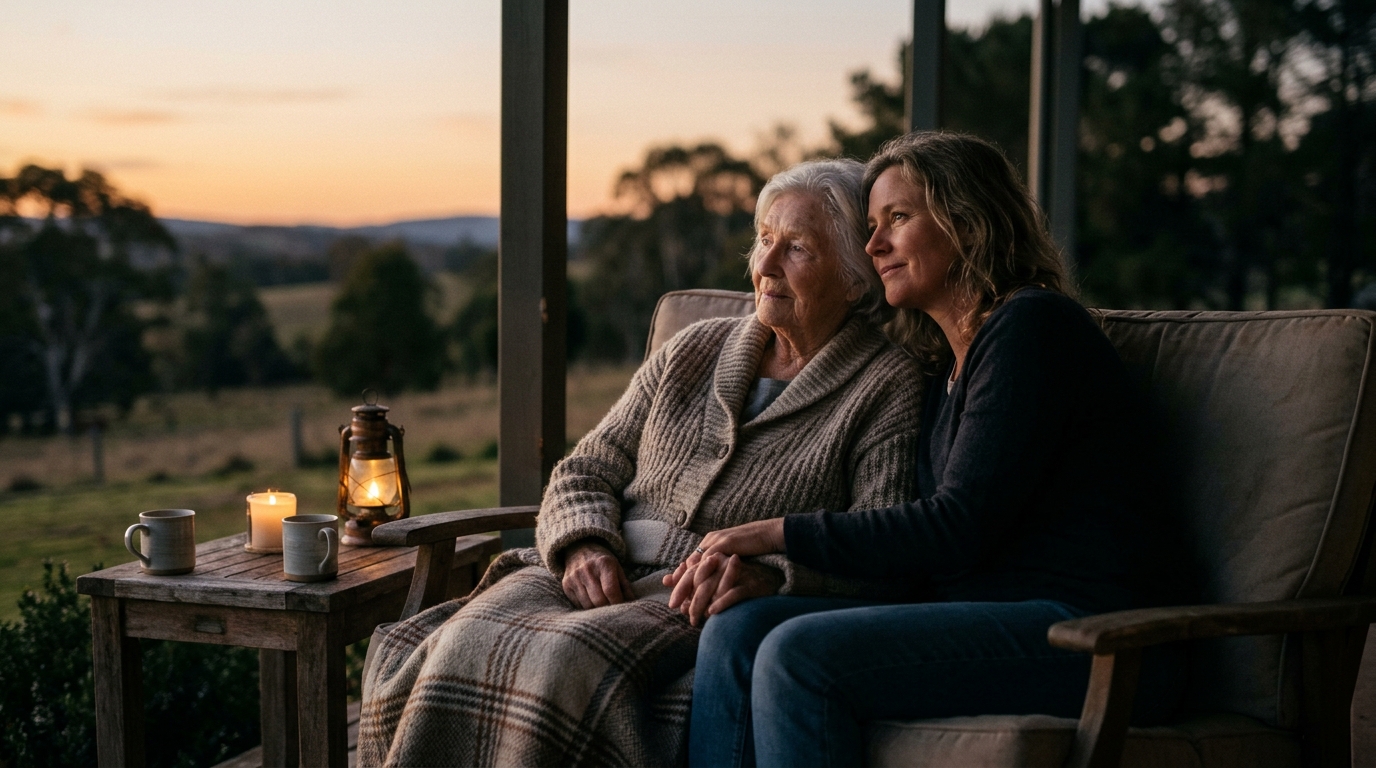
By the end of that week, it was our appointment. Four-thirty, then five, then earlier as the days shortened. I would make tea she could barely sip, tuck the blanket around her knees, and we would wait for the sky to do its slow work.
What the Light Showed Us
There is something about the end of a day that gives you permission to stop. The morning demands things from you. The afternoon is a negotiation. But dusk asks nothing. The work is done, or it is not, and either way the light is leaving and you cannot hurry it or slow it down.
Sitting beside her, I started to notice things I had missed for decades:
- How a sunset is never one color but a long conversation between gold, rose, and a blue so deep it feels like a held breath.
- How the birds grow louder just before dark, as if they are all saying their goodnights at once.
- How my mother’s hand, resting on the blanket, had the same shape as mine. I had never really looked at it before.
- How silence between two people who love each other is not empty. It is full.
The Lesson About Time
For most of my life, I treated time like money: something to spend carefully, to save, to feel anxious about running short of. I kept a calendar that was color-coded and merciless. I had told myself, many times, that I would slow down once things settled. Once the project ended. Once the kids were older. Once there was more room.
My mother, in her last weeks, showed me that there is no “once.” There is only this evening, this light, this cup of tea going cold in your hands.
One night she turned to me and said something I wrote on the back of a receipt so I would not lose it. She said, “I spent so much of my life getting ready for the good part. I think this might be the good part.”
She was not being sad. She said it with a kind of wonder, the way you might announce a small, surprising discovery. And I realized she was right, and that I had been doing the same thing: standing in the doorway of my own life, waiting for it to start.
Three Things I Learned in the Stillness
1. Presence is the only real gift
I had spent weeks trying to find the right thing to say, the right thing to do, the perfect way to make her last days meaningful. In the end, what she wanted was simple. She wanted me to sit beside her and look at the sky. No speeches. No grand gestures. Just my attention, fully given.
2. Small rituals hold more than we think
That daily appointment with the window became the spine of our days. Everything else was medicine schedules and quiet worry. But the sunset was ours. It gave the days a shape, a thing to look forward to, and a thing to remember. If someone you love is nearing the end, or if you simply want to love your ordinary days better, choose one small ritual and protect it.
3. Endings can be beautiful without being easy
I will not pretend those evenings were all peace. Some nights she was too tired to stay awake for the light, and I watched alone, crying quietly so I would not disturb her. But even in the grief there was beauty. A sunset does not pretend that the day is not ending. It simply ends well, with color and grace, and lets you watch.
The Last Evening
She died in the early weeks of winter, on a morning, not an evening, which I have always found oddly kind. I did not have to associate the sunset with the loss. The sky was spared that.
But the first evening after she was gone, I went to the window anyway. The armchair was still there. The blanket was still folded over its arm. And the sun went down behind the maple tree exactly as it always had, turning the room to honey, indifferent and generous at once.
I sat for a long time. And for the first time in my adult life, I did not reach for my phone, or my list, or my worry. I simply stayed until the last of the light had gone, and the first stars came out, and the room was dark and soft around me.
What I Do Now
I have kept the appointment. Most evenings, when the day begins to loosen its grip, I stop what I am doing and go sit by a window. Sometimes I make tea. Sometimes I invite my own children to join me, and they fidget at first, then slowly settle, and then someone points and says, “Look,” in just the way my mother did.
I do not think I will ever fully understand time. But I understand this: it is not something you have. It is something you are inside of, like weather, like light. And the only way to honor it is to notice it while it is here.
A Gentle Invitation
Tonight, when the day starts to fade, I hope you will do something small and slightly rebellious. Put down whatever you are holding. Find a window, a porch step, a patch of sky. Sit beside someone you love, or sit alone with your own good company. And watch the light go quiet.
You do not have to learn anything. You do not have to feel anything in particular. Just be there while it happens, the way my mother was, the way she taught me to be.
Because this, as she said, might be the good part.