🎧 Listen to this story
Narrated by Kore · 7,600 characters
There is a particular kind of quiet that settles over a house around nine o’clock at night. The dishwasher hums its final cycle. The hallway light clicks off. Somewhere upstairs, a small person finally stops negotiating for one more glass of water and surrenders to sleep.
I used to treat that quiet as a finish line. This is a story about the night I realized it was something else entirely.
The Evening That Went Sideways
It started, as these things do, over something small. My daughter, who was seven at the time, had decided that she would not be wearing the green pajamas. Not tonight. Not ever. They were, in her words, ‘itchy in a way you cannot understand.’
I understood perfectly well that the pajamas were not itchy. I had worn them myself, in a joking moment, to test the theory. They were soft as a cloud. So I explained this to her. Calmly, at first.
She countered. I countered her counter. We volleyed back and forth like two lawyers arguing a case that neither of us would remember by morning. Somewhere around the fifth round, my voice took on a tone I recognized from my own childhood, the tone of a parent who has stopped solving a problem and started trying to win it.
‘Because I said so,’ I heard myself say, and the words landed in the room like a dropped plate.
She stared at me. Her chin wobbled. And then, quietly, she said, ‘You always have to have the last word.’
I opened my mouth to respond. To defend myself. To explain, once more, why I was right.
And then I closed it, because she had a point, and I did not like what that meant.
The Silence After
She wore the green pajamas. I tucked her in without the usual song. She turned toward the wall, and I stood in the doorway feeling like I had won a battle and lost something I could not name.
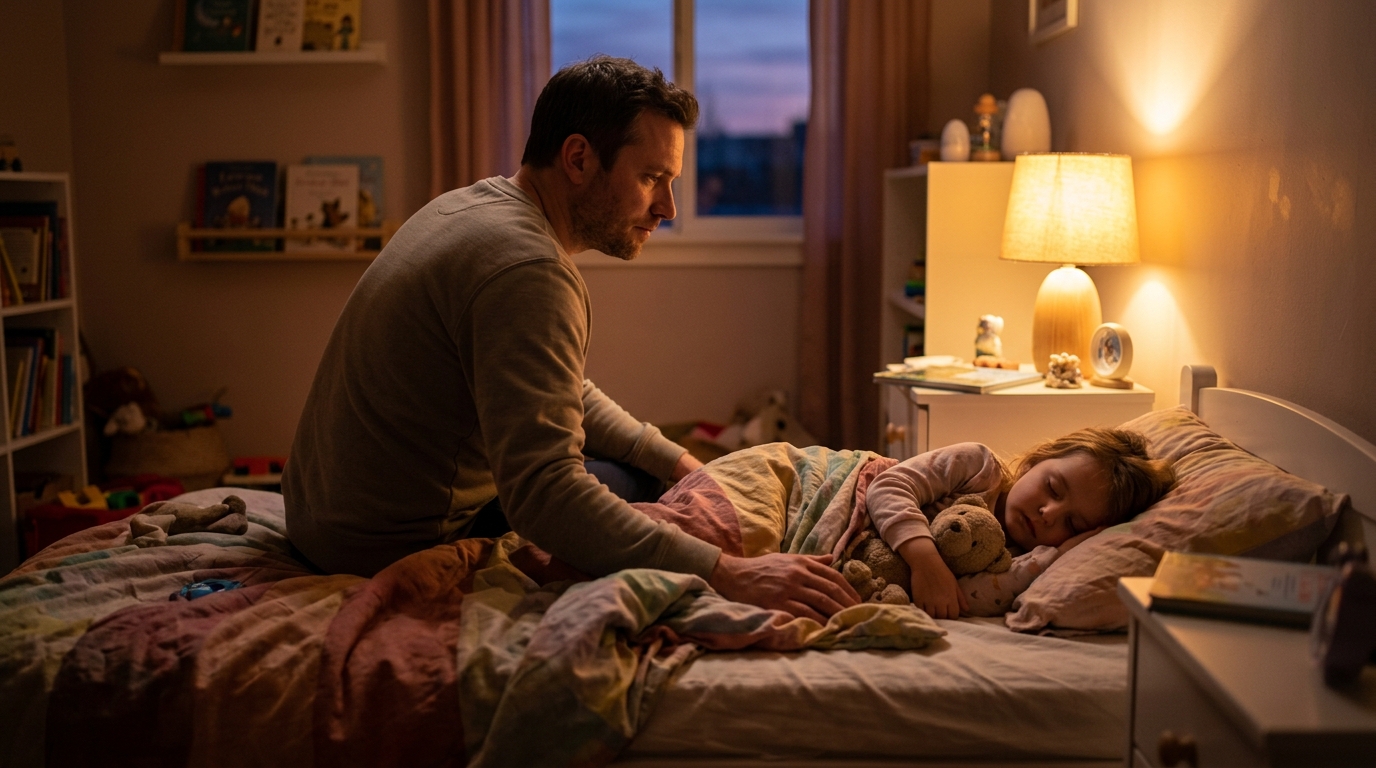
I did not leave. For reasons I cannot fully explain, I sat down on the floor beside her bed, my back against the dresser, and I listened to her breathing slow and deepen.
There is something about watching a child sleep that dismantles you. The fierce little person who had been debating me an hour earlier was gone. In her place was a small, soft face, one hand curled near her cheek, a stuffed rabbit crushed beneath her arm. Her eyelashes rested on her cheeks. She looked about four years old again.
The room was lit only by a night light shaped like a moon, and in that amber glow I did something I rarely do: I replayed the evening honestly.
What the Dark Showed Me
Sitting there, I noticed something uncomfortable. The argument had never really been about pajamas. It had been about a long day of my own, a tense phone call, a deadline, a sense that I had spent ten hours being agreed with or ignored and wanted, desperately, to be the one who made the final call about something.
My daughter had simply wandered into the path of a feeling that had nothing to do with her.
I thought about all the times I had needed the last word in my life. With my siblings, over decades-old grievances. With my spouse, in the little disagreements about directions and dishwasher loading. With coworkers, in emails I rewrote three times to land the perfect closing line.
And I asked myself a question that has stayed with me ever since: what has the last word ever actually given me?
Not peace. Not connection. Not the feeling of being understood. At best, it gave me a brief flicker of satisfaction that curdled almost immediately into something heavier.
Why We Cling to the Last Word
In the weeks that followed, I became a quiet student of my own habit. I noticed that the need to have the last word almost never shows up when I feel secure. It shows up when I feel unheard, small, tired, or afraid of being wrong.
The last word, I realized, is often armor. It is a way of saying, ‘I still matter here, and I am not going to be diminished.’ But armor, however useful, is heavy to carry into the one place where I most wanted to be soft.
Here is what I came to understand:
- The last word is rarely about the topic. It is usually about status, safety, or pride wearing a disguise.
- Winning an argument with a child is a strange kind of loss. The power gap is already enormous. Using it to prove a point teaches them that love comes with conditions.
- Silence is not surrender. Choosing not to reply is a decision, and sometimes the strongest one available.
- Being right and being close are two different goals. They only occasionally overlap.
The Apology I Almost Skipped
The next morning, I made her pancakes shaped, badly, like stars. She came to the table still a little guarded, watching me the way children watch adults they are not sure about yet.
I sat down across from her and said the sentence I had practiced in the dark: ‘I’m sorry I said because I said so. That wasn’t fair. You told me the pajamas felt wrong, and I didn’t listen.’
She considered this. Then she said, with the solemn honesty only a seven-year-old can manage, ‘They were a little itchy.’
I laughed. She laughed. And just like that, the thing that had felt so enormous the night before shrank to its true size.
We found a different pair of pajamas together that afternoon. Blue ones. She declared them ‘acceptable.’
What Changed in Me
I would love to tell you I became a perfectly serene person overnight. I did not. The impulse to have the last word is old and stubborn, and it still taps me on the shoulder in traffic, in email threads, in kitchen disagreements.
But something shifted that night on the floor beside her bed. I developed a small practice, one I now think of as the evening test.
The Evening Test
Before I go to sleep, I ask myself three gentle questions:
- Did I need to win something today that did not need winning?
- Is there someone who went to bed feeling smaller because I insisted on being right?
- If I could take back one closing remark, which would it be?
The answers are not always comfortable. But there is a peculiar grace in asking them at night, when the day’s noise has drained away and the only sound is the house settling. Evening has a way of stripping our arguments down to their bones. What felt urgent at four in the afternoon often looks embarrassingly small by nine.
A Different Kind of Strength
My daughter is older now. She still has strong opinions about fabrics, among many other things. And sometimes, when we disagree, I watch her do the very thing I am learning to do: pause, breathe, and let a sentence go unsaid.
Last month, during a spat over a missing library book, she looked at me, shrugged, and said, ‘You can have the last word this time. I’m tired.’
And I surprised us both by saying, ‘No. You can have it.’
We stood there for a second, two stubborn people holding the door open for each other.
Tonight, Try This
If you are reading this in the quiet hours, with the day finally behind you, I would invite you to sit with it for a moment. Think about the last conversation where you pushed to have the final say. Think about who was on the other side of it.
You do not have to call anyone tonight or draft a grand apology. You can simply notice. Noticing is where it begins.
And if there is a sleeping child nearby, or a sleeping partner, or even just a quiet room that has absorbed your day, let it teach you what it taught me: the most peaceful people I know are not the ones who always get the last word. They are the ones who have discovered they do not need it.
The house is quiet now. The night light is glowing. And somewhere upstairs, a small person is breathing slow and easy, trusting that tomorrow I will do a little better than I did today.
That trust is worth more than every argument I have ever won.