🎧 Listen to this story
Narrated by Kore · 8,085 characters
There is a particular hour, just after the sun slips behind the tree line and before the stars fully commit, when a farm seems to exhale. The cattle settle. The wind drops. The long shadows soften into something almost kind. For most of his life, Walter Haskins used that hour to count what was wrong. Then, one evening in late August, he used it to start counting what was left.
The Year Everything Came Due
Walter, now sixty-one, is a third-generation vegetable and orchard farmer in a small river valley where the land has been in his family since before his father was born. For decades the farm did what farms do: it survived on thin margins, good weather, and stubbornness. Then came a run of bad luck that read like a country song nobody wanted to hear. A late frost killed most of one spring’s blossoms. A major grocery buyer shifted suppliers and cancelled a contract that had carried the farm for eleven years. A tractor died, then a refrigeration unit, then a well pump, one after another, each repair eating the cushion that was supposed to protect the next.
By the following autumn, Walter was behind on loan payments and facing a bank notice. He filed for bankruptcy protection, a word he still says quietly, as if the walls might hear. The farmhouse, the barn, and the fields were all at risk. He remembers sitting on his porch one evening with the paperwork folded in his shirt pocket, watching the last light drain out of the orchard and thinking that he might be the one to lose what four generations had held.
“I wasn’t afraid of being poor,” he told me. “I was afraid of being the last name on the deed.”
The Idea Nobody Believed In
The idea came from something small. His granddaughter, Josie, nine years old, had wandered the rows at dusk with a basket, picking the tomatoes that were too ripe to survive the trip to a morning market. They were soft, fragrant, and a little bruised, the kind of fruit that grocery buyers reject and farmers quietly feed to the chickens. Josie held one up and said, “These are the best ones, Grandpa. They just can’t wait till tomorrow.”
That sentence stuck. Walter realized that his best produce was often his most perishable, and that the whole machinery of selling it, the early drives, the wholesale pricing, the cosmetic standards, was built around fruit that could survive a long trip. What if he sold what was at its peak, right now, at the end of the day, to people who were already heading home?
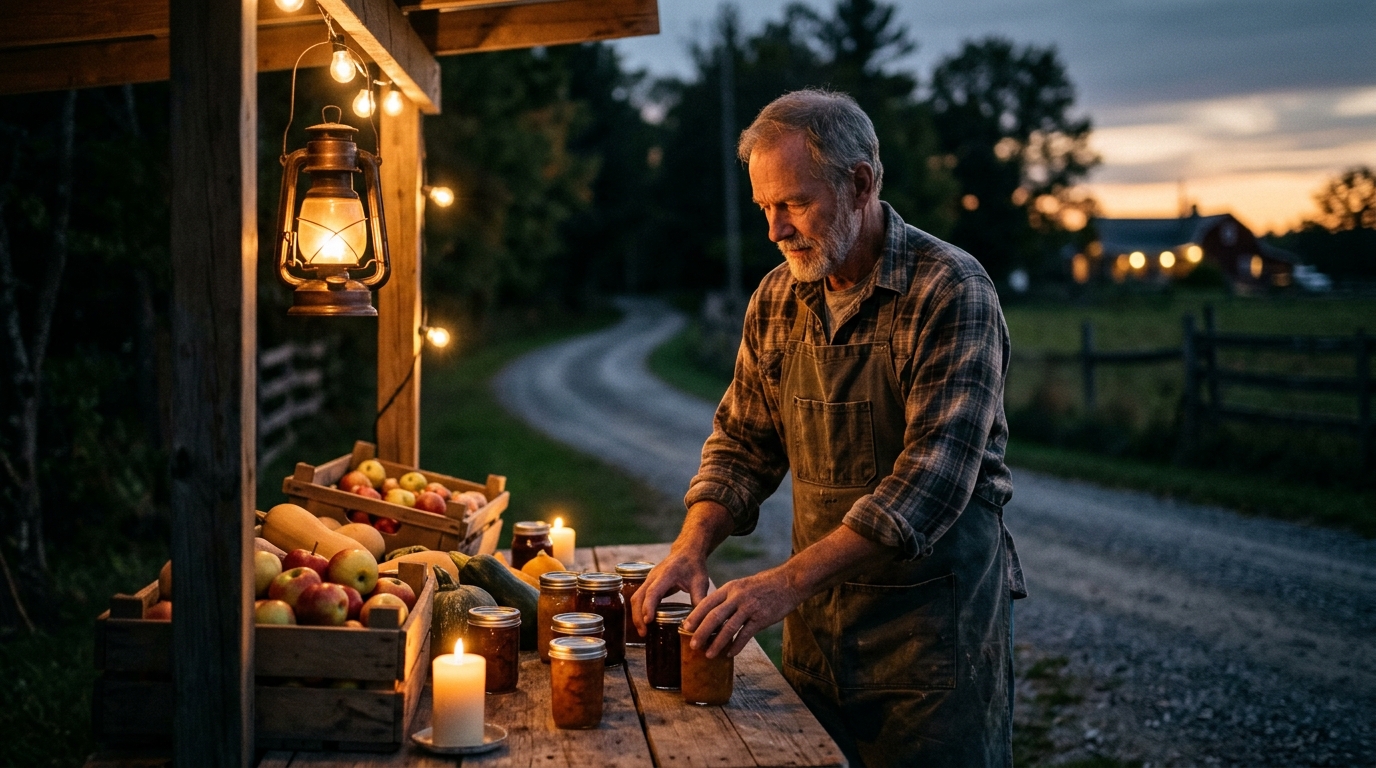
So he set up a folding table at the end of his gravel lane, where it meets the county road that commuters use to get back to town. He hung a single battery lantern from a fence post, wrote “Picked Today, Gone Tonight” on a piece of scrap plywood, and waited.
His neighbors were polite about it. His banker was less so. One friend gently suggested he was wasting gas and gloom. Nobody shops for tomatoes at seven in the evening, they said. Farm stands run on Saturday mornings. This was not how it was done.
The First Night
The first night, Walter sold four pounds of tomatoes and a handful of peaches. He made eleven dollars and forty cents. He remembers the exact figure because he wrote it in a notebook and looked at it for a long time afterward. It was nothing. It was also the first money in months that had come from something he decided rather than something that happened to him.
The second night, a woman in scrubs pulled over. She was a nurse coming off a long shift, and she told him she hadn’t cooked a real meal in two weeks because by the time she got home, the stores were closed or the produce was wilted. She bought a bag of everything, and she came back the next night, and the next.
What the Evening Did That Morning Never Could
Over the following weeks, Walter noticed something he hadn’t expected. The evening crowd was different from a morning market crowd. People weren’t browsing or comparing prices or hurrying to the next errand. They were tired, they were heading home, and they were hungry for something that felt real at the end of a hard day.
- Commuters stopped because the stand was on their way, with no detour and no parking hassle.
- Shift workers, nurses, factory crews, and delivery drivers, finally had a place that was open when they were free.
- Neighbors started lingering, sharing recipes and stories as the sky turned amber and then violet.
- Families began bringing kids to pick their own peaches in the last light, turning errands into small rituals.
Walter began staying later, then adding a second table, then a handwritten chalkboard listing what had been picked that afternoon. He added jars of preserves his late wife’s recipe had made famous in the family. He added a coffee urn in the cooler months. He never advertised beyond the plywood sign, yet the lantern at the end of the lane became a kind of landmark. People started calling it “the lantern stand.”
The Quiet Mathematics of Survival
By the end of that first full season, the nightly stand was bringing in more than his old wholesale contracts ever had, partly because he kept the whole margin instead of surrendering most of it to middlemen, and partly because selling peak-ripe produce meant almost no waste. The fruit that used to rot in the field or feed the chickens now paid the electric bill.
Over two years, the numbers climbed steadily. He paid down his arrears, worked out a repayment plan, and eventually emerged from bankruptcy protection with the land intact. He hired two part-time helpers, one of them a local teenager who now studies agriculture at a state college.
The Lesson That Settles In After Dark
I asked Walter what he’d learned, and he took a while to answer. We were sitting on folding chairs behind the stand, the lantern humming softly above us, the road quiet between cars.
“I thought the problem was that I didn’t have enough,” he said. “Turns out the problem was I was selling at the wrong time to the wrong people in the wrong way. The land was fine. The fruit was fine. I just had to meet folks where they actually were.”
That is the kind of insight that only seems obvious afterward. It took a bankruptcy notice, a nine-year-old’s offhand remark, and an evening hour that most people spend on the couch to find it.
Why Evening Is Kinder Than We Think
There is a gentleness to the end of the day that we rarely credit. The pressure to perform has lifted, the phone calls have mostly stopped, and the world slows enough that we can finally hear our own thoughts. Walter’s best idea did not arrive at noon, in the middle of the clatter. It arrived at dusk, when a child’s small voice carried clearly across a quiet field.
If you are carrying something heavy tonight, a debt, a doubt, a door that seems to have closed, consider this a small invitation. Sit with the stillness a little longer than usual. Notice what the day left behind that you have been too busy to see.
A Few Gentle Takeaways for Tonight
- Look at what you throw away. Your “seconds” might be someone else’s treasure.
- Listen to the smallest voice in the room. Wisdom often arrives in a child’s offhand comment.
- Start small and start tonight. Eleven dollars and forty cents was enough to begin.
- Be where people actually are. Sometimes the answer is not a better product but a better hour.
The Lantern Still Burns
Last I visited, it was a cool September evening, and the stand was busy. A line of cars idled at the end of the lane. A man in a delivery uniform was telling Walter about his daughter’s first week of school. Josie, now twelve, was weighing peaches with the seriousness of a bank teller, her braid coming loose in the breeze.
When the last customer left and the sky had gone fully dark, Walter wiped down the table, tucked the cash box under his arm, and reached up to turn off the lantern. He paused for a second, hand on the switch, and looked down the lane toward the house with its warm kitchen light.
“Same land,” he said, mostly to himself. “Same man. Just a different hour.”
Then he clicked off the lantern, and the whole valley went soft and quiet, the way it does when something has finally been set right.