🎧 Listen to this story
Narrated by Kore · 7,074 characters
At 6:00 every evening, the front door of the Maple Ridge Animal Shelter clicks shut. The lobby lights go off. The last adopter’s car pulls out of the gravel lot, and the staff drift toward their own dinners and their own dogs and their own quiet couches.
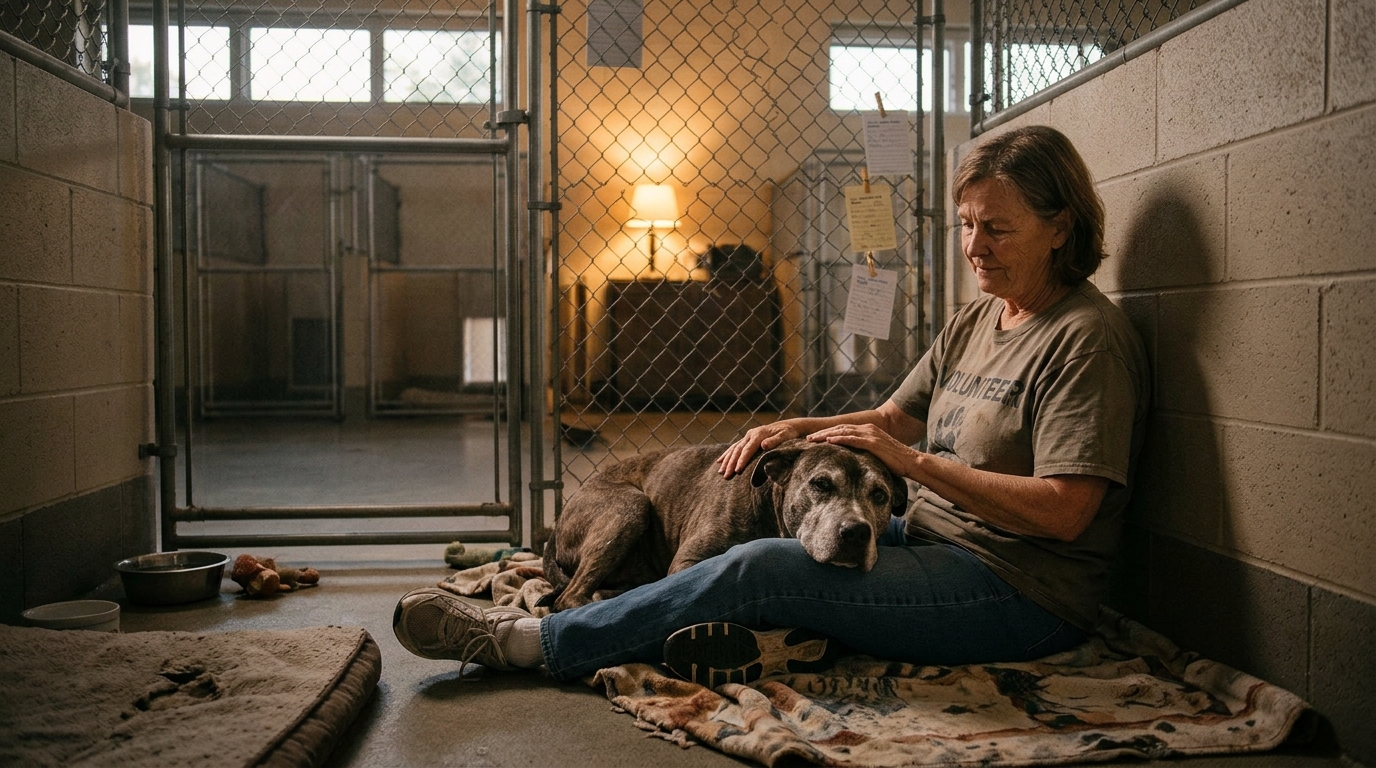
That is when Dolores Whitaker, 67, retired school bus driver, settles onto an overturned bucket in the hallway of Kennel Row, unscrews the lid of a thermos, and begins what she calls her “second shift.”
Nobody assigned it to her. Nobody pays her for it. She simply decided, three years ago, that nightfall was the loneliest hour in a shelter, and that she could do something about it.
The Hour Nobody Talks About
Most stories about animal shelters happen in daylight. There are the wagging tails at the adoption window, the balloons on the day a family goes home together, the cheerful photos on a website. Those moments are real and wonderful. But shelter workers will tell you there is another side to the clock.
When the volunteers leave and the building goes dim, the noise changes. The daytime barking, which is mostly excitement, shifts into something thinner and more worried. Cats that were curious at noon press themselves to the backs of their cages. Newly surrendered dogs, still smelling their old homes on their own fur, pace in tight circles and wonder why no one is coming back.
“Animals don’t understand the concept of a temporary stay,” Dolores told me, speaking softly so as not to wake the dog dozing near her boots. “They only know that the people left and the lights went out. For a dog who just lost everything familiar, that’s a very long night.”
How It Started
Dolores began volunteering at Maple Ridge after her husband, Walter, passed away. The house had grown too quiet, especially in the evenings, when his reading lamp sat dark beside his chair. She took a Tuesday morning slot walking dogs, then added Thursdays, then Saturdays.
One autumn evening she stayed late to finish folding blankets and lost track of time. As the staff locked up around her, she heard a small, cracked whimper from the last kennel. It belonged to a gray-muzzled shepherd mix named Biscuit, surrendered that same afternoon when his elderly owner moved into assisted living.
“He wasn’t barking,” she said. “That’s what got me. He was just standing at the gate, looking at the door where his person left. Waiting.”
She asked the closing manager if she could stay a little while. She sat down on the cold concrete, slid her fingers through the bars, and talked to him about nothing in particular: the weather, the leaves, a recipe she was thinking about trying. Within twenty minutes, Biscuit had lain down with his chin against her hand.
She went home that night and, for the first time in months, slept straight through.
What the Second Shift Looks Like
Dolores keeps a simple routine now, and the staff have quietly built it into their closing procedures. She is one of only a few approved volunteers allowed to remain after hours, and the shelter director says the program has changed how the animals settle.
Here is what a typical evening looks like for her:
- Six o’clock: She does a slow walk down Kennel Row, greeting every animal by name, even the ones who hide.
- Six-fifteen: She sits with whichever animal arrived most recently, since the first night is always the hardest.
- Seven o’clock: She reads aloud. Lately it has been a worn paperback of old western stories. The content does not matter. The steady sound of a calm voice does.
- Eight o’clock: She dims the hallway light, checks every water bowl, and tucks fresh blankets around the shakiest sleepers.
- Before she leaves: She stops at each kennel and says goodnight, one by one, like a parent making the rounds.
“People ask if it’s sad,” she said. “It isn’t. It’s the most peaceful part of my day. When the world gets quiet, you notice who needs you.”
Why the Quiet Matters
Animal behavior specialists have long observed that stress in shelter environments is highest during transitions, and few transitions are sharper than the one between a busy day and an empty night. A consistent, gentle presence during those hours can lower anxiety in newly arrived animals and help them eat, rest, and eventually show their true personalities to adopters.
The staff at Maple Ridge say they have seen it firsthand. Dogs who once shook through their first nights now curl up and sleep. Cats who refused to leave their hiding boxes now rest near the front of their cages. Adoption interest rises when an animal looks relaxed, and relaxed animals tend to be the ones who have had a comforting evening.
“We can’t clone ourselves,” the shelter director said. “But Dolores gives these animals something we simply don’t have the staffing to provide, which is company when it counts.”
A Night to Remember
Dolores recalls one evening in particular, in the middle of a January cold snap. A trembling terrier named Pepper had been brought in earlier that day, found tied to a fence post with no collar and no note. Pepper refused food, refused blankets, and would not let anyone approach.
Dolores did not approach either. She sat a few feet from the kennel with her back half turned, the way you do with a nervous creature, and she began to hum. She hummed for nearly an hour. Slowly, inch by inch, Pepper crept forward until a small cold nose touched her sleeve.
“That’s all it was,” she said. “A hum and some patience. But I watched that dog decide the world might be safe after all.”
Pepper was adopted two weeks later by a young family. Dolores wasn’t there to see it. She was home, as she always is by then, with a cup of tea and a quiet heart.
The Lesson That Settles In at Night
There is something worth sitting with in Dolores’s story, especially as your own day winds down. We tend to measure kindness by its visibility: the big gesture, the public thank-you, the photograph. But some of the most meaningful care happens in the margins of the day, after the applause has faded and the lights have gone low.
Dolores never set out to change anything. She just noticed a need in the quiet and chose to stay.
If you are reading this in the soft hush of your own evening, consider a few small ways to carry that spirit into your life:
- Notice who in your world is most alone at the end of the day, and send them a message.
- Offer a few minutes of undivided presence to someone who is struggling, with no advice and no agenda.
- Look for the quiet need that others walk past on their way out the door.
Goodnight, Kennel Row
When Dolores finally stands up from her bucket, her knees complain a little and the hallway is nearly dark. She pauses at the final kennel, where Biscuit, now a permanent resident of the shelter’s “senior sleepover” program, is already snoring.
“Goodnight, old friend,” she whispers. “I’ll see you tomorrow.”
Then she clicks off the last light, steps out into the cool evening air, and walks to her car beneath a sky fading from amber to deep blue, carrying the gentle certainty that somewhere behind her, a few frightened hearts are a little less alone.