🎧 Listen to this story
Narrated by Kore · 8,680 characters
The Dock at the Edge of the World
There is a small fishing community tucked along the coast of southeastern Queensland, Australia, where the days start before the sun does. The docks smell of salt and diesel, the boats groan against their moorings, and the fishermen who work these waters know every current, every tide, and every creature that calls this stretch of ocean home.
Among those creatures, for more than a decade, was a bottlenose dolphin the locals came to call Mystique.
She first appeared near the Tin Can Bay shoreline sometime in the early 2000s, drawn, it seemed, by the activity of the boats and the easy promise of a shared meal. Fishermen began tossing her small pieces of their catch, and she learned quickly that these strange land-creatures were, against all instinct, friendly. She kept coming back. And back. And back again.
What nobody expected was what would happen next.
A Relationship Built on Consistency and Trust
The story of Mystique is not just a charming wildlife anecdote. It is a slow-building lesson in what happens when two entirely different species choose, day after day, to show up for each other.
Volunteers and locals at the Barnacles Cafe and Dolphin Feeding site began to formalize the feedings over time, always careful to follow wildlife guidelines that ensured Mystique was never made dependent on humans and was always free to leave. She was not a captive animal. She was not a trained performer. She was a fully wild dolphin who simply chose, of her own accord, to return to this particular dock, to these particular people, again and again.
Trust, it turns out, looks the same across species lines. It is built slowly, honored consistently, and never taken for granted.
What the Regulars Started to Notice
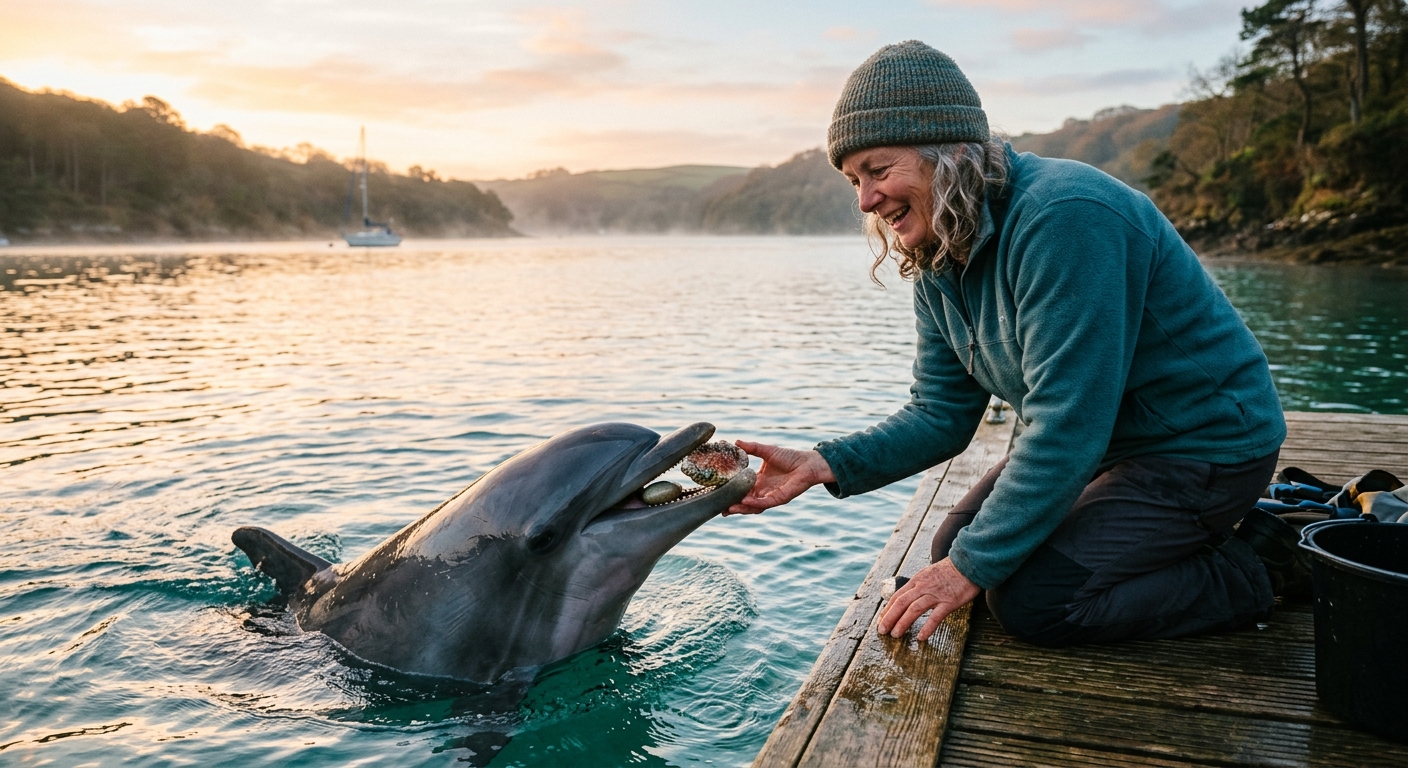
Around 2020, something shifted. Volunteers and visitors began noticing that Mystique was arriving at the dock with objects in her mouth. Not fish. Not food. Objects from the ocean floor and surrounding waters: pieces of coral, a barnacle-covered bottle, chunks of sea glass, smooth stones.
She would surface, present the item to the nearest human, and wait.
Marine biologists and animal behaviorists were quick to weigh in, and their observations were fascinating. The behavior, they noted, was consistent with what researchers call “gift-giving,” a social bonding behavior observed in dolphins that typically occurs within their own pods. Dolphins offer objects to other dolphins as a form of connection, a gesture that communicates relationship and trust.
Mystique, it appeared, had decided the humans at the dock were part of her pod.
What Science Says About Dolphin Gift-Giving
Bottlenose dolphins are among the most cognitively complex animals on Earth. Their brains are large relative to body size, second only to humans in that ratio. They use tools, recognize themselves in mirrors, communicate with signature whistles that function almost like names, and form long-lasting social bonds.
Gift-giving behavior in dolphins has been documented in several studies, but it remains relatively rare in human-dolphin interactions. When it does occur, researchers treat it as a significant indicator of the animal’s emotional and social engagement with the recipient.
Dr. Barry Clements, one of the researchers who followed Mystique’s behavior closely, described it this way in an interview with local Australian media: “What she is doing is not random. She is choosing to engage in a social ritual that, for dolphins, carries real meaning. She is treating these people as members of her community.”
The Objects She Chose
Not all of Mystique’s gifts were equal, and that detail is what made observers truly pause. Among the items she brought over the months and years:
- Smooth, rounded stones worn by years of tidal movement
- A barnacle-encrusted glass bottle, old enough to suggest it had been on the ocean floor for decades
- Pieces of hard coral, delicate and jagged at the edges
- Sea glass in shades of green and brown
- On at least one occasion, what appeared to be a fragment of old pottery
These were not accidental. Dolphins do not accidentally carry things in their mouths to the surface. Each object was deliberately retrieved, deliberately held, and deliberately offered. What Mystique found meaningful enough to bring, nobody can say with certainty. But the act of bringing it, that part was entirely intentional.
The Humans on the Other Side of the Dock
It would be easy to make this story entirely about the dolphin, but the humans involved deserve equal attention. Because the truth is, Mystique’s gift-giving did not happen in a vacuum. It happened because a group of ordinary people showed up, day after day, with patience and generosity and no expectation of anything in return.
Lynda Stidwill, one of the longtime volunteers at the feeding site, described her first experience receiving one of Mystique’s gifts in a community newsletter: “She came right up to the edge and just held it there, looking at me. I didn’t know what to do. I was genuinely moved in a way I hadn’t expected. You don’t think a wild animal is going to look at you like that.”
That look, that sustained, deliberate eye contact from a wild animal offering something of its own, is the kind of thing that rearranges your understanding of the world a little.
Kindness Flowing in Both Directions
What the Tin Can Bay community built with Mystique over the years was not a transaction. They were not feeding her to get something back. They were feeding her because she came, and because feeding her felt like the right thing to do, and because somewhere along the way she became part of the fabric of that place.
The gifts she brought were not payment. They were something more interesting than payment. They were recognition. They were her way of saying: I see you. You are in my world. You matter to me.
Not every act of kindness gets acknowledged. Not every good thing you do comes back around. But sometimes, in ways you never could have predicted, something wild and beautiful swims up to the edge of your dock and hands you a piece of the ocean floor, and you understand that connection does not require a shared language.
What This Story Teaches Us
It would be a mistake to reduce what happened at Tin Can Bay to a feel-good footnote. There are genuine lessons embedded in this years-long exchange between a wild dolphin and a fishing community.
1. Consistency Is Its Own Form of Love
Nobody at that dock made a grand gesture. Nobody did anything dramatic. They showed up. Repeatedly. Over years. That kind of quiet, consistent presence is what builds trust in any relationship, human or otherwise.
2. Kindness Without Expectation Changes Things
The fishermen and volunteers were not feeding Mystique in hopes of getting anything back. They were doing it because it felt good and right. That posture, generosity without a scoreboard, is precisely what made the relationship safe enough for her to eventually reciprocate.
3. The Natural World Is Paying Attention
We often move through natural spaces assuming we are the observers. Mystique’s behavior is a reminder that the observation runs both ways. Animals notice us. They assess us. They decide, over time, whether we are trustworthy. We are being evaluated constantly by the world we share, and our behavior has consequences beyond what we can see.
4. Connection Crosses Every Boundary We Think Is Fixed
A wild ocean dolphin and a group of coastal fishermen have almost nothing in common. Different environments, different biology, different ways of experiencing the world entirely. And yet a genuine bond formed between them, deep enough that she brought them gifts. If that is possible, it raises interesting questions about every other boundary we assume cannot be crossed.
Mystique’s Legacy
As of the most recent reports from the Tin Can Bay community, Mystique continues to visit the dock, though her appearances have become less frequent as she ages. The volunteers continue to show up. The feeding guidelines continue to prioritize her wildness and her freedom above everything else.
Her story has traveled far beyond the Queensland coast. It has been shared in wildlife publications, community blogs, and social media feeds around the world, and it resonates wherever it lands because it touches something most of us already sense to be true: that kindness, offered freely and sustained over time, has a way of coming back to us in forms we never anticipated.
Sometimes that form is a smooth stone carried up from the ocean floor by a creature who had no obligation to come back at all, and came back anyway.
That, perhaps, is the most honest definition of a gift there is.