🎧 Listen to this story
Narrated by Sulafat · 6,839 characters
It Started With a Handful of Clover
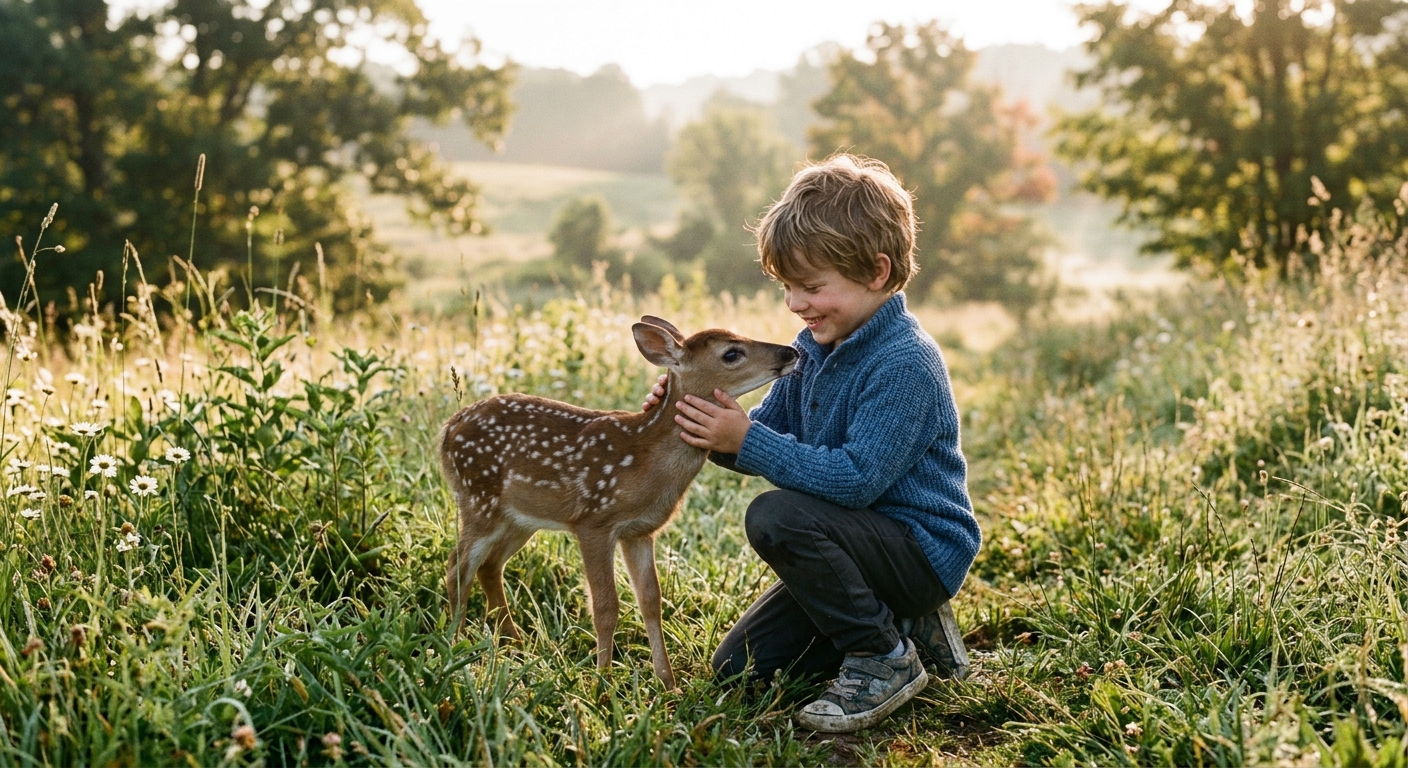
Nobody planned it. Nobody set up a feeding station or left a trail of breadcrumbs. It began the way the most remarkable friendships always do: by accident, on an ordinary Tuesday morning, when seven-year-old Caleb Tanner crouched down at the edge of his family’s property in rural Vermont and held out a fistful of clover to a spotted fawn trembling in the tall grass.
The fawn, barely old enough to stand steadily on her pipe-cleaner legs, took one hesitant step forward. Then another. And then, in a moment that Caleb’s mother Sandra describes as “the kind of thing you see in movies and never expect to happen in real life,” the tiny deer ate right from his palm.
That was September. By October, the fawn, whom Caleb had named Maple, was waiting at the end of the driveway every single morning. By November, she was walking him to school.
The Route They Shared
Caleb’s school, a small K-8 building about a quarter mile down a winding country road from the Tanner property, sits at the edge of a meadow that backs up against a stretch of forest. For most kids in the area, the walk to school is unremarkable: a quiet road, maybe a neighbor waving from a porch, the occasional school bus rumbling past.
For Caleb, it became something else entirely.
“She would just appear,” he said, in the matter-of-fact way that children describe miraculous things. “I’d come outside and she’d be there by the mailbox. And then she’d just walk with me.”
Sandra began documenting the walks in late October after her neighbor, who had spotted the pair from her kitchen window, called her in disbelief. What Sandra captured on her phone over the following weeks and months is genuinely difficult to watch without feeling something shift inside your chest. A small boy with a dinosaur backpack. A spotted deer at his shoulder. The two of them moving in easy, unhurried step down a leaf-scattered road in the low gold light of a New England morning.
What the Teachers Saw
Maple never crossed onto school property. That detail, perhaps more than any other, is the one that made researchers and wildlife observers take notice. Every morning, the fawn would walk Caleb to the edge of the school’s gravel driveway, pause, watch him walk inside, and then turn back toward the meadow. Every afternoon, she was waiting at the same spot when the final bell rang.
“I’ve been teaching for twenty-two years,” said Caleb’s second-grade teacher, Ms. Patricia Ouellet. “I’ve seen kids bring in turtles, I’ve seen a kid show up with a chicken once. But watching that deer wait for him in the afternoon? That was something I will never forget for the rest of my career.”
Other parents began timing their drop-offs around the chance to see Maple and Caleb arrive together. The school principal, after consulting with a local wildlife officer, made the quiet decision not to interfere, provided the deer remained on public land and showed no signs of aggression. She never did.
What the Experts Said
Dr. Louise Ferraro, a wildlife biologist at the University of Vermont who was contacted after Sandra’s videos began circulating locally, offered some context for what appeared to be happening.
“White-tailed deer, particularly fawns that have had positive early contact with humans, can form remarkably strong associative bonds,” she explained. “What’s unusual here is not just the bond itself but the consistency of the behavior and its apparent intentionality. Maple wasn’t stumbling across Caleb each morning. She was waiting for him.”
Dr. Ferraro was careful to note that this kind of relationship, while heartwarming, requires thoughtful management as deer mature. “Wild animals are not pets,” she said. “But within those important boundaries, what this family experienced is a genuine and scientifically interesting example of cross-species connection.”
Seven Things This Unlikely Friendship Taught a Community
- Patience earns trust. Caleb never chased Maple or tried to force contact. He simply waited. The lesson that trust cannot be rushed is one adults forget far more often than children.
- Presence is enough. The two of them rarely interacted dramatically on their walks. They simply moved together. Sometimes that is the whole definition of companionship.
- Children see differently. Every adult who learned about Maple and Caleb’s routine initially assumed it would stop. Caleb never doubted it would continue. He was right.
- Boundaries can be mutual. Maple never crossed into the schoolyard. Caleb never tried to bring her inside. Their friendship had a shape that both of them seemed to understand and respect.
- Ordinary routes become sacred with the right company. A quarter mile of Vermont road became, for one school year, one of the most talked-about walks in the state.
- Nature responds to gentleness. The Tanner family did nothing to attract wildlife to their property. One boy’s gentle instinct in a single moment opened a year-long conversation with the natural world.
- Community is built in unexpected ways. Parents who had never spoken to each other found themselves standing together at school drop-off, watching a deer and a boy, sharing something they couldn’t quite name but all needed.
The Day the Walks Changed
By the following August, Maple had grown considerably. The spots were gone. She was leaner, taller, and increasingly drawn toward the deeper woodline as her instincts matured. The morning walks became less frequent through the summer and then, as the new school year began, they simply stopped.
Caleb’s mother braced herself for a difficult conversation. She rehearsed explanations about wildness and freedom and how love sometimes means letting go. When she finally sat down with Caleb and gently told him that Maple had grown up and gone back to the forest, he listened carefully, nodded once, and said: “I know. She had things to do.”
Sandra says she had to leave the room for a moment after that.
What Stays Behind
The Tanner family still lives on the same road in Vermont. Caleb is nine now and in third grade. He walks to school each morning with the same dinosaur backpack, though Sandra suspects it will be retired soon in favor of something he considers more age-appropriate.
Some mornings, a deer stands at the edge of the meadow beside the road. Whether it is Maple or another member of the local herd, no one knows for certain. Caleb lifts a hand as he passes. The deer watches him go.
That, perhaps, is the truest and most lasting lesson in all of this: that connection leaves a mark on a place. That kindness given freely, even to a trembling fawn in tall grass, ripples outward in ways we cannot predict or measure. And that sometimes the most profound teachers in a child’s education have four legs, spotted coats, and meet them at the end of the driveway every morning without being asked.