🎧 Listen to this story
Narrated by Iapetus · 9,053 characters
A Beginning Nobody Expected
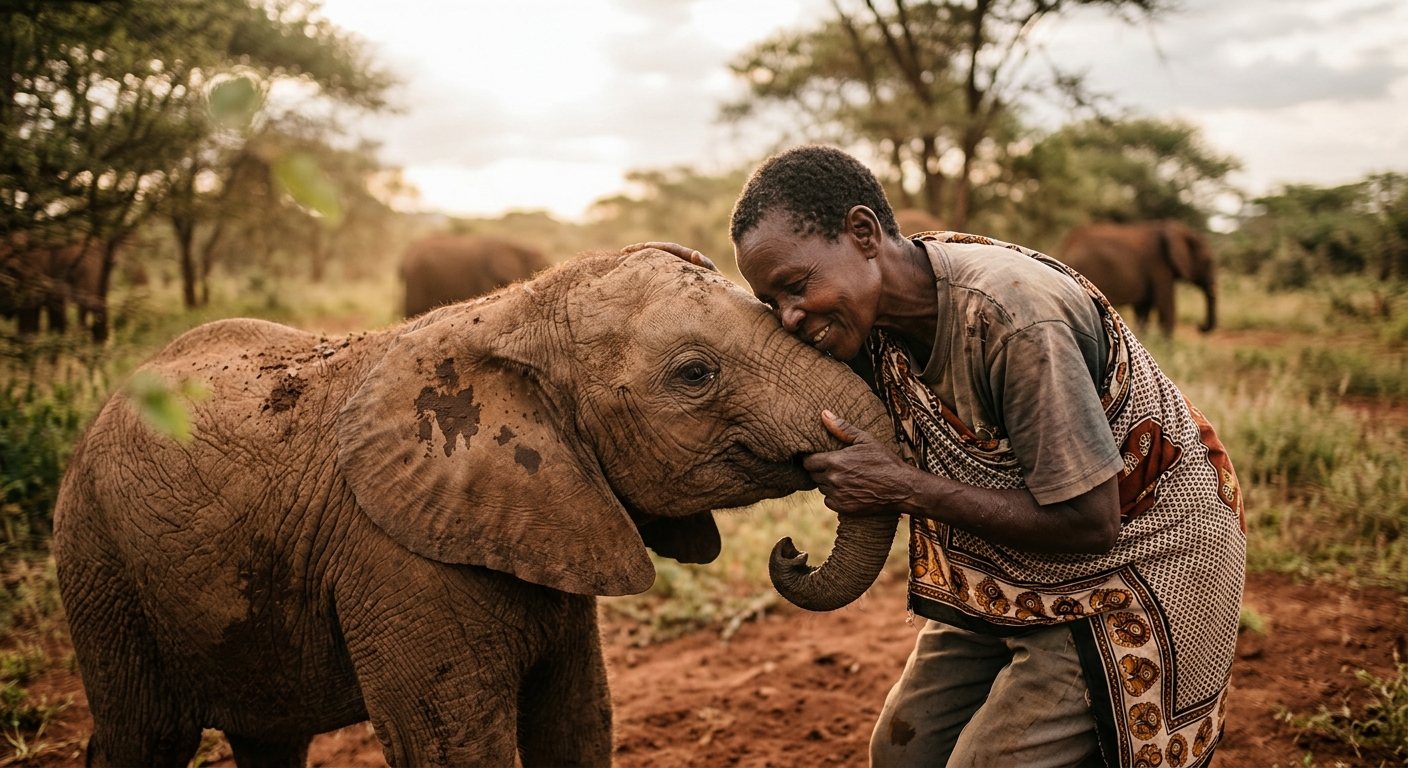
In the vast, sun-scorched savannas of southern Africa, a baby elephant took his first shaky steps into a world that, by all rules of nature, should have embraced him immediately. Elephants are among the most socially bonded creatures on the planet. Their herds are tight-knit, matriarch-led families that grieve their dead, celebrate their newborns, and rarely leave a member behind. So when a calf is rejected by its own herd, something has gone profoundly, heartbreakingly wrong.
This is the story of one such calf, and the completely unexpected family that stepped in to claim him as their own.
What Does Elephant Rejection Actually Look Like?
Before diving into the story, it helps to understand just how rare and distressing herd rejection is for a baby elephant. Elephant calves are entirely dependent on their mothers for the first two to three years of life. They cannot survive alone. When rejection happens, it is typically the result of one of several painful circumstances:
- A first-time mother who is too young or inexperienced and does not know how to bond with her calf
- A calf born with physical abnormalities that trigger instinctual avoidance behavior in the herd
- A mother who died during or shortly after birth, leaving a calf without an advocate within the group
- Severe trauma or environmental stress that disrupts normal bonding behavior
- Human interference early in the calf’s life, leaving a scent or behavioral imprint that confuses the herd
In many documented cases, a rejected calf will follow the herd for days, trumpeting desperately, only to be nudged away again and again. It is one of the most viscerally painful things wildlife conservationists describe witnessing in the field. The sound of a crying elephant calf, alone and confused, is something no one who has heard it ever forgets.
The Calf They Called Themba
One of the most well-documented and widely shared stories of inter-species elephant adoption involves a calf named Themba, which means “hope” in Zulu. Themba was just six months old when he was found wandering alone in a South African game reserve after his mother fell ill and passed away. The reserve’s caretakers watched and waited, hoping that the remaining herd would absorb him. They did not. For several agonizing days, Themba circled the herd’s periphery, calling out. He was met with indifference at best, hostility at worst.
Staff from an animal rehabilitation center made the difficult decision to intervene before the calf perished from dehydration and heartbreak, quite literally. Research has shown that elephants, like humans, can die from acute grief-related stress.
Enter Albert: The Sheep Who Rewrote the Rulebook
When Themba arrived at the Shamwari Wildlife Rehabilitation Centre, caretakers faced a critical challenge. An elephant calf that age needed more than food and medical care. He needed companionship. He needed to feel safe and connected. Without that, no amount of nutrition would save him.
The solution came in the unexpected form of a woolly, somewhat bewildered sheep named Albert.
At first, Albert wanted absolutely nothing to do with this enormous, trunk-swinging, ear-flapping creature that had been placed in his enclosure. He spent the better part of the first week hiding in his shelter whenever Themba approached. Caretakers watched nervously, unsure if the introduction would work at all.
Then something shifted.
On the eighth day, Albert cautiously approached Themba and sniffed him. Themba, who had been growing increasingly listless and withdrawn, lifted his head. He extended his trunk toward Albert slowly, with the careful curiosity that young elephants use to investigate their world. Albert held his ground. Themba touched Albert’s woolly back with the tip of his trunk, and held it there.
That was the beginning of everything.
An Unlikely Brotherhood
Within weeks, Themba and Albert were inseparable. They ate together, explored together, slept side by side, and played in ways that delighted everyone who witnessed it. Themba, true to elephant nature, became the leader of their tiny two-member herd. He would drape his trunk over Albert protectively and guide him across the enclosure like a small, bleating shadow.
Conservationists noted several remarkable behavioral developments during this period:
- Themba began eating again with enthusiasm, his appetite restored entirely after Albert began eating alongside him
- Albert, who had previously been a fairly timid sheep, grew noticeably bolder and more adventurous under Themba’s influence
- The two developed a clear communication system, with Themba learning to moderate his size and movements around Albert, showing an astonishing level of social awareness for his age
- Caretakers observed Themba comforting Albert during thunderstorms, placing himself between Albert and the source of the noise
What Science Says About Cross-Species Bonding
Stories like Themba and Albert are not isolated curiosities. Cross-species bonds have been documented across the animal kingdom with increasing frequency, and researchers are beginning to take them seriously as windows into animal psychology and social intelligence.
Dr. Marc Bekoff, a behavioral ecologist and professor emeritus at the University of Colorado Boulder, has spent decades studying animal emotions and social bonds. His research suggests that many animals, particularly mammals, are far more emotionally flexible than previously believed. “The capacity for attachment,” he has written, “does not appear to be rigidly species-specific. It is triggered by need, proximity, and repeated positive interaction.”
In other words, animals bond with who is there, who is safe, and who responds to them with consistency. When a baby elephant has lost everything familiar, a sheep who stays nearby and does not run away may be exactly enough to activate ancient bonding instincts.
What This Story Teaches Us About Belonging
It would be easy to read Themba’s story as simply a charming wildlife anecdote. But it carries something weightier beneath the surface, something that speaks directly to human experience.
How many of us have felt rejected by the group we were supposed to belong to? By a family that did not know how to hold us, a community that looked away when we needed to be seen, or a world that seemed to have no place for who we actually were? The instinct to find belonging is not a weakness. It is biology. It is survival. And like Themba, sometimes the family we find looks nothing like the family we expected.
The sheep was not a substitute elephant. Albert could not teach Themba the rumbling low-frequency communications of a herd, the matriarchal wisdom passed down through generations, or the specific geography of a home range. There were things Themba would always be missing. But Albert gave him the one thing that made all future learning possible: the felt sense that he was not alone.
The Bigger Picture for Conservation
Stories like Themba’s have also shaped the way wildlife rehabilitation centers approach the care of orphaned and rejected megafauna. The old model focused almost exclusively on physical health: nutrition, veterinary care, shelter. Modern rehabilitation increasingly recognizes that psychological and social wellbeing are not secondary concerns. They are primary ones.
Several elephant orphanages, including the celebrated David Sheldrick Wildlife Trust in Kenya, now incorporate structured social integration programs for orphaned calves, pairing them with compatible companions from other species or carefully managed elephant groups while longer-term herd integration is prepared. The goal is always, eventually, to return these animals to a life as close to wild as possible. But getting there requires acknowledging that healing is social before it is anything else.
A Note on Themba’s Later Life
Themba eventually grew large enough that living alongside Albert posed safety concerns, not from any aggression, but simply from the physics of an adolescent elephant sharing a space with a sheep. The two were gradually and carefully separated, a process that was reportedly more distressing for Themba than for Albert, who adapted quickly to new companions.
Themba went on to be introduced to other elephants in a carefully managed process, carrying with him, one hopes, the foundational security that Albert had given him in those early, fragile months.
Albert, for his part, reportedly continued being entirely Albert, which is to say unimpressed by most things and fond of food.
In the End
The story of the baby elephant rejected by his herd is not a story about loss, though there is loss in it. It is a story about the stubborn persistence of connection. About the way life finds a path toward warmth and companionship even when every expected door has been closed. A sheep in a South African enclosure did not save an elephant by doing anything remarkable. He saved him simply by staying. By being present. By not turning away.
Sometimes that is the whole of what love requires.