
🎧 Listen to this story
Narrated by Rasalgethi · 6,833 characters
A Regular Tuesday Night at the Diner
Nobody pays much attention to a Tuesday night shift at a small-town diner. The fluorescent lights hum the same way they always do. The coffee gets refilled without being asked. And the servers move between tables with the quiet efficiency of people who have learned to carry a lot without dropping anything.
That was Marisol Vega’s world, five nights a week. Thirty-four years old, mother of two boys aged six and nine, and exactly eleven days behind on her electric bill the night a stranger sat down in her section and ordered a grilled cheese with tomato soup.
What happened next would be shared thousands of times online, but the part that most people missed was the part that mattered most.
Who Was the Stranger?
Her name, according to those who know her, is Deborah Kline. A retired schoolteacher from Ohio who had just driven through the area after visiting her daughter two states away. She had stopped at the diner not for any particular reason, only because she was tired and the parking lot had room.
Deborah has given a handful of interviews since the story went viral, and her explanation for what she did is both simple and quietly profound.
‘I watched her for about twenty minutes before I even opened the menu,’ Deborah told a local news station. ‘She was doing about six things at once and smiling through all of them. And then I saw her step into the back hallway and just stand there for a second with her eyes closed. That ten-second pause told me everything.’
Deborah ordered, ate slowly, and before she left, she asked to speak to the manager. Not to complain, but to ask one question: ‘Is she going through something hard?’
The manager, caught off guard, said only, ‘Aren’t they all?’
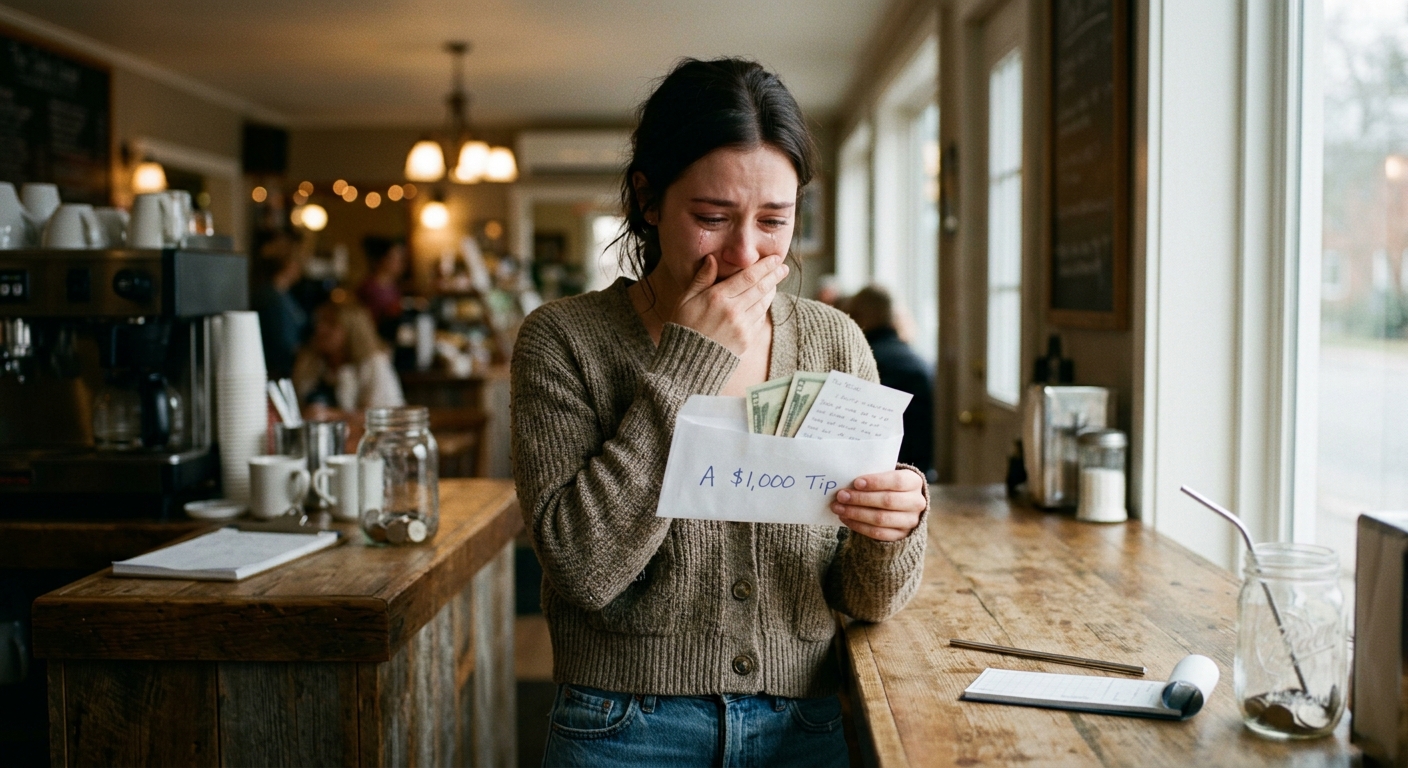
Deborah paid her $14 bill and left an envelope on the table. Inside was $1,000 in cash and a handwritten note on the back of a receipt.
What the Note Said
Marisol has shared the contents of the note publicly, and it has since been quoted in dozens of articles. But reading it in full still stops people mid-scroll.
‘You don’t know me and I don’t know you. But I know that look. I wore it for years when my kids were small and I was doing it alone. You are not invisible. You are not forgotten. Please use this for whatever you need most. You have already earned far more than this. Keep going. Someone is watching and they are proud of you.’
Marisol found the envelope after Deborah had already pulled out of the parking lot. She sat in a booth for twenty minutes before she could stand up again.
What the Money Actually Did
This is the part of the story that tends to get glossed over in favor of the emotional headline, but it is worth slowing down for. Because the $1,000 did not just pay a bill. It did something harder to quantify.
- The electric bill was paid in full, with enough left to cover the following month as well.
- Marisol bought her youngest son the backpack he had asked for, the one with the dinosaurs on it, which she had told him they would get someday.
- She put $200 into a small savings account she had been trying to start for over a year but kept raiding out of necessity.
- She took her boys out for pizza, something that sounds small and is enormous.
But the most significant thing the money gave Marisol was not any item on that list. It was the feeling, even briefly, of being seen.
The Psychology of Being Witnessed
Psychologists and social researchers have long studied what they call witnessed effort, the powerful human need not just to be helped, but to be acknowledged. Studies on caregiver burnout consistently show that one of the leading contributors to emotional exhaustion is not the workload itself, but the invisibility that so often accompanies it.
Single parents, in particular, frequently describe a specific kind of loneliness that has nothing to do with being alone. It is the loneliness of doing something enormously difficult while the world moves past without noticing.
Deborah did not just leave money. She left proof of notice.
It Started a Chain
When Marisol’s story was shared by a local Facebook group, something unexpected happened. Within 72 hours, three other people in her town had left similar notes, though with smaller amounts, for service workers they had seen struggling silently. A barista received $80 and a grocery store bag boy received a gift card along with a letter from an anonymous neighbor.
The ripple effect was not orchestrated. No fundraiser was started, no hashtag campaign launched. People simply saw the story and thought of someone in their own orbit who deserved to be seen.
What We Can Take From This
You do not need $1,000 to do what Deborah did. The amount was generous, and it made a concrete difference in Marisol’s life. But the act itself was available to anyone willing to pay attention.
Here are a few things this story quietly teaches:
- Observation is an act of care. Deborah did not scroll her phone while waiting for her food. She watched. She noticed. That alone was radical.
- You rarely know the full weight someone is carrying. The smiling server, the cheerful cashier, the neighbor who always waves from the driveway. Invisible burdens are the heaviest kind.
- A note can outlast the money. Marisol has said she has read Deborah’s note dozens of times since that night. The cash is gone. The words remain.
- Small acts do not stay small. Three families in one community were touched by something that started with a retired teacher who was just tired and needed a parking spot.
- Saying I see you costs nothing and means everything.
Where They Are Now
Marisol and Deborah have since spoken on the phone twice. They are not close friends, not yet anyway, but there is a warmth between them that defies the brevity of their actual encounter. Marisol has said she hopes her boys grow up to be the kind of people who notice the pause in the hallway.
Deborah, for her part, says she does not think of herself as having done something extraordinary. ‘I just had the money that night and I had been that woman before. It felt less like generosity and more like memory,’ she said.
That framing, less like generosity and more like memory, might be the most important line in this entire story. Because it suggests that kindness is not always about having extra. Sometimes it is about having been there. About recognizing a road you have already walked and reaching a hand back down it.
Final Thought
Somewhere tonight, a server is carrying eight plates and a full set of worries nobody asked about. A cashier is smiling at customers while calculating how far her paycheck has to stretch. A parent is standing in a hallway with their eyes closed for ten seconds before going back out to face the rest of the evening.
They are not invisible. They are just waiting for someone to look up.
Be the person who looks up.