🎧 Listen to this story
Narrated by Orus · 8,524 characters
Nobody Expected the Horse to Make the Decision Himself
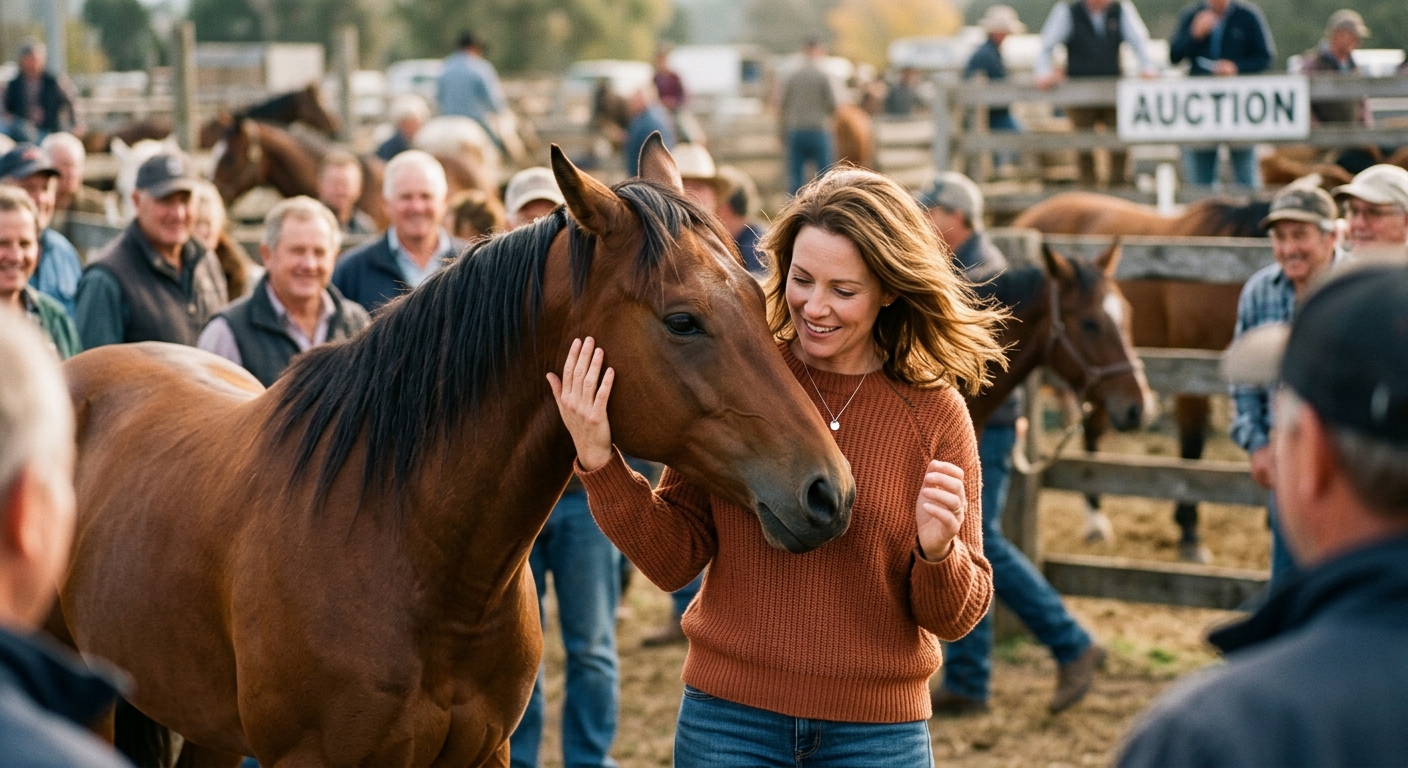
It was a loud, dusty Saturday morning at a livestock auction in rural Tennessee when something happened that auctioneers, ranchers, and horse trainers still talk about today. A seven-year-old Appaloosa named Copper, listed simply as “difficult temperament, not recommended for beginners,” walked into the sale ring, scanned the crowd, and walked straight to the fence where a quiet woman named Marlene Hutchins was standing.
Marlene wasn’t bidding. She had come with her neighbor to help load some hay bales after the sale. She had no intention of buying a horse. She hadn’t owned one in over a decade. But Copper pressed his nose against the wooden rail and refused to move, refused to be led away, and made it abundantly clear, in the way only animals can, that he had found exactly who he was looking for.
What followed was not just a purchase. It was the beginning of one of the most remarkable human-animal bonds anyone at that auction had ever witnessed, and a story that raises genuine questions about what horses, and perhaps animals in general, are capable of sensing.
The Auction That Changed Two Lives
Copper had passed through three previous owners in two years. Each one had returned him with similar complaints: he was unpredictable, resistant to training, prone to sudden stillness where he would simply stop and refuse to move for no apparent reason. One trainer called him “emotionally unavailable.” Another said he was “too smart for his own good.”
At auction, horses with that kind of history usually sell low or don’t sell at all. Copper was expected to go for a modest price to whoever was willing to take a gamble.
But when the gate opened and Copper was led into the ring by a handler he’d already nipped twice that morning, something shifted. Witnesses describe him as suddenly alert, ears forward, scanning the bleachers with an almost deliberate focus. He pulled toward the fence on the far left side of the ring, where Marlene was standing with a cup of coffee, watching absentmindedly.
“He just came right up to me,” Marlene recalled in a conversation with a local equine rescue volunteer who later shared the story. “Put his whole face against the rail and just breathed on me. I remember thinking, oh, you’re beautiful. And then I thought, well, I can’t just leave you here.”
She bought him for $340.
What Happened Next Surprised Even the Experts
Marlene had a small property with a modest pasture. She had no fancy barn, no trainer on speed dial, and no particular philosophy about horse behavior. What she had was time, patience, and what she described as “a willingness to just sit with him and not ask for anything.”
Within two weeks, Copper was following her around the pasture like a dog. Within a month, she was riding him bareback with nothing but a halter. The horse that three experienced owners had called unmanageable stood quietly while Marlene’s six-year-old granddaughter braided his mane.
But here is the part that truly set Copper apart: he would not allow anyone else near him. Not aggressively, not violently, but with an immovable, quiet insistence. If a stranger entered the pasture, he would walk to Marlene’s side and stand there. If someone tried to approach him without her present, he would simply move away, again and again, calm but absolute.
Equine behaviorist Dana Forsythe, who heard about Copper through the rescue community and eventually visited the property, described what she saw as extraordinary.
“Horses do form deep attachments,” Forsythe explained. “But what I observed with Copper was something beyond normal bonding. He had essentially made a unilateral decision about his person. He wasn’t fearful of others. He just had no interest in them. His entire social world had one center point, and that was Marlene.”
Can Animals Really Choose Their People?
This question sits at the heart of what makes Copper’s story so fascinating, and so worth examining carefully.
The scientific community has increasingly acknowledged that animals, particularly horses and dogs, are capable of sophisticated social and emotional processing. Research published in journals studying animal cognition has shown that horses can read human facial expressions, remember individual humans over long periods, and respond differently to people based on past emotional experiences.
But the idea of an animal actively selecting a human, especially one it has never met before, pushes into more philosophically charged territory.
What Horses May Be Sensing
Experts offer several compelling theories about what Copper may have detected in Marlene that morning:
- Heart rate and breath patterns: Horses are acutely sensitive to the physiological states of those around them. Marlene, simply watching the auction without anxiety or agenda, may have projected a calm that Copper, after years of high-pressure training environments, found profoundly attractive.
- Micro-expressions and body language: Horses read posture and facial cues with remarkable precision. Marlene’s relaxed, open stance may have communicated safety in ways she wasn’t even conscious of.
- Scent: The equine sense of smell is far more refined than our own. Some researchers believe horses can detect stress hormones, dietary markers, and even emotional states through scent alone.
- Prior association: Some animal behaviorists propose that certain animals may respond to people who share physical or behavioral similarities with someone from their past who treated them well.
None of these explanations fully account for the deliberateness of what Copper did. He didn’t simply calm down near Marlene. He sought her out in a crowd.
The Loyalty That Followed
Over the next three years, Copper and Marlene became a fixture in their small community. She never competed with him, never entered a show ring. They simply existed together, going on long trail rides through the hills behind her property, standing together in the early mornings when Marlene brought her coffee out to the fence.
She tried, twice, to allow a friend to ride him. Both times Copper stood perfectly still while being tacked up, and then, once the unfamiliar rider was aboard, stopped completely and refused to move a single step. No bucking, no aggression. Just a full, dignified, unshakeable refusal.
“He wasn’t mean about it,” Marlene said. “He just wasn’t going to do it. I stopped trying after that. I figured he’d earned the right to decide.”
What Copper Taught a Community About Animals and Trust
Stories like Copper’s travel fast in small towns and farming communities, and this one became something of a local legend. The auction house where it happened started telling the story to new visitors. The equine rescue volunteer who first documented it shared it at a regional animal welfare conference.
But beyond the charm of the story itself, there are real lessons here that horse owners, animal lovers, and even people who have never touched a horse in their lives might find worth carrying with them.
Lessons From a Horse Who Knew His Own Mind
- Presence is its own kind of power. Marlene wasn’t trying to impress anyone that morning. She was simply present, calm, and open. That quality, accessible to all of us, is apparently visible to animals in ways we underestimate.
- A difficult past doesn’t write the whole story. Copper had been labeled, returned, and written off. The right match changed everything. The same truth applies, quietly but insistently, to people too.
- Animals communicate clearly if we’re paying attention. Copper’s message was not subtle. It was direct, repeated, and consistent. How often do animals in our lives communicate their needs and preferences with that same clarity while we miss it entirely?
- Loyalty is not trained, it is earned. No one taught Copper to be devoted to Marlene. No treat, no schedule, no technique produced it. It arose from something more fundamental, and perhaps that is the most important lesson of all.
A Story Worth Sitting With
Copper is still alive, now eleven years old and still firmly devoted to one person. Marlene, who turned sixty-three last spring, says she can’t imagine her mornings without him.
She still brings her coffee to the fence. He still meets her there.
In a world that often feels transactional and loud, there is something quietly radical about a story where the most important decision was made not by the person with money or credentials or a plan, but by a horse who simply looked across a crowd and knew.