
🎧 Listen to this story
Narrated by Gacrux · 9,067 characters
A Radical Idea That Raised a Lot of Eyebrows
When Robert W. Coleman Elementary School in Baltimore quietly replaced its after-school detention program with something called the ‘Mindful Moment Room,’ the skeptics were ready. Parents raised questions. Teachers exchanged glances. And more than a few people assumed the whole thing would collapse within a semester.
It did not collapse. In fact, what unfolded over the following months became one of the most quietly revolutionary stories in modern education, a story that has since inspired schools across the United States, Canada, the United Kingdom, and beyond to rethink one of the oldest tools in a teacher’s disciplinary toolkit.
So what exactly happened when schools swapped punishment for presence? The results are more nuanced, more human, and more hopeful than most people expected.
The Problem With Detention (That Nobody Wanted to Say Out Loud)
Detention, as a concept, has been around for well over a century. The idea is simple: misbehave, lose your free time, sit in a room, think about what you did. On paper, it sounds reasonable. In practice, researchers and educators have long suspected something was not quite working.
Studies have shown that traditional punitive measures like detention and suspension often do little to address the root causes of disruptive behavior. Children who act out in school are frequently dealing with stress at home, untreated anxiety, trauma, hunger, or simply a nervous system that has never been taught how to regulate itself.
Sitting alone in a silent room does not teach a child how to breathe through anger. It does not give them tools. It gives them time to stew.
Dr. Daniel Siegel, a clinical professor of psychiatry at UCLA and one of the leading voices in interpersonal neurobiology, has spoken extensively about how young brains respond to stress. When a child is in a state of emotional flooding, the prefrontal cortex, the part of the brain responsible for decision-making and impulse control, essentially goes offline. Punishment in that moment is not just ineffective. It may actually reinforce the very stress response that caused the behavior in the first place.
This is the backdrop against which a new idea began to take shape.
What the Mindful Moment Room Actually Looked Like
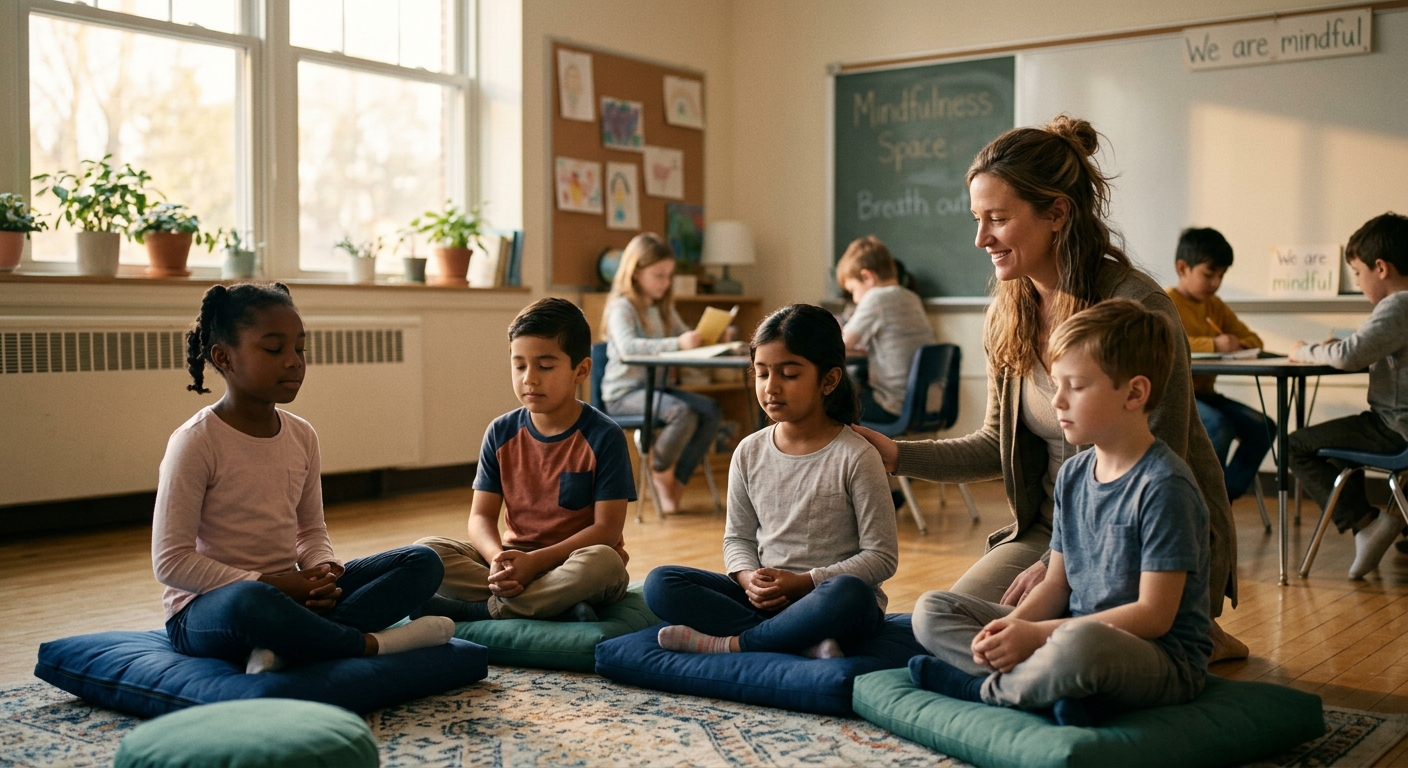
At Robert W. Coleman Elementary, the room set aside for mindfulness was nothing like a detention hall. It was warm, softly lit, and filled with plants, beanbags, and calming colors. Students who were sent there, or who chose to go there when they felt overwhelmed, were greeted by trained instructors rather than a silent clock on the wall.
These instructors guided children through breathing exercises, stretching, and quiet reflection. They asked open questions: What are you feeling right now? Where do you feel it in your body? What do you think would help?
The goal was not to let kids off the hook. It was to give them the internal resources to understand their own behavior and, eventually, to change it from the inside out.
The results at Coleman were striking. Suspensions dropped dramatically. In some reported periods, the school recorded zero suspensions. Teachers noted that students who regularly used the room became calmer in class, more willing to work through conflicts verbally, and less likely to escalate disagreements into physical altercations.
This Was Not Just One School
Coleman’s story gained national attention, but it was far from alone. Schools across the country began piloting similar programs, often under broader frameworks like Social Emotional Learning (SEL) or trauma-informed education.
Here is a look at what educators and researchers found across multiple programs:
- Reduced suspensions and expulsions: Multiple schools reported significant drops in disciplinary actions after introducing mindfulness or SEL programs. Some districts saw suspension rates fall by 30 to 50 percent within two years.
- Improved academic performance: Students who participated in mindfulness programs showed improvements in attention, working memory, and grades. A calmer nervous system, it turns out, is a better learning environment.
- Lower teacher burnout: Educators in schools with mindfulness programs reported feeling less emotionally exhausted. When students have tools to self-regulate, the emotional labor on teachers decreases considerably.
- Better conflict resolution: Students began applying breathing and reflection techniques outside of school, at home, and in their communities.
- Greater empathy among peers: Several schools noted that students who practiced mindfulness together developed a stronger sense of community and were more likely to stand up for classmates being bullied.
The Critics Still Had Questions, and They Were Fair Questions
Not everyone embraced the shift without reservation, and it is worth honoring that skepticism. Some parents worried that removing punitive consequences would signal to children that disruptive behavior carried no real weight. Some teachers felt that implementing a whole new practice on top of an already demanding curriculum was simply one more thing being asked of them without adequate support or training.
And in some schools, poorly implemented programs did fall flat. Mindfulness that feels performative or forced rarely produces results. A teacher who has never practiced mindfulness themselves and who is simply reading from a script is unlikely to create the kind of genuine, safe space that makes the approach work.
The experts are clear on this point: the effectiveness of mindfulness in schools depends heavily on authenticity, consistency, and proper training. It is not a magic room. It is a practice, and like all practices, it requires cultivation.
What the Children Said
Perhaps the most compelling evidence does not come from statistics at all. It comes from the children themselves.
In interviews and documentary footage from schools that have adopted mindfulness programs, children as young as six and seven years old have described their experiences in ways that are quietly extraordinary.
One child from a Baltimore school explained: ‘When I get really mad, I used to just start yelling. Now I breathe and I think about why I am mad and then I can talk about it.’
Another student, a twelve-year-old from a Chicago middle school that adopted a similar program, said: ‘Nobody ever taught me that feelings could pass. I thought when I was upset, that was just it, that was me. Now I know it goes away if I let it.’
These are not small revelations. For many of these children, learning that emotions are temporary and manageable is genuinely transformative knowledge, the kind of knowledge that can shape how they handle stress for the rest of their lives.
The Science Behind Why It Works
Mindfulness, at its core, is the practice of paying deliberate, non-judgmental attention to the present moment. When children practice this regularly, several measurable changes occur in the brain and body.
Cortisol levels, the primary stress hormone, decrease. The amygdala, the brain’s threat-detection center, becomes less reactive over time. The prefrontal cortex, the center of rational thought and emotional regulation, becomes more active and better connected to the rest of the brain.
In simple terms: regular mindfulness practice rewires the brain to be calmer, more focused, and better able to think before reacting. For children growing up in high-stress environments, this is not a luxury. It is a lifeline.
What Schools Are Still Getting Wrong
Progress has been real, but there are still significant gaps. Mindfulness programs are often introduced in wealthier districts with more resources and then praised loudly, while underfunded schools in the communities that arguably need these tools the most struggle to access them.
There is also a risk of using mindfulness as a band-aid over structural problems. A child who is hungry, unsafe at home, or dealing with undiagnosed learning differences needs more than a breathing exercise. These programs work best when they are part of a broader, well-resourced commitment to student wellbeing, not a standalone substitute for systemic change.
The Bigger Lesson for All of Us
There is something worth sitting with here, even for those of us long past school age. The idea that punishment alone changes behavior is one we seem to carry well into adulthood, in how we parent, how we manage teams, and how we treat ourselves when we fall short.
What these schools discovered is something that contemplative traditions have known for thousands of years: that awareness, practiced with kindness, is more transformative than shame. That teaching someone to understand their inner landscape gives them more power than taking something away ever could.
A child who learns to pause, breathe, and ask themselves what they are feeling is not getting a free pass. They are getting something far more valuable: a set of skills they will carry for the rest of their lives.
And that, perhaps more than any statistic or study, is the real story here.