🎧 Listen to this story
Narrated by Orus · 8,794 characters
The Forest Has Been Keeping a Secret
Walk through any old-growth forest and you might assume you are looking at a collection of individual trees, each competing silently for sunlight, water, and nutrients. That is the story most of us were taught. Survival of the fittest. Nature red in tooth and claw. Every organism out for itself.
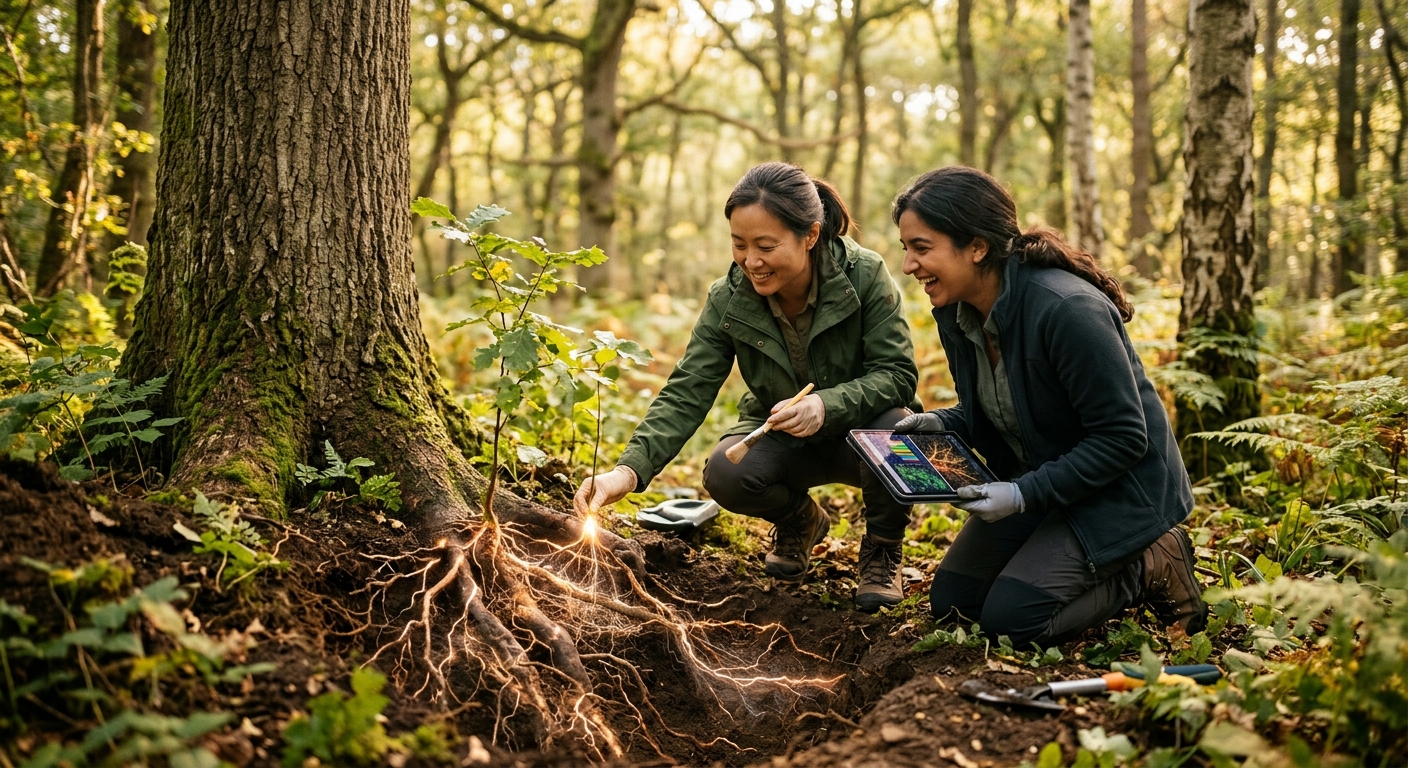
But scientists have now confirmed something that quietly upends that entire narrative. Beneath your feet, in the dark tangle of roots and fungi that threads through forest soil, mature trees are actively sending sugar, carbon, and nutrients to young seedlings that are struggling to survive. Not randomly. Not accidentally. Deliberately, and in measurable quantities.
The forest, it turns out, is not a battleground. It is something far closer to a family.
What the Research Actually Found
The science behind this discovery centers on what researchers call the mycorrhizal network, a web of fungal threads called hyphae that connects the root systems of trees across enormous distances. This network has been nicknamed the “Wood Wide Web” by science communicators, and while that label is a little playful, the underlying biology is serious and rigorously documented.
Dr. Suzanne Simard, a forest ecologist at the University of British Columbia, spent decades studying these underground networks in Canadian forests. Her landmark research, published in the journal Nature, demonstrated that carbon flows between trees through fungal connections, and that the direction of that flow is not random. It responds to need.
Here is what her team found when they traced radioactive carbon isotopes through the soil:
- Large, established “mother trees” transferred significantly more carbon to shaded seedlings than to seedlings growing in full light.
- Seedlings that were struggling, whether from shade, drought, or damage, received disproportionately higher quantities of resources from neighboring mature trees.
- When mother trees were artificially injured or killed, the seedlings connected to them showed measurable declines in growth and survival rates.
- Trees appeared to favor seedlings of their own species, though they also supported unrelated species within the network.
These are not soft, interpretive findings. The carbon transfer was measured. The fungal pathways were mapped. The correlations between maternal tree health and seedling survival were statistically significant.
How the Network Actually Works
To understand what is happening underground, it helps to understand the relationship between trees and mycorrhizal fungi. This relationship is ancient, stretching back roughly 450 million years. Trees produce sugars through photosynthesis, and they share a portion of those sugars with fungi that colonize their roots. In return, the fungi dramatically expand the tree’s ability to absorb water and minerals from the soil.
What Simard and subsequent researchers discovered is that these fungal networks do not just connect one tree to one fungus. They create vast, interconnected meshes that can link dozens or even hundreds of trees in a single stand. A single teaspoon of healthy forest soil can contain several kilometers of fungal filaments.
Through these filaments, dissolved sugars, carbon compounds, water, phosphorus, and nitrogen can all travel. The transfer is not simply passive diffusion. Research suggests the network responds to chemical signals from trees under stress, effectively routing resources toward areas of greatest need.
The Role of Light and Shade
One of the most compelling details in Simard’s findings involves how light drives the exchange. A young seedling growing in deep forest shade cannot photosynthesize efficiently. It is carbon-deficient. At the same time, a tall canopy tree overhead has abundant light and produces far more sugar than it can use. The network, it appears, allows excess carbon from light-rich trees to flow toward carbon-starved seedlings below.
It is, in the most literal sense, the forest feeding its young.
What This Means Beyond Science
The implications of this research reach well beyond academic ecology. For forestry and land management, the findings suggest that clear-cutting practices, which remove mature trees entirely, may be devastating not just for the visible ecosystem but for the invisible support network that young trees depend on to survive their earliest, most vulnerable years.
Simard has become an outspoken advocate for what she calls “selection harvesting,” a practice that retains elder trees rather than stripping a forest bare. Her argument is not sentimental. It is structural. Remove the mother trees and you remove the underground infrastructure that makes forest regeneration possible.
But beyond policy, there is something more personal in this discovery. Something that many people feel when they first encounter it.
A Lesson Written in Roots
Humans have long projected loneliness onto forests. We see trees as isolated, silent, unreachable. And yet the data tells a different story. These organisms, which cannot speak, cannot move, cannot perceive the world the way we do, have evolved over hundreds of millions of years to recognize struggle in their community and respond to it.
They share what they have. They sustain what is weak. They do not abandon the seedling simply because it is small and unproven.
There is no guarantee that trees possess anything like intention or awareness. The scientific community is careful and rightly so about anthropomorphizing plant behavior. But the outcome of their biological processes maps remarkably closely onto values we consider deeply human: generosity, mutual aid, the protection of the young.
7 Things We Learned From the Wood Wide Web
- Cooperation is ancient. The mycorrhizal relationship between trees and fungi predates animals on land. Mutual aid is not a recent innovation. It is a foundational survival strategy.
- Strength supports weakness. Resources in forest networks demonstrably flow toward struggling organisms, not away from them.
- Elder members of a community hold irreplaceable knowledge and infrastructure. Removing them has consequences that are invisible until the damage is already done.
- Connection is not metaphor. The forest is physically, chemically, literally connected beneath the soil. Isolation is the exception, not the rule.
- Small and struggling does not mean abandoned. The seedlings receiving the most support are often the ones with the least to offer in return.
- Diversity strengthens networks. Forests with greater species diversity tend to have more robust mycorrhizal networks, a point increasingly relevant to ecological restoration.
- Paying attention changes things. Simard’s research shifted forestry policy in British Columbia and has influenced land management conversations globally. Noticing something carefully, and refusing to dismiss it, matters.
The Scientist Who Listened to the Forest
It is worth pausing on Suzanne Simard herself, because her story mirrors the one she discovered. She grew up in the forests of British Columbia, the granddaughter of a horse logger who worked the land with care and intimacy. When she entered academic forestry, she was working in a field dominated by a very different philosophy, one that saw forests as timber crops to be managed for maximum yield.
Her early research was dismissed. Her findings were called impossible. The idea that trees cooperated rather than competed ran so contrary to prevailing assumptions that she faced years of institutional resistance before her work gained traction.
She kept going anyway. And eventually, the data was undeniable.
Her book, Finding the Mother Tree, is part memoir and part scientific account, and it reads with the quiet urgency of someone who has spent a career trying to tell people something important about a world they walk through every day without really seeing.
Why This Story Matters Right Now
We are living through a period of profound ecological anxiety. Forests are burning, disappearing, and being converted at rates that alarm scientists around the world. In that context, the discovery of underground cooperation networks carries a particular weight.
It tells us that forests are not just collections of trees. They are systems. Communities. And like all communities, they are most resilient when their connections are intact and their most vulnerable members are supported.
That is not just a biological observation. It is, if you are willing to sit with it, a kind of instruction.
The next time you walk through a forest, look down. Beneath the leaves and the soil and the tangle of roots, something ancient and generous is happening. A mother tree is sending sugar to a seedling it will never see. And somehow, against all our assumptions, the forest keeps growing.