
🎧 Listen to this story
Narrated by Sulafat · 9,201 characters
The Ocean Is Doing Something Remarkable to Your Brain
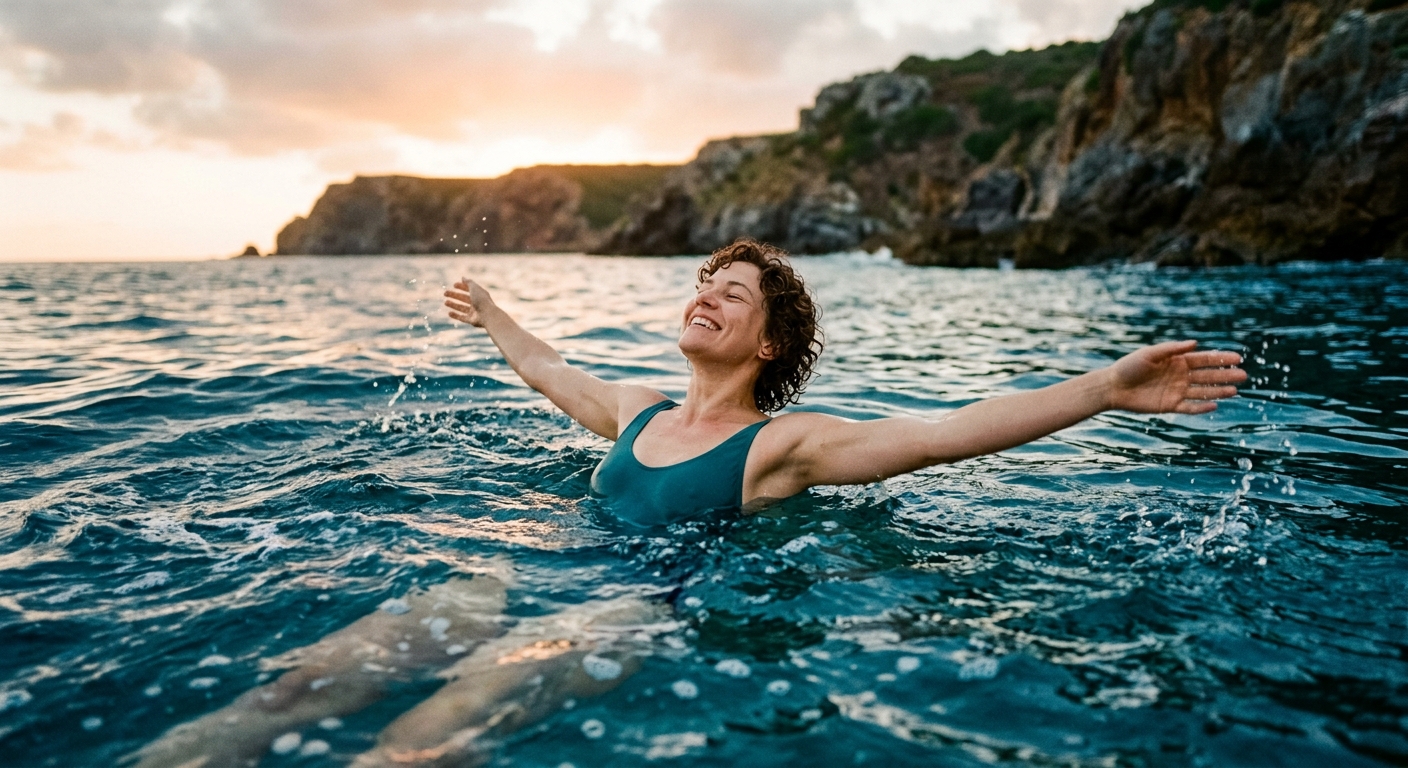
You already know the feeling. You wade into the ocean, cold water rising past your ankles, your knees, your waist, and something shifts. The noise in your head quiets. Your shoulders drop. You exhale in a way you haven’t exhaled all day. For years, most of us chalked this up to a nice vacation vibe or the simple pleasure of being outside. But scientists now have a different explanation, and it is far more fascinating than anyone expected.
Research emerging from neuroscience, marine biology, and environmental psychology is converging on a striking conclusion: swimming in the ocean triggers a cascade of physiological and neurological responses that can recalibrate your nervous system in ways that prescription medications, meditation apps, and therapy sessions sometimes struggle to match. This is not wellness hype. This is biology.
Your Nervous System on Saltwater: The Basic Science
To understand what the ocean does to you, it helps to understand the two branches of your autonomic nervous system. The sympathetic nervous system governs your fight-or-flight responses, raising your heart rate, flooding your body with cortisol and adrenaline, and keeping you in a state of readiness. The parasympathetic nervous system does the opposite: it slows your heart rate, lowers blood pressure, aids digestion, and signals to your body that it is safe to rest and recover.
Modern life is extraordinarily effective at keeping the sympathetic system switched on almost permanently. Notifications, deadlines, financial pressure, traffic, social comparison: all of it feeds a low-grade state of physiological alarm that many people have simply accepted as normal. Ocean swimming, according to researchers, interrupts this cycle in multiple simultaneous ways.
The Dive Reflex: Your Built-In Reset Button
One of the most powerful mechanisms at play is something called the mammalian dive reflex. When cold water hits your face, your body responds with an immediate, involuntary drop in heart rate. Blood is redistributed away from your extremities toward your vital organs. Your oxygen consumption slows. This reflex, which we share with dolphins, seals, and whales, is hardwired into human physiology and has been present for millions of years.
Dr. Mark Harper, a consultant anesthetist and co-founder of the Chill Project, has studied cold water immersion extensively and describes the dive reflex as a direct activation of the parasympathetic system. In other words, the moment the ocean touches you, your body begins shifting from stress mode into recovery mode, whether you consciously intend it or not.
Blue Mind: What Neuroscientist Wallace J. Nichols Discovered
Marine biologist Wallace J. Nichols spent years trying to articulate what he and millions of other people felt near water. His 2014 book, Blue Mind, synthesized decades of neuroscience research into a coherent framework. His central argument: proximity to water, and especially immersion in it, induces a mildly meditative state he calls the Blue Mind, characterized by calm, creativity, and a reduced mental load.
Brain imaging studies referenced in his work show measurable decreases in activity in the default mode network, the brain region responsible for rumination, self-referential thinking, and the kind of anxious mental chatter that keeps people awake at 2 a.m. The ocean, it turns out, is remarkably effective at quieting the part of your brain that won’t stop talking.
The Role of Negative Ions
The ocean air itself appears to play a supporting role. Sea air is saturated with negative ions, electrically charged molecules produced by the collision of waves with water. Research from Columbia University and other institutions suggests that high concentrations of negative ions are associated with elevated serotonin levels in the brain, which may contribute to reduced symptoms of depression and anxiety.
While the science on negative ions is still developing, the correlation between coastal environments and improved mood has been documented across multiple large-scale studies, including a landmark 2013 analysis of over 48 million people in England, which found that those living near the coast reported consistently better mental health than their inland counterparts.
What Happens Over Time: The Training Effect on Your Stress Response
Regular ocean swimming does not just provide temporary relief. It appears to train your nervous system to become more resilient over time. Researchers studying cold water immersion have found that repeated exposure reduces the severity of the initial stress response, meaning your cortisol spike becomes smaller, your recovery becomes faster, and your baseline anxiety levels tend to drop.
A 2021 study published in the journal PLOS ONE found that a 12-week open water swimming intervention produced significant reductions in anxiety among participants, with many reporting improvements that outlasted the swimming sessions themselves. Some participants described it as a kind of recalibration, a resetting of what their nervous system considered a normal level of alertness.
The Cold Shock Response and How to Work With It
It is worth being honest about the initial discomfort. When you first enter cold ocean water, your body does not go straight to calm. There is a cold shock response: gasping, rapid breathing, a spike in heart rate and blood pressure. This is normal and expected. The key insight from researchers is that this response diminishes significantly after the first 30 to 90 seconds of immersion, after which the parasympathetic shift begins to take over.
Learning to breathe slowly and deliberately during those first moments, rather than panicking or exiting the water, is itself a form of nervous system training. You are teaching your brain that discomfort is not the same as danger, a lesson with applications far beyond the water’s edge.
Seven Things Scientists Say Ocean Swimming Does to Your Body and Brain
- Lowers cortisol levels: Cold water immersion has been shown to reduce circulating cortisol, the primary stress hormone, both during and after swimming sessions.
- Boosts endorphins and dopamine: The physical exertion of swimming combined with cold water exposure triggers endorphin release and increases dopamine receptor sensitivity.
- Activates the vagus nerve: Cold water on the face and neck directly stimulates the vagus nerve, a key pathway of the parasympathetic system linked to emotional regulation and social connection.
- Reduces inflammation: Chronic stress is linked to systemic inflammation. Studies show regular cold water swimming lowers inflammatory markers, including C-reactive protein.
- Improves sleep quality: Post-swim drops in core body temperature and cortisol create conditions favorable for deeper, more restorative sleep.
- Enhances cognitive clarity: The combination of physical movement, cold exposure, and sensory immersion increases blood flow to the prefrontal cortex, supporting focus and decision-making.
- Builds emotional resilience: Repeated voluntary exposure to manageable discomfort strengthens the neural pathways associated with emotional regulation and distress tolerance.
The Social Dimension: Why Swimming Together Amplifies the Effect
One element that researchers emphasize, and that tends to get overlooked in discussions of cold water therapy, is the social component. Outdoor and ocean swimming has quietly become one of the most community-oriented fitness movements in the world. From the Forty Foot in Dublin to wild swimming groups across the UK, Scandinavia, Australia, and coastal America, people are gathering at the water’s edge together.
This matters neurologically. Human connection stimulates oxytocin release and further activates the parasympathetic system. When you combine the physiological effects of ocean immersion with the warmth of a shared ritual and genuine community, the nervous system benefits compound. You are not just swimming. You are reminding your ancient, social, mammalian brain that you are safe, held, and not alone.
A Note on Safety and Accessibility
Scientists and open water swimming advocates are careful to note that ocean swimming carries real risks, including cold water shock, rip currents, and hypothermia, particularly for beginners or those with cardiovascular conditions. Gradual acclimatization, awareness of local conditions, and ideally swimming with others are all strongly recommended. The goal is not to endure suffering but to find the threshold where challenge meets safety, which is precisely where the most meaningful physiological benefits appear to live.
The Takeaway
The ocean has always known something about us that we are only now beginning to measure and name. It pulls us back, again and again, not just because it is beautiful or because we deserve a holiday, but because something deep in our nervous system recognizes it as a place of restoration. The science is catching up to what our bodies have always understood. Sometimes the most sophisticated treatment for a frayed and overwhelmed nervous system is simply the cold, honest weight of saltwater, and the courage to keep breathing.