🎧 Listen to this story
Narrated by Orus · 9,823 characters
The Unlikely Restoration Crew Transforming Dying Rivers
Picture a stretch of river so degraded that its banks have collapsed, its water runs brown with sediment, and the fish that once thrived there have long since disappeared. Now picture that same river two years later: crystal clear water, lush vegetation along every bank, thriving populations of trout, waterfowl nesting in the reeds, and a wetland ecosystem so vibrant it barely resembles its former self.
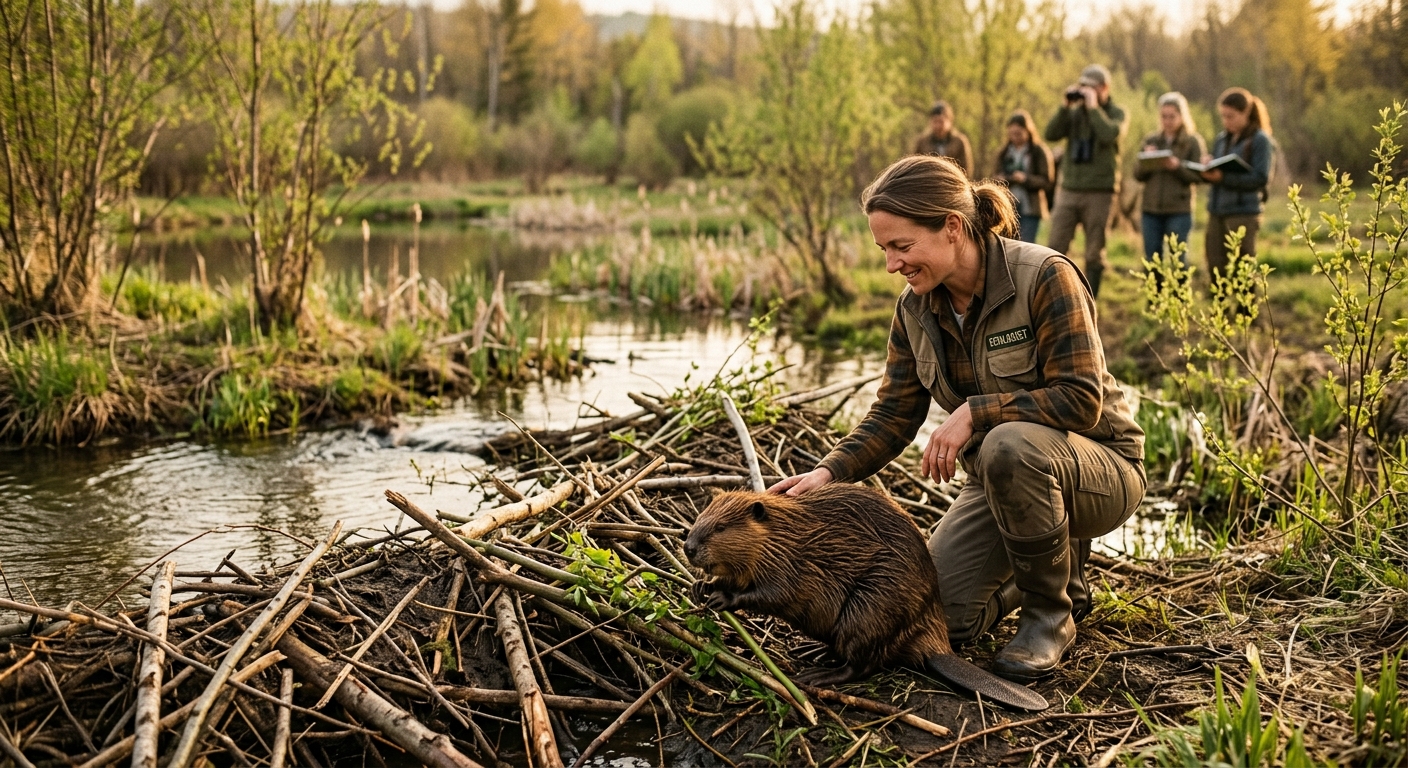
No excavators were brought in. No concrete was poured. No government agency spent millions on a restoration project. Instead, a family of beavers moved in, and nature did what it has always known how to do.
Across North America, the United Kingdom, and parts of Europe, ecologists, conservationists, and river restoration specialists are turning to beavers as one of the most powerful tools in the fight against degraded waterways. The results are stunning researchers, and the data is hard to argue with.
Why Rivers Are in Crisis
Before we can appreciate what beavers bring to a river system, we need to understand just how badly damaged most of our waterways have become. Centuries of human activity have taken a serious toll on rivers and streams worldwide.
- Agricultural runoff has loaded rivers with excess nutrients, causing algal blooms that choke out oxygen and kill aquatic life.
- Channelization projects have straightened and deepened rivers for flood control, stripping them of the natural curves and pools that create biodiversity.
- Deforestation along riverbanks has removed the root systems that hold soil in place, leading to massive erosion and sediment loads.
- Groundwater depletion has lowered water tables in many regions, causing streams to run dry during summer months that once flowed year-round.
- The removal of natural dams, including those historically built by beavers, has accelerated water flow and reduced the retention time water spends in a landscape.
Human engineers have tried to reverse this damage. Riparian buffer zones have been planted. Rock weirs have been installed. Millions of dollars have been poured into projects that, at best, partially restore a fraction of what was lost. The problem is that human restoration projects work from the outside in. Beaver restoration works from the inside out.
What Beavers Actually Do to a River
To understand why beavers are so effective, you need to understand what makes them unique among all animals on Earth aside from humans. Beavers are ecosystem engineers. Their instinct to build dams does not just create a home for themselves. It fundamentally reshapes the hydrology, biology, and chemistry of an entire landscape.
Slowing the Flow
When a beaver builds a dam, it slows the movement of water through a system. This single act has cascading effects that ripple outward for miles. Slowed water spreads across the floodplain instead of racing downstream. It seeps into the ground, recharging aquifers. It drops the sediment it was carrying, allowing the riverbed to rebuild itself. It creates a buffer of moisture in the surrounding landscape that persists even through drought conditions.
Creating Wetland Complexity
A beaver pond is not just a pond. It is a mosaic of habitats. The edges where water meets land become breeding grounds for amphibians. Dead trees standing in flooded areas, called snags, become nesting sites for woodpeckers and cavity-nesting birds. Deep pools offer refuge for fish during summer heat. Shallow marshy areas filter pollutants from agricultural runoff with remarkable efficiency.
Studies have shown that a single beaver family can convert a degraded stream corridor into a wetland complex that supports hundreds of species within just a few years. No human-built wetland restoration project has ever matched that speed or that biodiversity density at comparable cost.
Raising the Water Table
One of the least understood but most significant effects of beaver activity is groundwater recharge. As water ponds behind beaver dams and spreads across floodplains, it percolates slowly into the soil. This raises the water table in surrounding lands, which in turn keeps vegetation green and fire-resistant even during dry seasons. Researchers studying beaver-restored watersheds in the American West have found that the landscape around beaver ponds can remain significantly wetter during drought years compared to adjacent unrestored areas, functioning almost like a natural sponge.
Real Results from Real Rivers
The evidence for beaver-led restoration is no longer just anecdotal. It is showing up in peer-reviewed research, government conservation reports, and the testimonials of farmers and landowners who once viewed beavers as pests.
The River Otter in Devon, England
In 2015, the United Kingdom conducted one of its most celebrated rewilding experiments by reintroducing beavers to a fenced section of the River Otter in Devon. What scientists documented over the following years was remarkable. The beavers created thirteen new ponds. Water retention in the landscape increased dramatically. Fish populations rebounded. Flooding downstream was measurably reduced as the beaver dams slowed and spread peak rainfall. By 2020, the project had been deemed such a success that the UK government approved the permanent wild reintroduction of beavers across England for the first time in 400 years.
Birch Creek, Utah
In the arid American West, where summer droughts are intensifying and streams routinely run dry, the Anabranch Solutions team has been pioneering a technique called Beaver Dam Analogues, or BDAs. These are simple human-built structures made of posts and willow branches that mimic beaver dams. They are designed to jumpstart conditions that attract actual beavers, or to maintain beaver-like hydrology in areas where beavers have not yet arrived.
At Birch Creek in Utah, the installation of BDAs transformed a deeply incised, degraded channel. The streambed rose, the water table recovered, and riparian vegetation exploded back to life within a single growing season. When beavers eventually moved in and took over maintenance of the structures, the restoration accelerated even further.
Methow Valley, Washington State
The Methow Beaver Project has been translocating nuisance beavers from urban areas and releasing them into degraded stream systems in the Methow Valley since the early 2010s. The results have included measurable increases in late-season streamflow, improved salmon and steelhead habitat, and the recovery of wetland vegetation across thousands of acres. One of the project’s most powerful findings: areas with active beaver populations retained significantly more water during drought years, directly benefiting both wildlife and the agricultural communities downstream.
7 Reasons Beavers Outperform Human Restoration Technology
- They work for free. No labor costs, no equipment rental, no ongoing maintenance budget.
- They self-maintain. Beavers continuously repair and expand their dams in response to real-time water conditions, something no static engineered structure can do.
- They create complexity. Human-built structures restore single functions. Beavers restore entire interlocking systems simultaneously.
- They adapt to the landscape. Every beaver dam is custom-built for its specific location, accounting for flow rate, bank materials, and seasonal variation in ways no engineer can fully predict.
- They replicate themselves. A successful beaver family expands, and young beavers disperse to restore new sections of a watershed over time.
- They improve soil carbon storage. Beaver ponds trap organic material and promote the kind of waterlogged soil conditions that sequester carbon, making them an unexpected ally in climate mitigation.
- They work fast. Landscapes restored with beaver involvement consistently show faster recovery timelines than comparable projects using only mechanical intervention.
Changing the Conversation Around Beavers
For much of the past two centuries, beavers were systematically trapped and eliminated across North America and Europe. At the peak of the fur trade, millions of beavers were killed annually, and the ecological consequences were profound in ways that scientists are only now beginning to fully map. The loss of beavers from watersheds corresponds historically with the degradation of river systems, the lowering of water tables, and the drying out of landscapes that were once naturally wet and resilient.
Today, attitudes are shifting. Farmers who once called animal control to remove beavers from their land are learning to coexist, sometimes with the help of flow devices called pond levelers that allow landowners to control water levels while keeping beaver families in place. Conservation organizations are actively trapping nuisance beavers in suburban areas and relocating them to degraded streams where their instincts become powerful restoration forces.
The shift in thinking is simple but profound: beavers are not a problem to be managed. They are a solution waiting to be deployed.
What We Can Learn from the Beaver
There is a quiet lesson in the story of beaver-led restoration. It is a lesson about humility and about recognizing that the most sophisticated technology we could bring to bear on a broken ecosystem is often no match for the instinct of an animal that spent millions of years co-evolving with that ecosystem.
Rivers did not break overnight. They broke slowly, through centuries of accumulated decisions that ignored the relationships between water, land, and living things. Healing them is going to require that we stop thinking of nature as something to be controlled and start thinking of it as something to be listened to.
The beaver has been telling us how to fix rivers for a very long time. We are finally starting to listen.