
🎧 Listen to this story
Narrated by Rasalgethi · 6,588 characters
A Graduation Day Like No Other
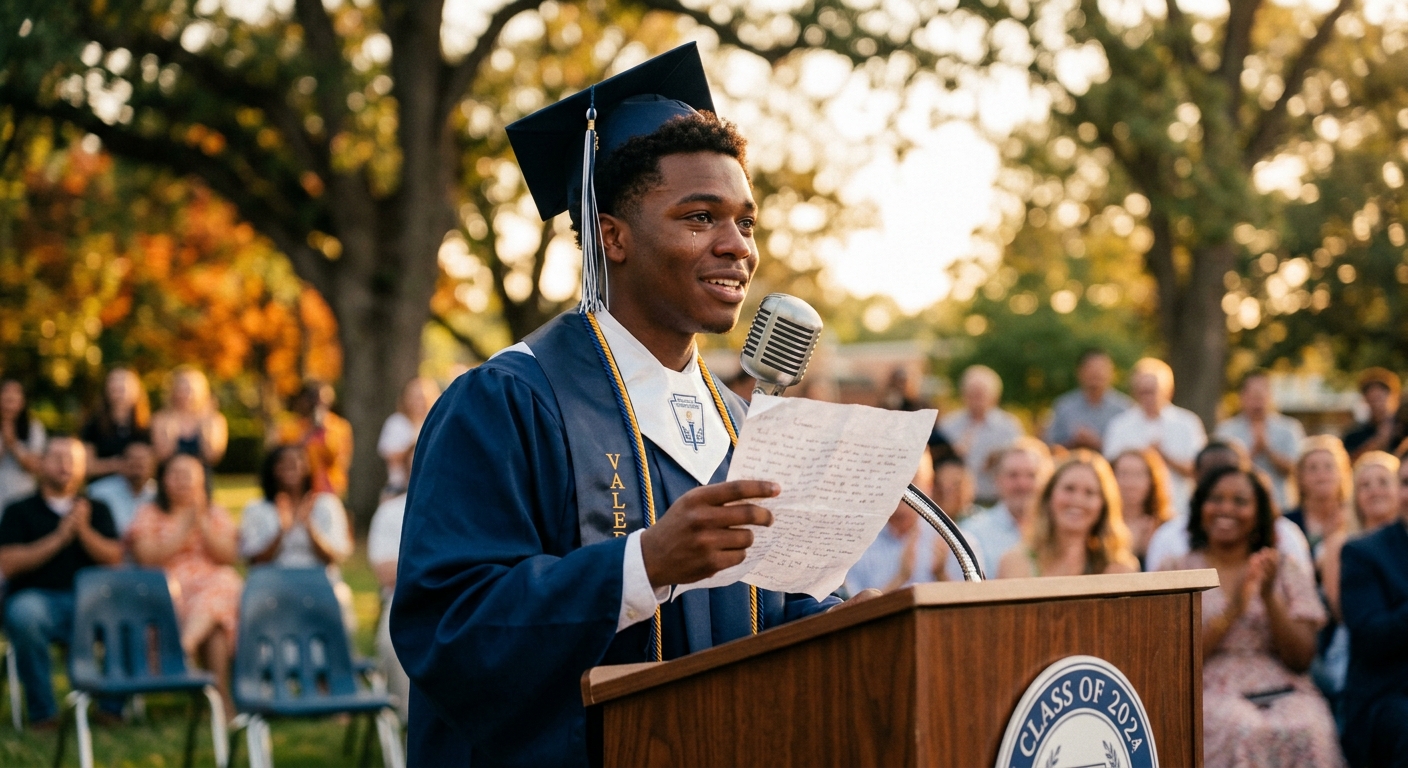
When Marcus Holloway stepped up to the podium at Jefferson High School’s commencement ceremony, the audience saw a confident young man in a cap and gown, smiling broadly, holding notecards in steady hands. What most of them did not know was that just eight months earlier, he had been doing his homework by the light of a gas station convenience store because the car he shared with his mother had no working interior lights.
Marcus graduated valedictorian of his class with a 4.2 GPA. He had never once missed a deadline. His teachers described him as curious, driven, and remarkably calm under pressure. His counselor, who did know his situation, would later say she had never seen anything like it in her twenty-three years in education.
This is his story.
When Everything Fell Apart
Marcus was fifteen when his family lost their apartment. His father had left two years prior, and his mother, Sandra, had been working double shifts at a laundry facility to keep them afloat. When the facility shut down unexpectedly and back rent piled up faster than Sandra could manage, they were evicted within sixty days.
For a while, they stayed with relatives. Then a friend’s couch. Then, eventually, their 2003 Honda Civic became their address.
“The hardest part was not the cold,” Marcus said in a recorded interview with a local news station shortly after graduation. “The hardest part was pretending everything was normal at school. Showing up and acting like I had eaten breakfast. Acting like I had slept in a bed.”
Sandra worked to keep the car fueled and parked in safe locations each night. She prioritized Marcus’s school attendance above everything else, driving him to school every single morning before circling back to look for day labor work. She kept his uniforms clean at laundromats and made sure he had his backpack packed.
“My mom never let me feel like I had an excuse,” Marcus said. “She never once said, this is too hard. She just kept moving.”
The Guidance Counselor Who Noticed
About three months into the school year, Marcus’s guidance counselor, Ms. Patricia Wren, pulled him aside after noticing he had begun arriving before the building even opened each morning. She had also clocked that he never accepted rides from friends, always had an excuse for why he could not attend after-school events, and had quietly stopped mentioning home.
“I just asked him gently,” Ms. Wren recalled. “I said, Marcus, is everything okay at home? And he looked at me for a long moment and said, we are between places right now. That was how I knew.”
Rather than alerting authorities in a way that might have disrupted his enrollment, Ms. Wren connected Sandra and Marcus to the school district’s McKinney-Vento homeless liaison, a federally mandated support position that most people never know exists. Through that program, Marcus gained access to free meals, school supplies, and tutoring, and his mother was connected to transitional housing resources.
Within two months, they had a room in a supported housing program. Within five months, their own small apartment.
What Kept Him Going: In His Own Words
During his valedictorian speech, Marcus did not hide his past. He had debated it, he said, almost decided to keep things vague and inspirational. But standing there, looking out at his classmates, he chose honesty instead.
“I want to tell you all something. For part of this school year, I did not have a home. I lived in a car. And I am standing here today not because that made me special, but because people showed up for me. My mother. Ms. Wren. Teachers who gave me extra time when I needed it without making me explain why. I am proof that circumstances are not the same as destiny.”
The gymnasium went silent for a moment. Then it erupted.
The Lessons Buried in This Story
Marcus’s story is extraordinary, but the forces that shaped it are not unique. According to the National Center for Education Statistics, on any given school night in the United States, more than 1.3 million students experience some form of homelessness. The vast majority of them go unnoticed.
Here are several things Marcus’s journey teaches us, not just about resilience, but about the systems and people around us:
- Stability is not a prerequisite for ambition. Marcus did not wait for perfect conditions. He worked with what he had, even when what he had was very little.
- One attentive adult can change everything. Ms. Wren did not fix Marcus’s life. She simply paid attention and connected him to what already existed. That was enough.
- Parents carry invisible weight. Sandra’s sacrifice often goes unacknowledged in the celebration of Marcus’s achievement, but her choices, made daily under enormous stress, were foundational.
- Shame silences more than pain does. Marcus hid his situation for months, not because he was ashamed of himself, but because he was afraid of how others would see him. That silence cost him resources and support he deserved sooner.
- Programs like McKinney-Vento exist but are underused. Many families in crisis do not know their rights or the resources available to them through public schools. Awareness saves lives.
Where Marcus Is Now
Marcus accepted a full scholarship to a state university, where he is studying political science with a focus on housing policy. He has spoken at two regional conferences on youth homelessness and has partnered with a local nonprofit to create a peer ambassador program that trains high school students to identify and quietly support classmates who may be experiencing housing instability.
He still drives past the gas station sometimes, the one where he used to do his homework under the fluorescent lights at the edge of the parking lot. He says he does not drive past it with sadness.
“I drive past it with gratitude,” he said. “That parking lot was part of my story. I am not going to pretend it was not. But it is not where the story ends.”
A Final Thought
We live in a culture that loves the concept of resilience but rarely stops to examine what resilience actually costs, and who pays the price for it. Marcus did not succeed despite the world. He succeeded because, at a critical moment, a few key people chose to see him clearly and act on what they saw.
The next Marcus is sitting in a classroom somewhere right now. Maybe arriving early. Maybe pretending to have eaten breakfast. Maybe doing homework under a gas station light.
The question is not whether that student has what it takes. The question is whether the rest of us are paying close enough attention to help them prove it.