
🎧 Listen to this story
Narrated by Gacrux · 7,817 characters
A Chance Meeting That Changed Two Lives Forever
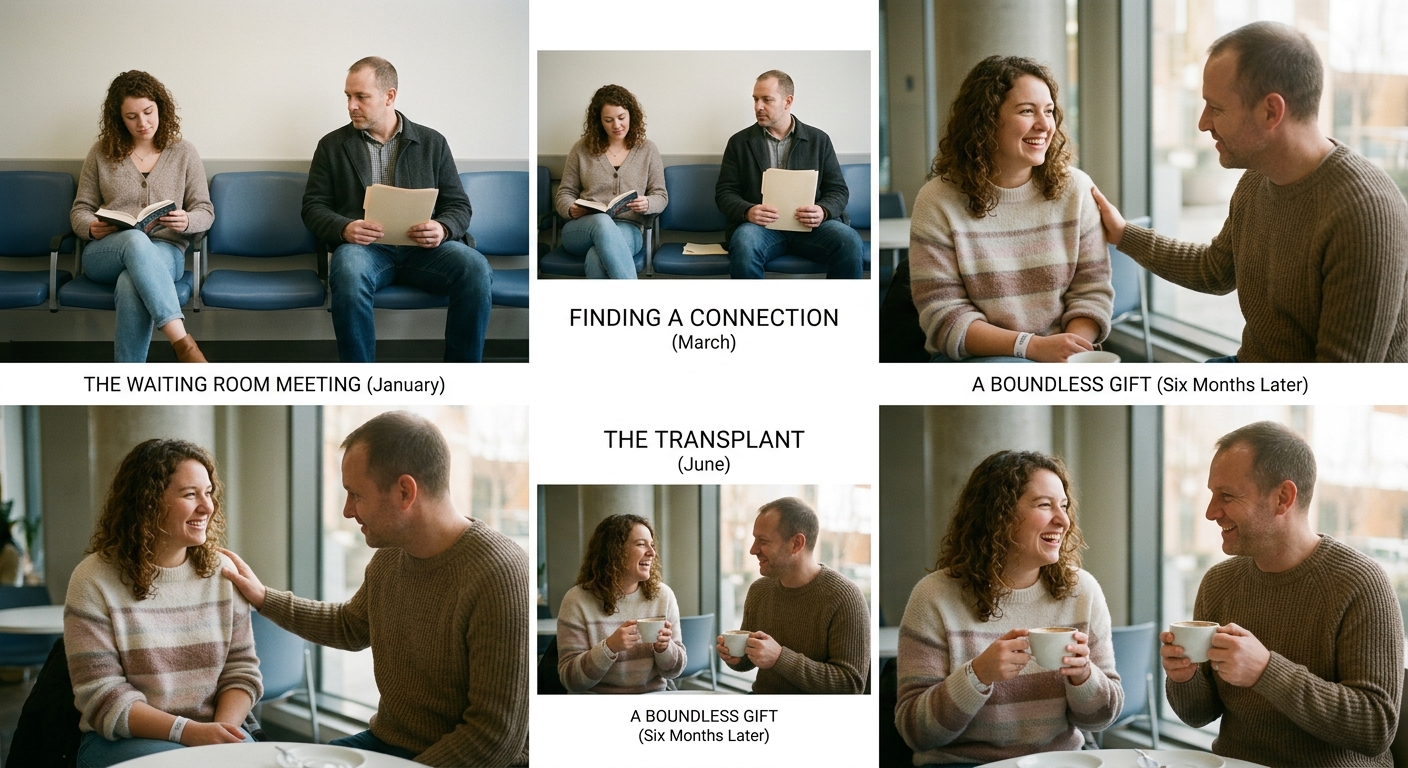
Most of us have sat in a hospital waiting room at some point. We scroll through our phones, stare at the ceiling tiles, maybe make polite small talk with the person beside us. We rarely expect those plastic chairs and flickering fluorescent lights to become the setting for something extraordinary.
But for 41-year-old Linda Carew, a routine cardiology appointment in the spring of 2022 became the starting point of one of the most profound decisions of her life. She sat down next to a quiet, tired-looking man named Gerald Moss, 58, who was waiting for his own appointment. They started talking, the way strangers sometimes do when anxiety fills a room and conversation becomes a small comfort.
What she learned in that hour-long conversation would set her on a path she never could have predicted.
The Conversation That Started It All
Gerald was not having a good day. He had been on dialysis for three years. His kidneys had failed due to complications from Type 2 diabetes, and despite being on the transplant waiting list, his doctors had told him the average wait time could stretch to five years or more. He was exhausted, physically and emotionally.
“He didn’t complain,” Linda recalled in an interview with a regional news outlet later that year. “He just told me the facts, very quietly, like he had accepted all of it. And something about that quietness just got into me. I couldn’t stop thinking about it.”
She went home that night and did something she had never done before. She started researching living kidney donation.
What She Found, and What She Decided
Linda was not a medical professional. She was a high school art teacher, a mother of two grown children, and someone who, by her own admission, fainted at the sight of needles. But the more she read, the more the idea took hold.
Here is what she learned during those late-night research sessions:
- Living donors can give one of their two kidneys and live a full, healthy life with the remaining one.
- The surgery is well-established and has been performed safely for decades.
- Donors go through extensive screening to ensure they are physically and psychologically healthy.
- Recipients of living donor kidneys typically have better outcomes than those receiving deceased donor kidneys.
- Over 100,000 people in the United States alone are currently waiting for a kidney transplant.
She called her sister first. Then her two adult children. The reactions ranged from stunned silence to tearful concern. Nobody told her it was a bad idea outright, but nobody exactly cheered either. “My daughter kept saying, ‘Mom, you don’t even know this man,'” Linda said. “And I kept saying, ‘I know. But does that really matter?'”
The Long Road to Donation
Linda reached out to the transplant center and asked how she could be evaluated as a potential living donor. She did not even know at first if she and Gerald were a medical match. The process, she quickly discovered, was not simple or fast.
Over the following four months, she underwent a series of evaluations:
- Blood and tissue typing to determine compatibility
- Comprehensive physical examinations including kidney function tests, imaging, and cardiovascular assessment
- Psychological evaluation to ensure her decision was informed, voluntary, and free from coercion
- Meetings with an independent donor advocate whose sole job was to represent her interests
- Financial counseling to understand the costs and coverage involved
Remarkably, she and Gerald were a compatible match. When the transplant coordinator called her with the news, Linda said she sat in her car in the school parking lot and cried for twenty minutes.
“Are You Sure?” He Asked Her Three Times
Linda and Gerald had stayed in loose contact since their waiting room meeting, exchanging a few text messages. When she told him she was moving forward with the donation process, he went quiet for a long moment.
“He asked me if I was sure,” Linda said. “I said yes. Then he asked again. And then a third time. And I said, ‘Gerald, I am not going to change my answer.'”
Gerald later described his feelings in a short video shared by the hospital’s transplant program. “I prayed for a donor for three years,” he said, his voice steady but his eyes full. “I never thought it would come from someone I met by accident. It makes you rethink what the word ‘accident’ even means.”
The Surgery and the Recovery
The transplant took place on a Thursday morning in November 2022. Linda’s surgery lasted approximately three hours. Gerald’s procedure, receiving the kidney, ran longer. Both were considered successful.
Linda spent two nights in the hospital and returned to teaching within six weeks. Gerald, after years of dialysis consuming three days of every week, felt the difference almost immediately.
“Within days, my energy started coming back,” Gerald said. “It’s hard to describe to someone who hasn’t been through dialysis. It takes everything from you. And then suddenly, you have yourself back.”
Linda describes her recovery as smoother than she expected, though not without discomfort. “There were hard days,” she admitted. “But I never once regretted it. Not for a single second.”
What This Story Teaches Us
It would be easy to frame Linda’s decision as saintly or superhuman, something the rest of us could never imagine doing. But Linda herself pushes back on that framing firmly.
“I’m not a hero,” she said. “I’m a person who had something to give and someone who needed it. The math felt simple to me, even if the process wasn’t.”
There are quieter lessons woven through this story, ones that do not require us to donate an organ but still ask something of us:
- Pay attention to the person beside you. Presence is a form of generosity that costs nothing.
- Ask questions before assuming limits. Linda did not know if donation was possible or safe. She asked. The answers surprised her.
- Courage does not always look dramatic. Sometimes it looks like a phone call, a blood test, or showing up for an appointment.
- Strangers are not as strange as we think. Gerald was a retired postal worker who loved jazz and had three grandchildren. He was not a statistic until circumstance made him one.
A Friendship Built on Something Unbreakable
Today, Linda and Gerald meet for coffee every few months. Their families have gotten to know each other. Gerald attended Linda’s younger daughter’s engagement party last summer. Linda says it feels both completely normal and completely remarkable at the same time.
“We joke that we share a kidney now,” she laughed. “Which is true. There’s a piece of me keeping him alive, and a piece of him changed me forever. That’s a bond you can’t really put a name to.”
Gerald, now healthier than he has been in years, volunteers two days a month at the very transplant center where his surgery was performed, talking to patients on the waiting list and their families.
“I want them to know that the wait can end,” he said. “And I want them to know it can end because of someone they haven’t even met yet.”
Could You Be a Living Donor?
If this story has stirred something in you, it is worth knowing that living kidney donation is more accessible than many people realize. Donors do not need to know the recipient personally. There are paired exchange programs that allow donations across networks of strangers. Evaluation is free, and in many cases, surgery and follow-up costs are covered by the recipient’s insurance.
Organizations like the National Kidney Foundation and the United Network for Organ Sharing (UNOS) offer detailed, trustworthy information for anyone curious about taking the first step.
You do not have to make a decision today. But maybe, like Linda, you could just start by asking questions.
Sometimes that is exactly how extraordinary things begin.