🎧 Listen to this story
Narrated by Sulafat · 7,399 characters
A Door That Is Always Open
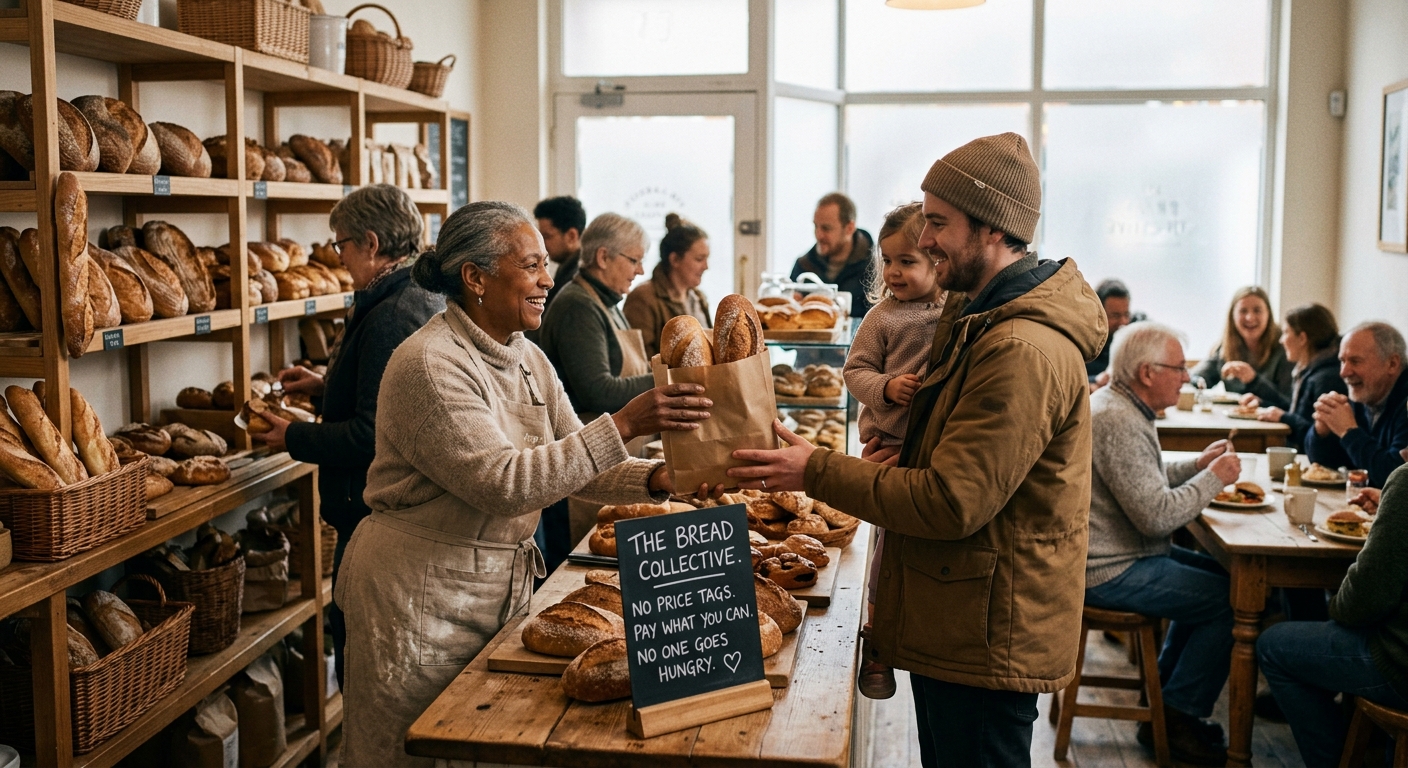
On a quiet street corner in Ithaca, New York, there is a bakery that smells like cinnamon and fresh bread and something harder to name. It smells like relief. Every morning, the ovens at Wide Awake Bakery fire up before dawn, and by the time the sun clears the hills, loaves are cooling on racks and a handwritten sign is already in the window. It reads, simply: “If you are hungry and cannot pay, you are still welcome here.”
That sign has been there for years. It is not a promotion. It is not a marketing stunt. It is, according to owner Mark Timmons, just the way things should be.
“Food is not a luxury,” Timmons said in a recent interview. “It is a basic human need. I got into baking because I love feeding people. I cannot love feeding people and then turn around and let someone walk away empty-handed because their wallet is thin.”
How the Policy Actually Works
The mechanics of the bakery’s open-door food policy are refreshingly simple, which is part of what makes it so powerful. There is no application. There is no income verification. There is no stack of forms to fill out. If someone comes to the counter and quietly says they cannot pay, or if they say nothing at all but look like they need a meal, they are handed something warm and they are thanked for coming in.
Staff are trained not to ask questions, not to stare, and not to make the moment feel transactional in any way. The goal, Timmons explained, is dignity.
“The worst thing you can do to a person who is already struggling is make them feel ashamed for needing help,” he said. “We want people to walk out of here feeling like a guest, not like a charity case.”
To offset the cost, the bakery operates on a simple community model. Regular customers who can afford to pay, and often want to contribute more, are invited to purchase an extra item or leave a small donation at the counter. A chalkboard near the register tracks how many “community loaves” have been contributed and how many have been claimed. On most days, the contributions outpace the claims.
The Regulars Nobody Talks About
There is a man who comes in every Tuesday. He always orders a plain roll and a small coffee. He always pays with exact change when he has it, and sometimes he does not have it. The staff never comment either way. They just smile and hand him his order. He has been coming in for three years.
There is a young mother who stops by on Friday afternoons with two small children in tow. She picks out two pastries for the kids and sometimes something for herself. She cried the first time she was told she did not need to worry about the bill. She does not cry anymore. She just comes in, picks what her children like, and chats with whoever is behind the counter about the week.
These are not dramatic rescue stories. They are ordinary moments of human decency playing out in a space that was intentionally built for them. And that, Timmons says, is exactly the point.
What Other Businesses Have Said
Since a local news segment aired a short piece on the bakery last spring, Timmons has received hundreds of messages from business owners across the country asking how to implement something similar. He responds to every one of them, and his advice is always the same.
- Start small. You do not need to overhaul your entire business model. Begin with one item, one shift, or one day of the week where the policy applies.
- Train your team with empathy first. The policy only works if the people carrying it out genuinely believe in it. Scripts help, but belief matters more.
- Trust your community. Most people will not abuse generosity. Most people are just trying to get through the day.
- Keep it quiet. Do not make a spectacle of giving. A small sign, a word of mouth reputation, a gentle offer at the counter. Loud charity can feel like performance. Quiet charity feels like care.
- Let the numbers surprise you. Most bakeries and cafes that have adopted similar models report that community contributions more than cover the cost of donated items. Generosity tends to be contagious.
The Ripple Effect in the Community
What has happened around the bakery in the years since this policy took hold is difficult to quantify but easy to feel if you spend any time there. Neighbors have started talking to each other more. Local shelters have begun pointing clients toward the shop not just for food but for a sense of normalcy, of being in a real place doing a real thing. A retired schoolteacher started volunteering to bake there on weekends because she wanted to be part of something that felt meaningful.
Two other small restaurants on the same street have quietly introduced their own versions of a no-questions-asked meal policy, inspired by watching what the bakery built. One of them is a Thai restaurant whose owner emigrated from Bangkok fifteen years ago and remembers what it felt like to be new to a place and not sure where the next meal was coming from.
“When I saw what Mark was doing, I thought, yes, that is what we are supposed to do for each other,” she said. “I did not need a business reason. I just needed a reminder.”
A Lesson Baked Into Every Loaf
There is a version of this story that focuses on the economics and tries to prove that kindness is good for business. The numbers do support that argument. The bakery has seen steady growth since the policy became well known, and loyal customers cite the shop’s values as a primary reason they keep coming back.
But Timmons does not like telling the story that way. He thinks it misses the point.
“I did not do this to grow my customer base,” he said, leaning against the counter on a slow Thursday morning while a rack of sourdough cooled behind him. “I did it because there was a woman standing outside my door one morning who looked like she had not eaten, and I had a whole rack of bread sitting right there. The decision was not complicated. It was actually the easiest decision I have ever made.”
That is the lesson the bakery is really teaching, one loaf and one cup of coffee at a time. Not that kindness pays off. Not that good deeds come back around. Just that when you have something someone else needs, and you are in a position to share it, the decision does not need to be complicated at all.
How You Can Support Businesses Like This
If you want to be part of something like what Wide Awake Bakery has built, here are a few practical ways to engage:
- Seek out local businesses in your area with pay-it-forward or community meal programs and become a regular customer.
- When you visit, purchase an extra item to contribute to the community fund if the option exists.
- Leave a positive review specifically mentioning the business’s community values. This helps others find them.
- Share stories like this one. Not for clicks, but because people who are doing quiet, good work deserve to be seen.
- Consider whether your own work, in whatever field, has room for a version of this kind of policy.
The bread at Wide Awake Bakery is genuinely excellent. The sourdough has a crust that cracks just right and a crumb that is soft and tangy and satisfying in the way that only real fermentation can produce. People come for the bread. They stay because of what the bread represents: a place that decided, firmly and without fanfare, that everyone deserves a seat at the table.
And somehow, that decision has made the bread taste even better.