
🎧 Listen to this story
Narrated by Orus · 9,271 characters
Something Ancient Is Happening in Your Living Room
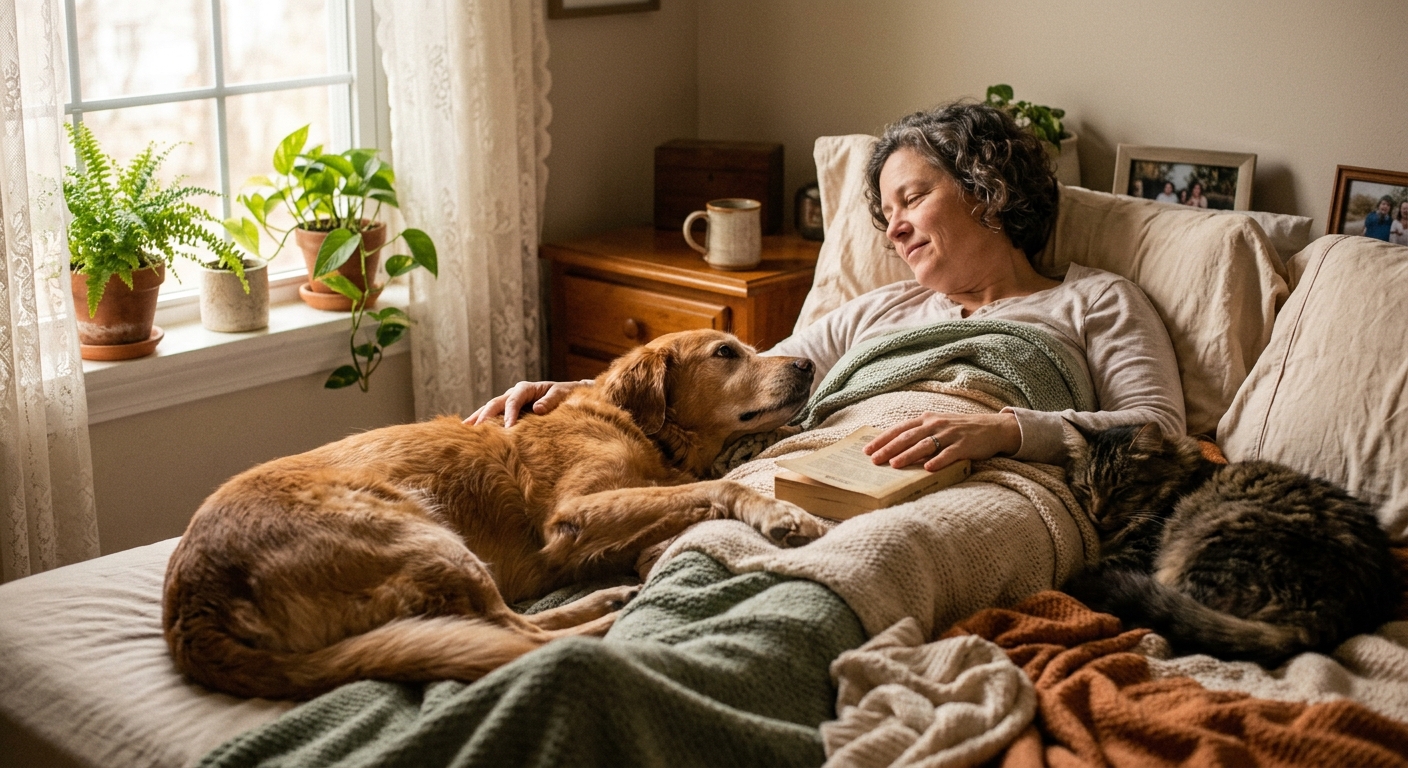
It starts subtly. Your dog, who normally bounces off the walls by 7 a.m., is lying quietly at the foot of your bed. Your cat, usually indifferent and aloof, has planted herself firmly on your chest. You have a fever of 102. You haven’t said a word. And yet, somehow, they know.
This is not a new phenomenon. Across cultures, across centuries, humans have documented the strange and moving behavior of animals who station themselves beside the sick, the grieving, and the dying. But only recently has science begun to catch up with what pet owners have long suspected: animals are not simply being affectionate when they refuse to leave. They may be responding to biological signals that human senses cannot detect.
This article explores the science, the stories, and the deeper meaning behind one of the most quietly profound relationships on Earth.
The Science Behind the Sensing
Animals, particularly dogs and cats, possess sensory capabilities that are difficult for most people to fully appreciate. A dog’s nose contains approximately 300 million olfactory receptors, compared to roughly 6 million in humans. This means dogs can detect odor concentrations nearly 100,000 times lower than we can.
When the human body becomes ill, its chemistry changes. Infections trigger inflammatory responses. Cancer cells emit volatile organic compounds. Drops in blood sugar alter the scent of sweat and breath. These are not subtle shifts on a molecular level, and to an animal with a highly tuned nose, they can be as obvious as a flashing neon sign.
What Animals Are Actually Detecting
- Changes in body temperature: A fever raises skin temperature, and animals pressed close to a sick person are literally feeling the difference.
- Altered breath chemistry: Diseases like diabetes, kidney failure, and even some cancers produce distinct chemical compounds in the breath.
- Shifts in hormones and stress markers: Cortisol, adrenaline, and other hormones spike during illness, changing a person’s unique scent profile.
- Changes in movement and posture: Animals are extraordinarily attuned to body language. A person moving more slowly, breathing differently, or lying unusually still sends unmistakable signals.
- Vocal changes: Even a slightly hoarser voice or a quieter tone can register as unusual to a pet who knows their owner’s normal patterns deeply.
Dr. Deborah Wells, a researcher at Queen’s University Belfast, has spent years studying animal behavior around human health. Her work and others like it strongly suggest that animals are not displaying random affection during these moments. They are responding to a very real and specific set of stimuli.
Famous Cases That Stopped the World
Perhaps no animal loyalty story captured global attention quite like that of Oscar, a therapy cat living in a Rhode Island nursing home. Oscar had a peculiar and consistent habit: he would curl up beside patients in the dementia ward in the hours before they passed away. Staff began to rely on Oscar’s presence as a clinical indicator. He was documented to have predicted over 100 deaths with remarkable accuracy.
Dr. David Dosa, a geriatrician who worked at the facility, initially dismissed Oscar as a curiosity. Then he began keeping records. He eventually published his observations in the New England Journal of Medicine and later in a book. His conclusion was careful but clear: Oscar was detecting physiological changes that human staff, even with medical training, were not yet registering.
Then there is Endal, a Labrador service dog in the United Kingdom, trained to assist a severely injured veteran. Endal was famous for anticipating medical episodes before any outward symptoms appeared, pulling his owner into a safe position before seizures struck. His owner, Allen Parton, credited Endal with not just his safety but his will to live.
These are not isolated tales. Across the world, veterinarians, nurses, and ordinary families report the same quiet, stubborn vigil: an animal who simply will not move.
The Emotional Dimension That Science Struggles to Measure
Here is where the story becomes harder to reduce to biology. Because while olfactory detection and behavioral sensitivity explain part of what animals do, they do not fully explain the emotional texture of these moments.
Consider the dog who lays its head across the chest of a person crying from grief they have never expressed out loud. Consider the horse that lowers its enormous head to rest beside a child undergoing chemotherapy. Consider the elderly cat who has never once slept in her owner’s bed, but begins doing so the week before a fatal diagnosis is made.
Are these animals simply reacting to chemical signals? Or is something more reciprocal, more relational, more ancient happening between two creatures who have evolved alongside each other for thousands of years?
The Bond That Runs Deeper Than Language
Researchers at the University of Tokyo discovered in 2015 that when dogs and their owners gaze into each other’s eyes, both experience a rise in oxytocin, the same hormone released between mothers and newborns. This suggests that the human-animal bond is not metaphorical. It is biochemical. It is mutual. And in times of illness, that bond may activate something that resembles, and perhaps truly is, a form of care.
Marc Bekoff, professor emeritus of ecology and evolutionary biology at the University of Colorado Boulder, argues that dismissing animal empathy as mere instinct is a failure of scientific imagination. Animals, he contends, experience nuanced emotional states. They form attachments. And those attachments shape their behavior in ways that mirror, in many respects, what we call compassion.
Real People, Real Vigils: Stories From Everyday Homes
Beyond the famous cases and the research papers, the most compelling evidence may simply be the flood of ordinary stories that never make the news.
A woman in Ohio described how her two dogs refused to leave her bedroom for three days while she battled what she believed was a bad flu. On the fourth day, she was hospitalized with a pulmonary embolism. The doctors told her that another 24 hours without treatment might have been fatal. Her dogs had not eaten properly the entire time.
A retired schoolteacher in Scotland wrote about her tabby cat sitting on her lap for nearly a week straight, something the cat had never done before. She eventually visited her doctor, more out of a vague unease than any specific symptom. She was diagnosed with early-stage breast cancer. Treatment was successful. She still credits her cat.
A father of three in New Zealand shared how his family’s rescue greyhound began following his wife room to room, sleeping outside the bathroom door, lying across her feet at dinner. She had been quietly struggling with severe depression and had not told anyone. The dog’s behavior prompted her family to ask questions they might not otherwise have asked. She got help.
What This Means for How We Think About Animals
These stories collectively ask us to reconsider something fundamental. We live in a culture that is still, in many ways, uncomfortable attributing deep awareness to non-human creatures. We prefer explanations that keep animals comfortably below us on some imagined hierarchy of consciousness.
But the evidence, both scientific and anecdotal, persistently pushes back against that comfort. Animals are not performing loyalty as a trick. They are not staying by the sick simply because they are trained to be close. Something in them recognizes distress, responds to it, and chooses, in whatever way animals choose, not to leave.
7 Things We Can Learn From Animals Who Stay
- Presence is its own medicine. The simple act of staying, of not leaving, communicates something that words cannot.
- Paying attention is a form of love. Animals notice changes we overlook in ourselves.
- Silence can be the most comforting language. No platitudes, no advice, just warmth and proximity.
- Our bodies tell the truth even when we don’t. Animals respond to what we are, not just what we say.
- Loyalty does not require explanation. It simply acts.
- Healing happens in relationship. Multiple studies confirm that pet ownership reduces blood pressure, cortisol levels, and recovery time from illness.
- We are not as alone as we sometimes feel. Something is always paying attention.
A Final Thought Worth Sitting With
There is a particular kind of comfort in knowing that another living creature has decided, without negotiation and without reward, that where you are is where they need to be. It does not matter whether we call it instinct or empathy or love. The effect is the same.
When you are sick and frightened and lying quietly in the dark, and the warm weight of an animal settles against your side and stays, something shifts. You feel, in however small a way, less alone in your body. Less alone in the universe.
Perhaps that is the most honest thing we can say about why certain animals refuse to leave. Not because they have calculated the odds, not because they were trained to stay, but because something in them recognizes something in you, and that recognition, old as the first fire and the first dog who crept close to it, will not be moved.