🎧 Listen to this story
Narrated by Schedar · 6,234 characters
Nobody Asked Her To. She Did It Anyway.
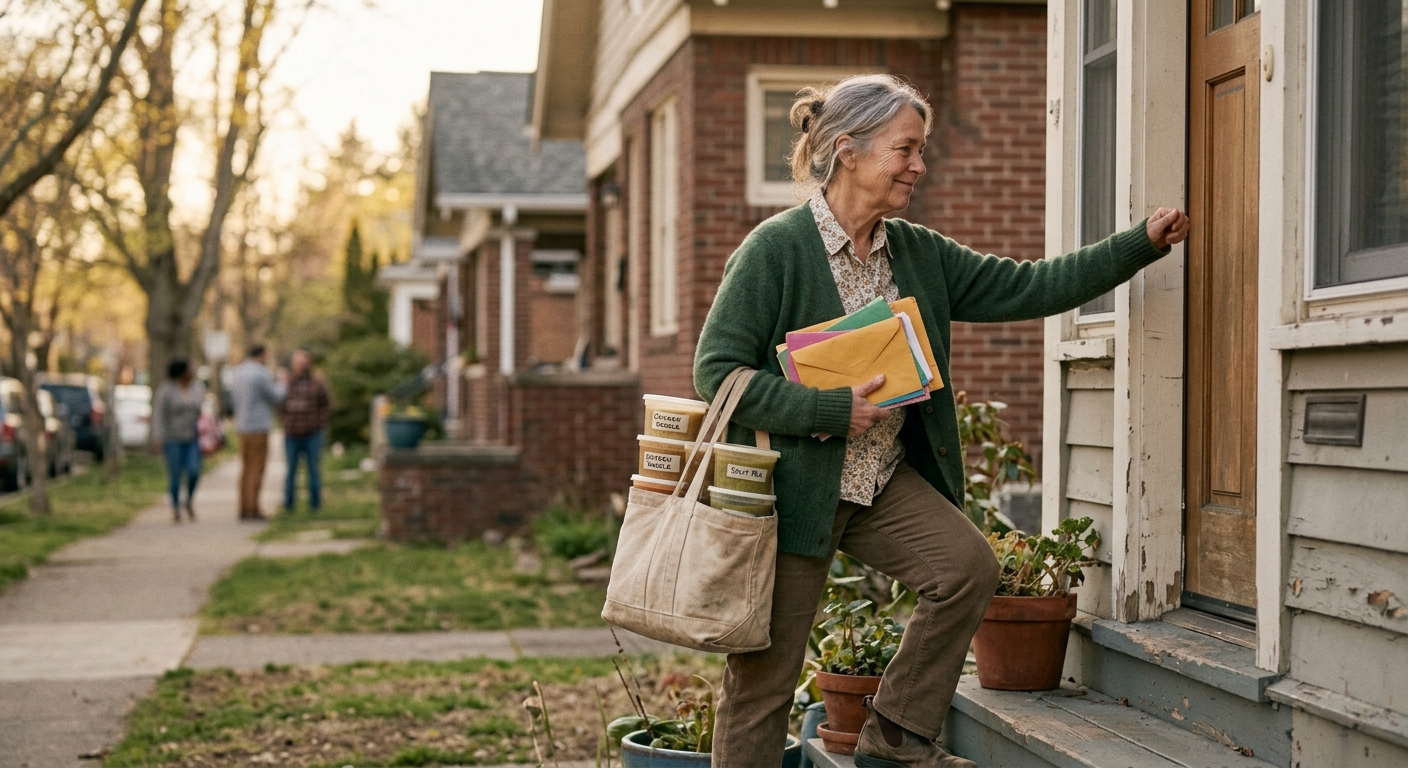
In the spring of 2020, when layoff notices were landing in inboxes faster than anyone could process them, a retired schoolteacher named Gloria Parkins in Dayton, Ohio, did something that nobody organized, nobody funded, and nobody announced on social media. She cooked. And then she walked. And then she knocked.
Pot by pot, street by street, Gloria prepared warm meals and slipped handwritten notes under the doors of every neighbor she knew had lost their job. Not just the people she was close to. All of them.
“I knew the young man two houses down had been let go from the warehouse. I knew the woman on the corner had her salon shut down. I knew the couple with the twins were both out of work at the same time,” Gloria told a local reporter who caught wind of the story three weeks in. “So I just… cooked.”
It Started With One Pot of Chicken Soup
The first delivery was to her direct neighbor, Marcus, a 34-year-old logistics coordinator who had been laid off after 11 years with the same company. He had a wife, two kids, and the particular kind of quiet panic that comes from not knowing how to tell your children things are going to be different for a while.
Gloria showed up at 6:47 in the evening with a Dutch oven full of chicken and rice soup and a folded piece of yellow notepad paper. Marcus still has that note. He photographed it and shared it much later, after everything had changed. It read:
“You are not what happened to you this week. You are what you do next. And tonight, what you do next is eat a warm meal and rest. Tomorrow is soon enough. With love, your neighbor Gloria.”
Marcus said he stood at the door for a long moment after she left, holding the pot with both hands, not sure whether to laugh or cry. He did both.
A One-Woman Operation With a Grocery List and a Mission
Over the following six weeks, Gloria delivered meals to 23 households in her neighborhood. She kept a handwritten log: names, dates, what she cooked, whether anyone had dietary restrictions she had managed to learn over the years. Each note was different. None of them were generic. Each one was specific to the person, reflecting something she knew about their life, their work, their family.
For the salon owner, she wrote about how the neighborhood missed her laugh and her light, and how both would be needed again soon. For the couple with the twins, she tucked in a small drawing she had done herself of two stick figures with big smiles, labeled with the twins’ names, under the words “These two still have everything they need.”
She cooked soups, stews, casseroles, and on one memorable occasion, a full brisket that she admitted took two days. She spent her own money, fixed income and all, and politely but firmly declined every offer to be reimbursed.
What the Notes Said That the Meals Could Not
Food fills the stomach. But Gloria understood that unemployment does something to a person that goes well beyond hunger. It shrinks confidence. It isolates. It makes people feel invisible, like they have slipped out of the social fabric without anyone noticing.
Her notes were precision tools against that specific feeling. They said: I see you. I have always seen you. This did not change anything about who you are to this street, to this community, to me.
Several neighbors later described reading their notes multiple times over the following weeks, not just once. One woman said she carried hers in her wallet throughout her job search, reading it before every interview. She got the job. She brought Gloria flowers.
The Ripple Nobody Planned For
By week four, something unexpected was happening. Neighbors who had received meals from Gloria began quietly passing the gesture forward. The man two houses down started shoveling the driveways of the households still struggling. The salon owner, once she had steadied herself, began offering free haircuts on her front porch on Saturday mornings to anyone who needed a confidence boost before an interview.
Nobody formed a committee. Nobody built a website. It spread the way real kindness tends to spread: informally, person to person, rooted in the specific and the local.
“I didn’t start a movement,” Gloria said with a laugh when someone used that word to describe what she had done. “I started dinner.”
7 Things Gloria’s Story Quietly Teaches Us
- Kindness does not require permission. Gloria did not wait for a sign-up sheet or an organization to join. She identified a need and responded to it.
- Specificity is the heart of real care. Generic sympathy is easy. Knowing someone’s name, their story, and their children’s names is something else entirely.
- The gesture matters as much as the gift. The soup was warm. But it was the walking over, the knocking, the standing on the porch that communicated: you are worth the trip.
- Fixed income does not mean fixed capacity for generosity. Gloria was not wealthy. She gave what she had and never framed it as sacrifice.
- Written words outlast spoken ones. Every person who received a note kept it. Not one was thrown away. There is something about ink on paper that signals permanence and intention.
- One person can shift the emotional temperature of an entire street. The ripple effect in Gloria’s neighborhood was not organized. It was inspired.
- Rest is a form of care too. Her first note told Marcus to rest. She understood that recovery, emotional and practical, requires permission to pause before charging forward.
Gloria Today
Gloria Parkins is 71 now. She still lives on the same street. She still cooks more than one person needs. She has a reputation in her neighborhood that she wears lightly and somewhat reluctantly, because she genuinely does not think she did anything unusual.
“My mother cooked for people when they were struggling. Her mother did too. I just kept doing what I was taught,” she said.
And maybe that is the most important part of the story. This was not a viral moment or a calculated act of public generosity. It was a thread of human tradition, passed quietly from woman to woman across generations, showing up in a Dutch oven on a Tuesday evening in 2020 on a street in Ohio, exactly when it was needed.
The meals are long eaten. The notes remain.